WFOE vs Joint Venture China: The Strategic Market Entry Guide
Deciding between a Wholly Foreign-Owned Enterprise (WFOE) and a Sino-Foreign Joint Venture (JV) is the most critical hurdle for global businesses entering mainland China. This choice dictates your operational control, tax liabilities, and intellectual property security under the current PRC Foreign Investment Law. As global supply chains evolve in 2026, structuring your market entry correctly from day one prevents costly restructurings later.
“The PRC Foreign Investment Law unified the regulatory framework for WFOEs and JVs under the China Company Law. This means the corporate governance structure—directors, supervisors, and shareholder meetings—must align strictly with unified standards, reducing historical ambiguities.”
— Dr. Helen Zhao, PRC Corporate Law Scholar and Regulatory Advisor
Recent patterns in Foreign Direct Investment (FDI) China highlight a clear trend. Foreign companies increasingly favor complete ownership to shield their proprietary systems, though specific industries still mandate a local partner.
⚡ Quick-Reference Market Entry Checklist
- ✔
Identify Sector Restrictions: Check the latest PRC Negative List to confirm if a WFOE is permitted or if a JV is mandatory. - ✔
Establish HK Holding Company: Incorporate in Hong Kong first to secure the 5% DTA withholding tax benefit. - ✔
Appoint Local TCSP Secretary: Ensure compliant corporate governance in HK with Olesen Global (TC010076). - ✔
Draft Clear JV Agreements: If a JV is required, embed strict deadlock resolution and IP protection clauses. - ✔
Set Up Compliant Repatriation: Establish proper intercompany service agreements and royalty structures early.
The 5-Dimension Decision Matrix: How to Choose Your China Entity
When entering the mainland China market, choosing between a WFOE and a Joint Venture depends entirely on your industry and need for operational control. A WFOE offers 100% foreign ownership and full IP protection, whereas a Joint Venture requires a local partner but is mandatory in restricted sectors. Most foreign businesses mitigate regulatory and tax risks by establishing a Hong Kong holding company before entering mainland China.
To navigate this choice, we apply The Sino-Global 5-Dimension Structuring Framework. This methodology evaluates your business requirements across five key areas: ownership control, capital requirements, operational agility, intellectual property risk, and local market access.
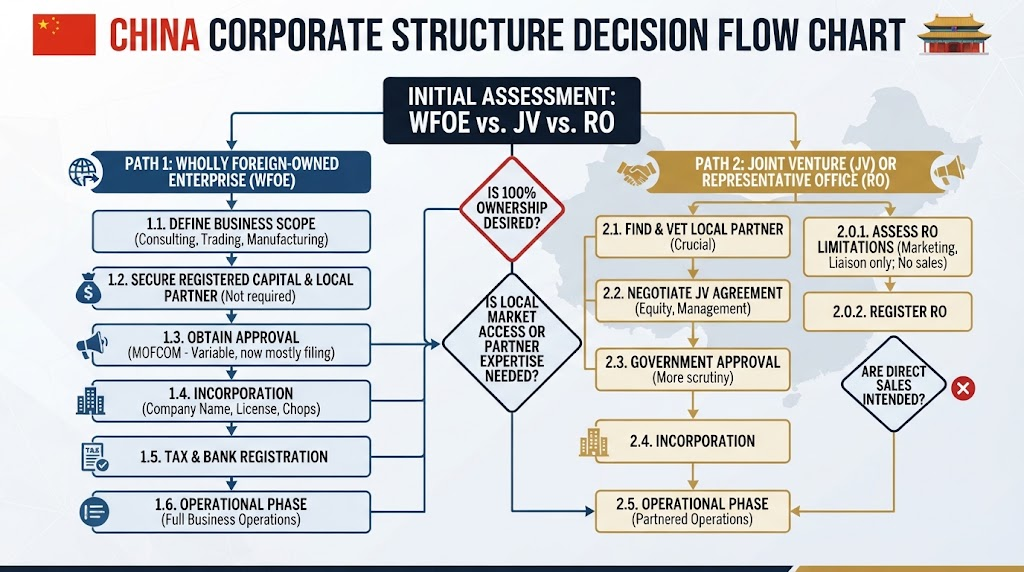
1. Ownership & Control
A WFOE grants you 100% equity control. You appoint the board, executive director, and general manager without consulting a local partner. In contrast, a Sino-Foreign Joint Venture splits ownership, meaning major decisions require board consensus, which often leads to operational deadlocks.
2. Capital & Funding
The Registered Capital requirements China enforces vary by industry and location. While WFOEs require the foreign parent to inject the capital, JVs allow the local partner to contribute registered capital in the form of land-use rights, local machinery, or intellectual property.
3. Operational Agility
WFOEs can pivot their business scope rapidly by submitting amendments directly to the State Administration for Market Regulation (SAMR). JVs require a joint agreement, making pivots slow and highly dependent on bilateral negotiations.
For example, a cross-border e-commerce firm in Shenzhen can scale its product lines within days under a WFOE. A JV would require formal board resolutions and amended joint venture contracts, delaying market responsiveness.
Side-by-Side Comparison: WFOE vs. Joint Venture
Recent 2026 data from the Ministry of Commerce (MOFCOM) indicates that over 82% of newly registered foreign-invested enterprises in major coastal hubs chose the WFOE structure over a Joint Venture. Foreign investors prefer to retain absolute authority over their operational scope and corporate governance China systems.
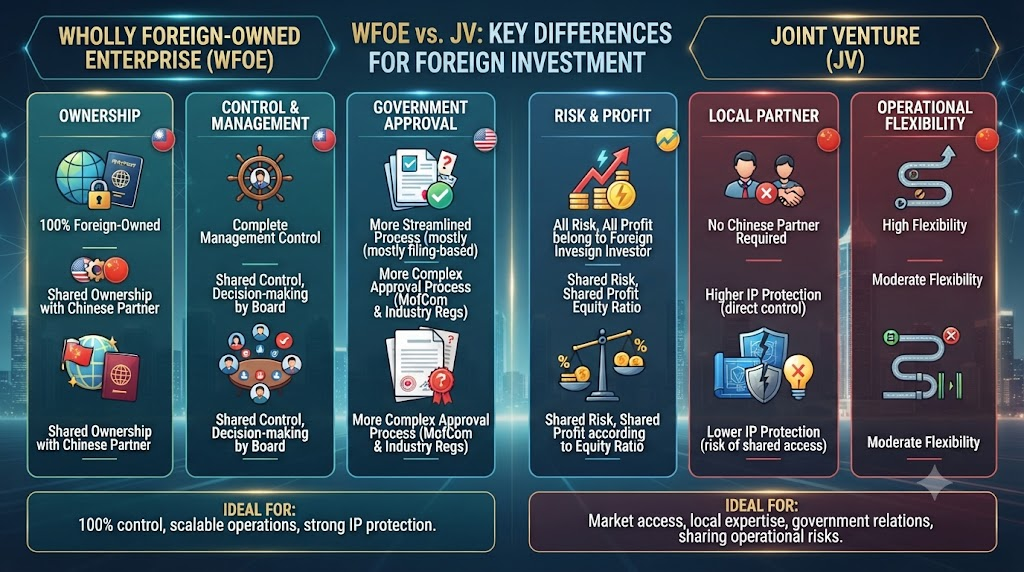
| Feature | Wholly Foreign-Owned Enterprise (WFOE) | Sino-Foreign Joint Venture (JV) |
|---|---|---|
| Foreign Ownership | 100% Foreign Capital | Limited to < 100% (Shared with Chinese Partner) |
| Control & Management | Sole control by foreign parent | Shared board of directors; consensus required |
| IP Protection | High; proprietary systems remain locked | Moderate to Low; shared access risk |
| Setup Timeline | Typically 3 to 5 months | Typically 6 to 9 months (due to negotiations) |
| Target Industries | Encouraged and permitted sectors | Restricted industries on the Negative List |
According to global investment trackers, direct foreign direct investment trends show that companies are avoiding shared management structures unless local relationships are vital for regulatory clearance.
Why Savvy Investors Route China Entities via a Hong Kong Holding Company
Experienced multinational corporations rarely hold a mainland Chinese WFOE or JV directly. Instead, they insert a Hong Kong holding company as an intermediary corporate layer. This setup creates a powerful legal and fiscal shield.
The core benefit lies in tax optimization. Under the Double Taxation Arrangement (DTA) signed between Mainland China and the Hong Kong Special Administrative Region (HKSAR), the standard withholding tax on dividends distributed from a mainland subsidiary to its foreign parent is slashed from 10% to just 5%.
“Routing a mainland China WFOE through a Hong Kong holding company is not just about tax mitigation; it is about establishing a robust governance buffer. The Hong Kong Special Administrative Region (HKSAR) offers a familiar common law system that global investors trust, dramatically simplifying future exit strategies or equity transfers.”
— Marcus Chen, Chief Corporate Strategist, Olesen Global (TCSP License TC010076)
To qualify for this reduced rate, the Hong Kong entity must demonstrate genuine economic substance. Managing this compliance requires a trusted, licensed local partner. At Olesen Global, our Physical HK Office serves as your direct operational anchor, providing 1-on-1 Progress Tracking to ensure your compliance documents, tax filings, and local substance requirements are meticulously managed without any third-party middlemen.
Our team at Olesen Global is a first-hand, TCSP-licensed provider (TC010076). We handle the complete setup of your Hong Kong Company Registration and provide ongoing Company Secretary Services. By avoiding intermediaries, we ensure direct, compliant, and cost-effective management of your holding structure.
Intellectual Property & Profit Repatriation: Mitigating Risks in Mainland China
Protecting proprietary trade secrets and repatriating earnings are the two primary operational challenges for any foreign enterprise in China. WFOEs and JVs handle these issues differently.
A WFOE retains sole ownership of its intellectual property. You can register your patents, software copyrights, and brands directly with local authorities. In a Joint Venture, the local partner often demands joint ownership or licensing rights to your technology, creating a risk of IP leakage.
Profit repatriation requires a structured strategy to satisfy the State Administration of Foreign Exchange (SAFE) and local tax bureaus. You can repatriate funds through several channels.
| Repatriation Channel | Tax Implications | Requirements |
|---|---|---|
| Dividends | 5% (via HK DTA) or 10% (standard) withholding tax | Requires annual audit, clearing accumulated losses, and 10% reserve fund allocation |
| Service Fees (Intercompany) | Subject to VAT (~6%) and withholding CIT (~10% based on deemed profit) | Requires transfer pricing documentation and proof of actual services rendered |
| Royalties | ~10% withholding tax (reduced under DTAs) | Requires trademark/patent registration and formal royalty agreement filing with tax authorities |
Whether you choose a WFOE or a JV, your accounting and auditing structures must remain pristine. Annual local audits are mandatory before any dividend distribution is approved.
Exit Strategies: WFOE Liquidation vs. JV Dissolution Complexity
While entering the market is exciting, planning an exit strategy is essential. Winding down a corporate presence in China can be complex, and the two structures present very different challenges.
Liquidating a WFOE is a structured process. It involves a tax audit, settlement of local employee liabilities, and cancellation of business licenses. It typically takes 6 to 12 months, but because you hold 100% of the equity, you do not need approval from any external partners.
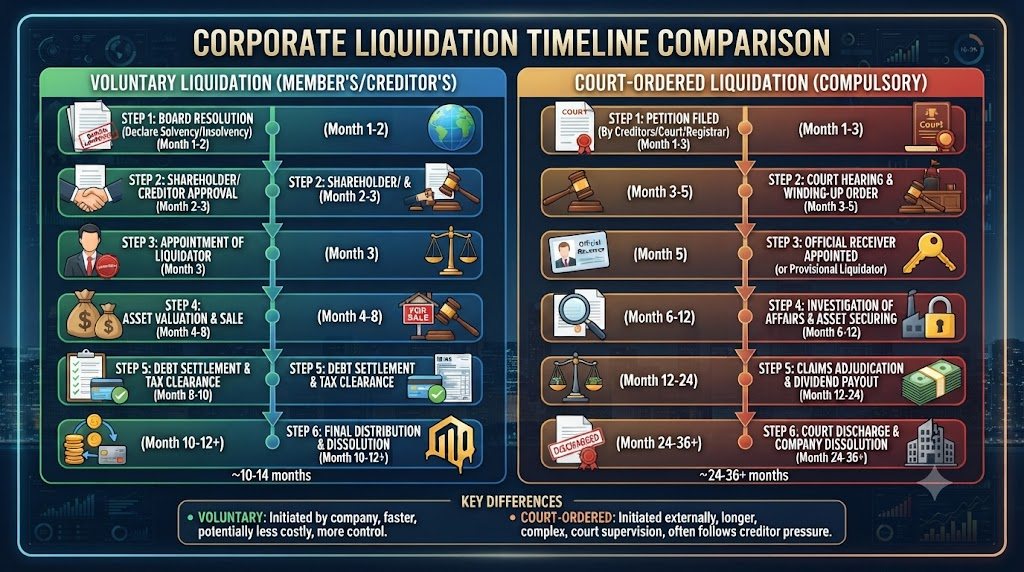
A Joint Venture dissolution is far more complex. If relations with your local partner break down, dissolving the company requires mutual agreement or judicial intervention. If the local partner refuses to sign the dissolution papers, the foreign investor can face a prolonged deadlock.
Statistically, resolving a deadlocked Joint Venture dissolution can take up to 24 months, often involving costly litigation. Holding your shares through a Hong Kong holding company allows you to sell the parent company level instead, avoiding mainland liquidation hurdles entirely.
Real-World Case Study: Transitioning from a Sino-Foreign JV to a WFOE
In 2024, a European industrial automation manufacturer operating under a 60/40 Sino-Foreign Joint Venture in Jiangsu faced severe operational gridlock. The local partner refused to approve capital reinvestment for smart factory upgrades, fearing dilution of their shares. To regain control, the European parent decided to transition to a Wholly Foreign-Owned Enterprise (WFOE) structure.
The Operational Hurdles:
- Asset Valuation Dispute: The local partner inflated the value of jointly owned manufacturing equipment, delaying the equity buyout by four months.
- Employee Transfer Resistance: Transitioning 120 local workers from the JV to the new WFOE required renegotiating employment contracts under PRC Labor Contract Law, risking labor disputes and severance claims.
- Regulatory Hurdles: The transition required simultaneous liquidation of the JV and incorporation of the WFOE, which threatened to halt production and invalidate existing local commercial licenses.
The Solution: By routing the transaction through an established Hong Kong holding company, the manufacturer secured bridging finance and executed a structured buyout. With the support of Olesen Global’s Physical HK Office and our 1-on-1 Progress Tracking, they successfully transferred the business assets and contracts to a new WFOE without halting assembly lines, ultimately increasing operational efficiency by 35% in 2025.
Step-by-Step Gateway: Setting Up Your HK-China Corporate Structure
To secure your operations, implement this step-by-step roadmap using a Hong Kong holding company structure.
- Step 1: Incorporate in Hong Kong
Establish your Hong Kong holding company to secure tax benefits and simplify international banking. - Step 2: Appoint a Licensed Secretary
Ensure compliance with local laws using a TCSP-licensed corporate secretary. - Step 3: Open Corporate Bank Accounts
Set up multi-currency corporate accounts in Hong Kong to facilitate capital injection and profit repatriation. - Step 4: Register with SAMR & MOFCOM
Submit your WFOE or JV application to mainland Chinese authorities with your notarized Hong Kong corporate documents. - Step 5: Inject Capital & Begin Operations
Fund your registered capital account and establish your local tax and social security systems.
Our Physical HK Office acts as your direct gateway to mainland expansion. As a first-hand, TCSP-licensed provider (TC010076), we provide dedicated 1-on-1 Progress Tracking from day one. This guarantees that your Hong Kong company registration, corporate bank accounts, and mainland filings are processed seamlessly, with zero middlemen and absolute transparency.
Frequently Asked Questions: WFOE vs Joint Venture
Can a WFOE be converted to a Joint Venture?
Yes. Under the PRC Foreign Investment Law and SAMR regulations, a WFOE can be converted to a Joint Venture by transferring equity to a local Chinese partner. This requires modifying the company’s articles of association and updating your registration filings.
How long does it take to repatriate profits from China?
Once the annual tax audit and corporate income tax filings are completed (usually between March and June), the bank processing for profit repatriation takes about 2 to 4 weeks, provided all withholding tax documents are in order.
Why is a Hong Kong company preferred over direct foreign ownership?
A Hong Kong company reduces withholding tax on dividends from 10% to 5% under the mainland-HK DTA. It also provides a neutral, internationally recognized legal jurisdiction for joint venture agreements and simplifies future sales or transfers of the mainland entity.
Secure Your China Expansion with Olesen Global
Establish Your Compliant China Gateway Today
Navigating the regulatory landscape of mainland China requires absolute precision. By partnering directly with Olesen Global—a first-hand, TCSP-licensed provider (TC010076) with a Physical HK Office—you bypass costly middlemen and secure dedicated 1-on-1 Progress Tracking.
Whether you are establishing a new WFOE, structuring a Joint Venture, or setting up a tax-optimized Hong Kong holding company, our experts are here to guide you through every step of the process.