Core Stages and Milestone Breakdown
The standard Hong Kong trademark registration timeline spans 6 to 8 months for smooth, uncontested applications. Applications encountering substantive office actions or third-party opposition can extend to 10 to 14 months or longer under the statutory procedures enforced by the Intellectual Property Department (IPD Hong Kong).
Under the statutory framework of the Trade Marks Ordinance (Cap. 559), every trademark filing moves through four distinct legal phases. Meeting strict filing standards at each phase determines whether an application proceeds on schedule or faces administrative delays.
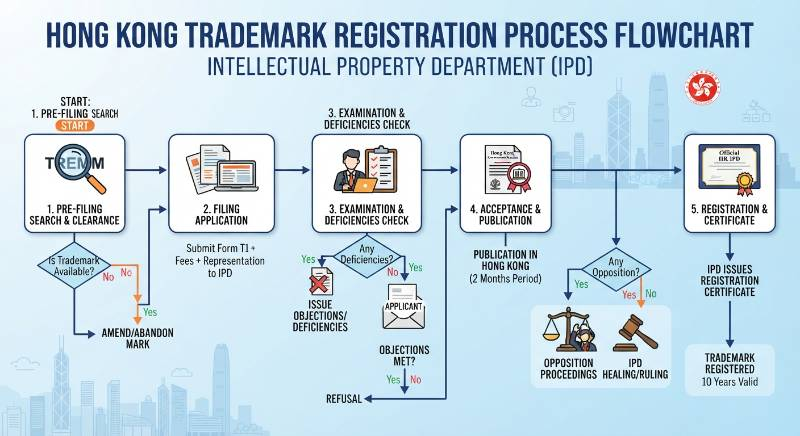
| Statutory Stage | Responsible Authority | Standard Duration | Primary Statutory Output |
|---|---|---|---|
| 1. Form T2 Application & Filing | Trade Marks Registry (IPD) | 1 to 2 business days | Official Filing Receipt & Application No. |
| 2. Formality & Substantive Examination | IPD Examination Officer | 2 to 3 months | Notice of Acceptance or Deficiency Letter |
| 3. Gazette Publication (Opposition Window) | HK Intellectual Property Journal | 3 months (Fixed statutory) | Public Notice Clearance |
| 4. Registration Entry & Certificate | Trade Marks Registry (IPD) | 3 to 4 weeks | Certificate of Registration |
Stage 1: Filing & Initial Examination (Months 1 to 2)
The process starts by submitting Form T2 to the Trade Marks Registry Hong Kong along with the official fee schedule. The registry validates the applicant’s legal entity information, graphical mark representation, and class specifications based on the international Nice Classification System.
If you claim priority under the Paris Convention, your application must be submitted within 6 months of the initial foreign filing date. When details are missing or class terms are non-standard, the registry issues a formality deficiency notice, requiring formal rectifications within two months.
Stage 2: Substantive Examination & Compliance Review (Months 2 to 4)
During substantive examination, the IPD examiner reviews the mark across absolute and relative grounds for refusal under Cap. 559.
- Absolute Grounds: The examiner confirms the mark is distinctive and not descriptive, generic, or deceptive regarding the underlying goods or services.
- Relative Grounds: The examiner searches the trade mark register for identical or confusingly similar prior marks registered in identical or associated classes.
If no conflicts exist, the IPD issues a formal Notice of Acceptance. If issues are identified, the IPD sends an official opinion letter outlining the statutory objections.
Stage 3: Public Gazette Publication & Statutory Opposition Window (Months 4 to 7)
Accepted marks are advertised in the official Hong Kong Intellectual Property Journal. This begins a mandatory, non-extendable 3-month opposition period.
Any third party holding prior rights may challenge the application by filing a Form T6 (Notice of Opposition). If no opposition is filed during these 3 months, the mark clears the public verification stage.
Stage 4: Final Approval & 10-Year Certificate Issuance (Months 6 to 8)
Once the opposition window closes without objection, the Registrar enters the mark into the official register. The IPD issues the official Certificate of Registration within 3 to 4 weeks.
Registration takes effect retroactively from the initial Form T2 filing date. The mark remains valid for 10 years and can be renewed indefinitely in 10-year increments using Form T5.
Hong Kong vs. Mainland China: Territorial IP Protection Comparison
Hong Kong maintains an independent legal jurisdiction under the “One Country, Two Systems” framework. A trademark registered with the China National Intellectual Property Administration (CNIPA) in Beijing provides zero legal protection within the Hong Kong Special Administrative Region, and vice versa.
| Dimension | Hong Kong (IPD) | Mainland China (CNIPA) |
|---|---|---|
| Governing Law | Trade Marks Ordinance (Cap. 559) — Common Law | Trademark Law of the PRC — Civil Law |
| First-to-Use Rights | Recognized under Common Law Passing Off actions | Strict “First-to-File” with limited exceptions |
| Average Timeline | 6 to 8 months (uncontested) | 7 to 12 months |
| Opposition Window | 3 months (Strictly non-extendable) | 3 months statutory notice |
| Official Language | Bilingual (English and Traditional Chinese) | Simplified Chinese exclusively |
“Cross-border enterprises often assume a single filing covers the Greater Bay Area. In practice, protecting your brand requires separate filings in Hong Kong and the Mainland to prevent bad-faith squatting across both regulatory jurisdictions.”
— Senior IP Legal Counsel, Hong Kong Intellectual Property Bar Association
Key Delay Factors: Standard vs. Contested Filings
While standard applications complete within 6 to 8 months, procedural mistakes or conflicts can delay approval past the 14-month mark. Understanding these bottlenecks helps you keep your application on schedule.
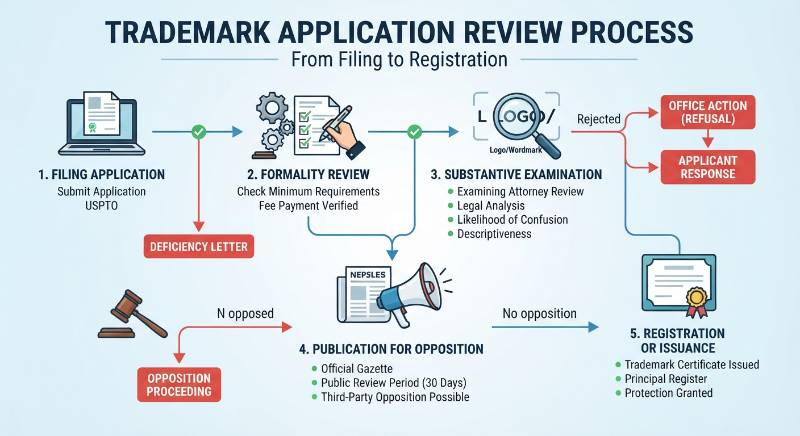
- Deficiency Notice Responses (Adds 3 to 6 months): When the IPD issues an objection regarding distinctiveness or class specifications, applicants receive an initial 6-month statutory rectification window. Taking full advantage of this response time automatically extends your processing schedule.
- Relative Grounds Citation Conflicts (Adds 4 to 8 months): If an examiner finds an existing conflicting mark, overcoming this requires legal submissions, consent letters from the prior owner, or evidence of honest concurrent use under Section 13 of Cap. 559.
- Formal Third-Party Oppositions (Adds 9 to 18 months): If a competitor files a Form T6 during the 3-month gazette window, the application moves into formal adversarial proceedings. This requires counter-statements (Form T7), evidence rounds, and a formal hearing before an IPD Hearing Officer.
- Non-Standard Specification Descriptions (Adds 1 to 2 months): Submitting free-text product descriptions rather than standard Nice Classification terms triggers manual classification queries from IPD examiners.
Specialized Filing Scenarios: Web3, Fintech, and Cross-Border E-Commerce Marks
Firms operating in Web3, cross-border e-commerce, and software-as-a-service (SaaS) face specific classification challenges that require structured drafting.
For a Web3 or fintech startup operating out of Cyberport or the Hong Kong Science Park, brand protection requires coverage across multiple coordinated classes:
- Class 9: Downloadable cryptographic software keys, smart contract programs, and virtual asset wallets.
- Class 36: Financial exchange services, digital asset trading platforms, and virtual currency payment processing.
- Class 42: Blockchain infrastructure design, software-as-a-service (SaaS), and decentralized application hosting.
Cross-border e-commerce firms managing supply chains across the Greater Bay Area must align Class 35 (online marketplace operation and retail management) alongside product-specific manufacturing classes (e.g., Classes 3, 14, 18, 25). Structuring your specifications around pre-approved IPD wording avoids broad classification queries that can add months to your application.
Strategic Acceleration: The 4-Pillar Hong Kong Brand Velocity Protocol
To secure a 6-month approval cycle and eliminate avoidable queries, our compliance team applies a structured preparation methodology before filing.
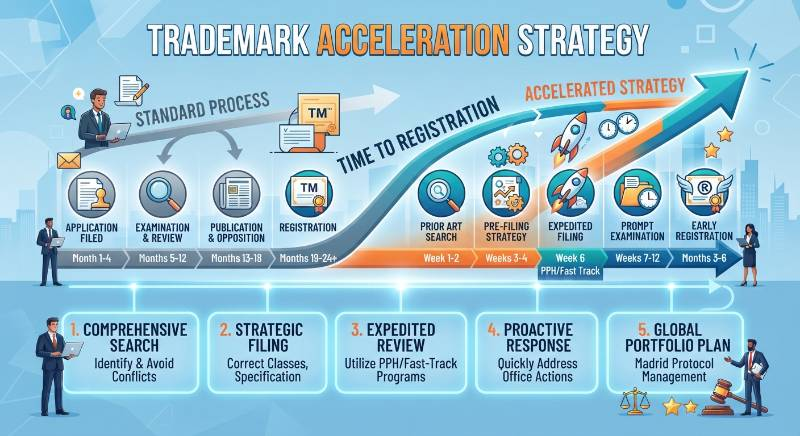
- Pre-Filing Clearance Search: Run deep phonetic, semantic, and visual conflict searches across the IPD register to identify potential conflicts before filing.
- Standard Class Term Adoption: Select standard classification terms directly from the WIPO Nice Classification database to clear initial examination within 48 hours.
- Direct Filing Agent Representation: File directly through a licensed Trust and Company Service Provider (TCSP) to ensure official correspondence and statutory deadlines are managed promptly.
- Immediate Deficiency Response Protocol: Address any formality or specification queries from the IPD within 10 business days rather than using the full 6-month statutory window.
Pre-Filing Trademark Readiness Checklist
- Mark representation finalized in crisp vector format (Black/White and full Color variants).
- Comprehensive clearance search completed across all primary and complementary Nice classes.
- Goods and services aligned with standard pre-approved IPD classification descriptions.
- Priority documents translated and notarized if claiming foreign priority within 6 months.
- Applicant details match the exact legal entity name shown on your Business Registration Certificate.
“Over 85% of trademark delays in Hong Kong stem from poorly drafted class specifications. Using pre-approved terminology resolves the vast majority of official queries before substantive examination even begins.”
— Senior Compliance Officer, TCSP License TC010076, Olesen Global
Integrating Trademark Strategy with Hong Kong Company Formation
Securing a registered company name with the Companies Registry does not grant proprietary trademark rights under Hong Kong law. Company name registration and trademark registration are governed by separate legal statutes.
Smart founders coordinate their intellectual property strategy alongside core corporate setup workflows:
- Corporate Setup: Pair your Hong Kong Company Registration with immediate Trademark Registration to establish complete legal ownership over your operating brand.
- Statutory Governance: Ensure compliant annual filings and corporate resolutions through qualified Company Secretary Services.
- Banking and Institutional Verification: Presenting a filed IP application or Registration Certificate significantly improves your profile during commercial Bank Account Opening reviews with international institutions like HSBC, Standard Chartered, and Bank of China (Hong Kong).
- Financial Reporting & Valuation: Account for registered intellectual property assets as valuable intangibles in your annual Accounting & Audit filings to strengthen corporate valuations.
Frequently Asked Questions (FAQs)
Can the Hong Kong trademark registration process be expedited?
Unlike certain overseas registries, the Hong Kong IPD does not offer a paid official fast-track mechanism. The most effective way to secure a 6-month turnaround is conducting a pre-filing clearance search, using standard Nice classification terms, and responding to any official notices immediately.
Can international applicants register marks directly through the Madrid Protocol in Hong Kong?
While preparatory legislation for the Madrid System in Hong Kong is established, international Madrid designations must be tracked carefully against domestic implementation schedules. Direct filing through a local licensed representative remains the most reliable route for securing local brand rights.
How long is a registered Hong Kong trademark valid?
A trademark registration remains valid for 10 years starting from the original filing date. It can be renewed indefinitely for successive 10-year terms by filing Form T5 and paying the statutory renewal fee within 6 months before expiry.
Can an individual or offshore corporate entity hold a Hong Kong trademark?
Yes. Any natural individual, Hong Kong limited company, or foreign enterprise (e.g., BVI, Cayman Islands, US, or Singapore entity) can apply for and own a Hong Kong trademark, provided a local address for service in Hong Kong is maintained on the register.
Secure Your Hong Kong Brand Protection with Olesen Global
Work directly with a licensed Hong Kong Trust and Company Service Provider (TCSP License TC010076). Our dedicated corporate services team provides end-to-end clearance searches, specification drafting, and official filing management without third-party intermediaries.