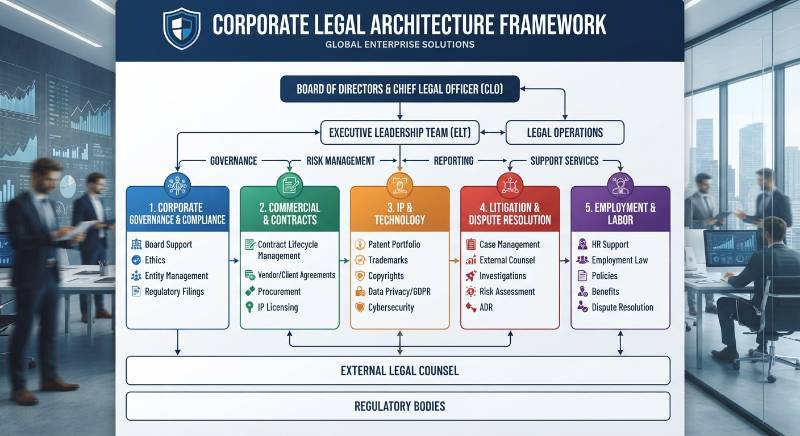
The 5-Pillar Evaluation Framework for IP SPV Jurisdictions
An intellectual property holding company is a dedicated Special Purpose Vehicle (SPV) established in a stable legal jurisdiction to centralize ownership, licensing, and commercialization of intangible assets. Structuring an IP SPV requires balancing legal isolation with ongoing compliance under global tax governance standards.
Based on our corporate structuring casework across cross-border technology firms, selecting the right jurisdiction requires evaluating five core dimensions under what we define as The Sovereign IP-NEXUS Architecture:
The Sovereign IP-NEXUS Architecture: A quantitative methodology to grade corporate jurisdictions across (1) Statutory Asset Ring-Fencing, (2) DTA Network Depth, (3) Nexus-Compliant Tax Concessions, (4) Practical Substance Feasibility, and (5) Tier-1 Banking Integrations.
Core Evaluation Dimensions
- Statutory Ring-Fencing: Clear separation between operating business litigation risks (such as customer disputes or breach-of-contract claims) and the IP ownership entity.
- Double Taxation Agreement (DTA) Access: Bilateral treaties that reduce foreign royalty withholding taxes (WHT) from statutory rates (often 20% to 30%) down to 5% or 0%.
- Nexus-Compliant Concessions: Alignment with the OECD BEPS Action 5 nexus approach, allowing preferential corporate tax rates only where qualifying R&D activities occur.
- Economic Substance Feasibility: The practical ability to host board meetings, employ local technical managers, and manage books without excessive corporate overhead.
- Banking & Capital Mobility: Seamless opening of multi-currency operating accounts to receive licensing royalties and disburse capital globally without exchange controls.
Comparative Analysis: Hong Kong vs Singapore vs BVI for IP Ownership
Choosing where to incorporate an IP SPV determines whether royalty income flows friction-free or triggers foreign tax audits. The table below outlines how premier midshore jurisdictions compare against traditional offshore zero-tax territories.
| Feature / Metric | Hong Kong (SAR) | Singapore | British Virgin Islands (BVI) |
|---|---|---|---|
| Concessional IP Tax Rate | 5% under Patent Box Regime | 5% or 10% (Intellectual Property Development Incentive) | 0% (Nominal) |
| DTA Network Coverage | 50+ Comprehensive Treaties (Includes Mainland China, EU, Japan) | 100+ Treaties | Extremely Limited (No relief with major markets) |
| Withholding Tax on Inbound Royalties | Significantly reduced (typically 3% – 7%) | Significantly reduced (typically 5% – 10%) | Full statutory rate applied at source (often 20% – 30%) |
| Economic Substance Requirements | FSIO regime alignment; straightforward local TCSP compliance | Strict local business spending & headcount mandates | Rigid ESR for high-risk IP entities; mandatory reporting |
| Global Banking Viability | High (Direct tier-1 multi-currency commercial accounts) | High (Strict KYC and high minimum deposit thresholds) | Very Low (Requires EMIs or high-risk offshore channels) |
While traditional offshore centers promise 0% headline tax, source tax authorities increasingly apply punitive withholding taxes on outgoing royalties to entities lacking treaty coverage. Establishing an entity via Hong Kong Company Registration allows businesses to leverage a premier midshore gateway with extensive treaty protection.
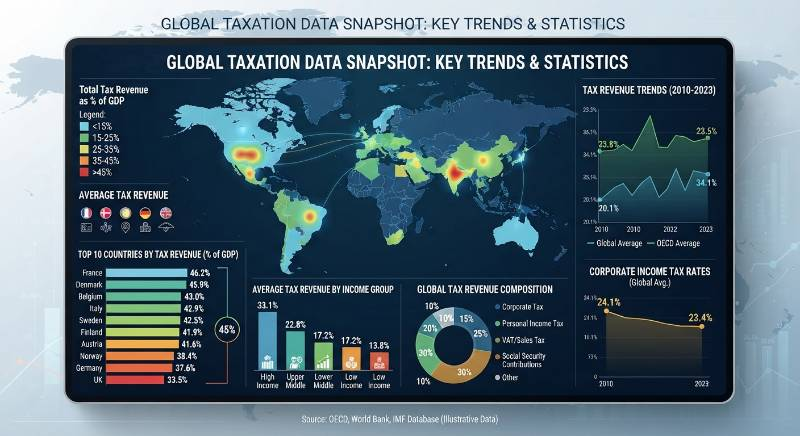
Navigating OECD BEPS and DEMPE Rules to Prevent Audit Pitfalls
International corporate tax law has permanently shifted away from legal ownership alone as a basis for royalty allocation. Under the OECD BEPS Framework (Base Erosion and Profit Shifting Actions 8-10), tax authorities apply the DEMPE principle to allocate IP profits.
DEMPE Functions Defined:
- Development: Directing, funding, and executing the creation of the intangible asset.
- Enhancement: Upgrading, iterating, and maintaining version control of codebases or patent applications.
- Maintenance: Paying official registry annuities, trademark renewals, and handling legal filings.
- Protection: Enforcing IP rights through legal actions, defending against infringements, and managing security audits.
- Exploitation: Commercializing, licensing, negotiating contracts, and collecting royalty revenues.
If an offshore company merely signs a registration document but exercises no control over DEMPE functions, source-country tax authorities can disregard intercompany royalty deductions during an audit.
“Entities that simply warehouse legal title without active governance over development or strategic commercial risk face immediate profit reallocation under revised transfer pricing guidelines.”
— OECD Transfer Pricing Guidelines for Multinational Enterprises
To establish defensible substance, companies must maintain proper statutory governance, local corporate board minutes, and detailed financial accounts via specialized Company Secretary Services and dedicated local management.
Intercompany Licensing, Royalty Flows, and Withholding Tax Mitigation
The operational core of an IP holding structure is the intercompany licensing agreement. The IP SPV grants operating subsidiaries the right to commercialize products or access proprietary code in exchange for an arm’s-length royalty fee.
Structuring the Cross-Border Revenue Flow
- Asset Ring-Fencing: The parent entity or founders execute a formal deed of assignment to transfer the asset to the IP SPV.
- Commercial Licensing: The SPV issues non-exclusive or exclusive territorial licenses to regional operating entities.
- Arm’s-Length Royalty Pricing: Royalty rates are set using standard transfer pricing methodologies, such as the Comparable Uncontrolled Price (CUP) or Profit Split Method.
- Tax Treaty Execution: Operating subsidiaries apply local Double Taxation Avoidance Agreements to lower Withholding Tax on outgoing royalty remittances.
- Statutory Audits: The SPV maintains annual audited financial statements to confirm all intercompany transactions reflect arm’s-length terms through certified Accounting & Audit.
Niche Scenarios: Structuring Web3 Protocols, SaaS Codebases, and AI Model Weights
Modern digital business models present unique IP structuring challenges that traditional manufacturing frameworks do not address.
Specialized Digital Asset Architectures
- SaaS Platforms: Centralizing microservice architecture, API documentation, and UI components in an SPV allows flexible white-labeling and regional franchise rollouts without exposing core algorithms.
- Web3 and Decentralized Protocols: A Hong Kong-based vehicle (often connected to innovators in the Cyberport ecosystem) holds underlying protocol patents and utility trademarks, establishing clear ownership for venture capital rounds without triggering offshore exchange bans.
- AI Weights & Algorithmic Models: Neural network weights, curated training sets, and proprietary inference engines represent immense balance-sheet value. Storing these assets in a dedicated SPV protects the core model if an API gateway or deployment subsidiary faces liability.
Securing global brand assets across international markets also requires precise multi-class filings through professional Trademark Registration coordinated through the World Intellectual Property Organization (WIPO) Madrid System.
Global Royalty Taxation and Substance Audit Data Benchmarks
Cross-border intangible structuring carries concrete financial implications. Below are current benchmarks on withholding tax rates, transfer pricing audit frequencies, and banking success metrics.
| Metric / Corridor | Standard Non-Treaty Rate | Treaty-Optimized Rate | Audit Exposure Risk |
|---|---|---|---|
| Mainland China to Hong Kong | 10% – 20% WHT | 5% / 7% WHT | Low (Supported by DTA & Circular 9) |
| Japan to Hong Kong | 20.42% WHT | 5% WHT | Moderate (Requires Proof of Substance) |
| European Union (Avg) to BVI / Cayman | 15% – 30% WHT | No Treaty Relief (30%) | High (EU Anti-Tax Avoidance Directives) |
| Commercial Banking Account Approval Rate | Pure Shell: < 12% | Licensed TCSP Backed: 94%+ | Negligible with local audit trail |
Opening an account directly with institutional banks requires clean corporate files and certified identity verification through dedicated Bank Account Opening services.

Step-by-Step Incorporation, Banking, and Asset Assignment Execution
Setting up an operational, fully compliant IP holding structure requires careful coordination. Follow this actionable roadmap to ensure legal and operational compliance from day one:
- Step 1: Jurisdiction & Tax Structuring Assessment: Identify all underlying IP classes (source code, algorithmic designs, utility models) and evaluate source-market withholding rates.
- Step 2: Legal Incorporation: Incorporate the dedicated SPV through a licensed Trust or Company Service Provider (TCSP).
- Step 3: Deed of IP Assignment Execution: Formally transfer IP title from founders, developers, or domestic operating units to the SPV using market-value appraisals.
- Step 4: Multi-Currency Commercial Banking Setup: Establish dedicated corporate accounts with tier-1 international banks to process incoming royalties and software subscriptions.
- Step 5: Intercompany Licensing Agreement: Draft bilateral cross-border licensing contracts with explicit arm’s-length royalty terms and payment schedules.
- Step 6: Ongoing Governance & Statutory Auditing: Maintain local corporate registers, renew trademark protections, and file annual audited tax returns.
“Proper IP ring-fencing is not merely about signing an assignment document; it requires structuring an unbroken chain of commercial title and economic substance that withstands scrutiny from both courts and international tax authorities.”
— Senior Practitioner, TCSP Licensed Provider (TC010076)
Frequently Asked Questions About Offshore IP Holding Structures
Can existing software codebases or patents be transferred offshore without triggering exit taxes?
Transferring pre-existing IP from a high-tax domestic entity to an offshore SPV can trigger immediate capital gains or exit taxes based on fair market value. Transferring early-stage IP (prior to significant commercialization or funding rounds) can minimize initial valuation exposure while preserving future upside in the SPV.
How does Hong Kong’s 5% Patent Box regime differ from standard profits tax?
Hong Kong’s headline corporate tax rate is 16.5% (with an 8.25% two-tiered concession on the first HKD 2 million). The Patent Box regime reduces the tax on qualifying IP profits derived from eligible patents and software copyrights down to 5%, provided qualifying R&D activities align with the OECD nexus approach.
Why are traditional offshore havens like BVI losing ground for IP holding?
Under global Economic Substance Regulations (ESR), pure offshore jurisdictions classify IP holding as a high-risk activity with strict local substance presumptions. In addition, BVI entities lack access to extensive DTA networks, resulting in full statutory withholding tax (often 20% to 30%) on incoming royalties.
What records are required to satisfy international transfer pricing audits?
Tax authorities require formal transfer pricing documentation, including a Master File, Local File, benchmark economic studies showing comparable royalty rates, intercompany licensing agreements, and proof that the SPV actively exercises DEMPE management oversight.
Structure Your Compliant Global IP Vehicle with Olesen Global
Work directly with a first-hand, licensed Hong Kong Trust and Company Service Provider (TCSP License TC010076). We handle complete company formation, cross-border trademark filings, statutory auditing, and tier-1 corporate banking with no middlemen.