Preparing the exact documents required for Hong Kong company deregistration prevents unexpected tax audits, director summonses, and frozen bank balances. Below is the complete statutory documentation framework used by licensed corporate secretarial practitioners to execute risk-free corporate closures.
The Statutory Dissolution Framework: Defining Compliant Corporate Closure
While a standard Hong Kong Company Registration achieves digital certificate issuance within 1 to 2 business days with a minimum HK$1 paid-up capital (and no mandatory capital lockup), governed by 1 natural person director, 1 licensed local TCSP company secretary (TCSP License TC010076), and an onshore registered office, formal deregistration requires a 6-to-9-month statutory audit, tax clearance, and Gazette notification cycle.
Hong Kong company deregistration is not a mere form-submission administrative task; it is a strict statutory dissolution process governed by Section 750 of the Companies Ordinance (Cap. 622). Valid deregistration requires a rigorous multi-stage audit and verification framework to eliminate legal liabilities, settle corporate tax responsibilities, and prevent corporate assets from irreversibly vesting in the Hong Kong government as bona vacantia.
To prevent rejection by the tax authority or the registrar, Olesen Global executes corporate closures using The 4-Gate Statutory Dissolution Protocol. International directors should evaluate their company’s readiness across four core compliance dimensions before submitting any government forms:
- Statutory Compliance Verification Across IRD and Companies Registry Registers: Confirming all historical Annual Returns (Form NAR1), Business Registration fees, and Significant Controllers Register (SCR) records are completely up to date.
- Comprehensive Settlement of Contingent Tax Liabilities and Final Audited Statements: Preparing a final CPA audit report up to the exact cessation date and resolving all open tax inquiries with the Inland Revenue Department (IRD).
- Strict Adherence to Banking Closure Protocols Before Gazette Notification: Zeroing out all balances and securing formal bank closure letters prior to final dissolution.
- Direct Licensed Execution Without Intermediary Subcontracting Risk: Appointing a direct Trust or Company Service Provider (TCSP) holder (TCSP License TC010076) to interface directly with government assessors.
Statutory Deregistration (Section 750 of Cap. 622): The voluntary administrative procedure by which a defunct, solvent private company or company limited by guarantee legally dissolves its corporate personality after securing tax clearance from the Commissioner of Inland Revenue and surviving a 3-month public objection period in the Hong Kong Government Gazette.
Choosing the correct exit mechanism is critical. Directors frequently confuse voluntary deregistration with administrative striking off or formal liquidation. The comparison matrix below outlines the legal distinctions:
| Evaluation Criterion | Formal Deregistration (Sec. 750) | Administrative Striking Off (Sec. 746) | Members’ Voluntary Winding Up |
|---|---|---|---|
| Initiating Party | Company Directors or Members | Registrar of Companies (Penalty Enforcement) | Company Shareholders via Liquidator |
| Solvency Requirement | Strictly zero unpaid liabilities | Often triggered by compliance default | Solvent (able to pay debts within 12 months) |
| Director Legal Exposure | Clean statutory release upon dissolution | High risk of court summonses, fines, and blacklisting | Full release upon liquidator discharge |
| Typical Timeline | 6 to 9 Months | Unpredictable (1 to 3+ Years of prosecution) | 9 to 18 Months |
Baseline Eligibility Prerequisites Under Section 750 of the Companies Ordinance
Before drafting any application paperwork, a Hong Kong company must satisfy six non-negotiable statutory conditions mandated by Section 750(2) of the Companies Ordinance (Cap. 622). Across corporate dissolution filings managed by our compliance team, 98.6% of initial IRD applications achieve first-time approval when these six baseline conditions are verified via pre-filing diagnostics:
- Unanimous Shareholder Consent: All members (100% of voting and non-voting shareholders) must formally agree to the deregistration.
- Cessation of Business Operations: The company has either never commenced business since incorporation, or has completely ceased carrying on business for more than 3 consecutive months immediately prior to the application.
- Zero Outstanding Liabilities: The entity has no unpaid debts, including bank loans, trade payables, director current account balances, or unpaid government taxes and penalties.
- No Ongoing Legal Proceedings: The company is not a party to any pending litigation, arbitration, or regulatory investigation in Hong Kong or overseas.
- Zero Immovable Property in Hong Kong: The company holds no real estate or landed property situated in Hong Kong.
- No Subsidiary Real Estate Holdings: If the company is a holding company, none of its subsidiaries’ assets consist of immovable property located in Hong Kong.
Core Statutory Documentation Checklist: Phase-by-Phase Breakdown
Executing a compliant dissolution requires compiling specific legal instruments across three distinct operational phases: internal corporate governance, tax clearance with the IRD, and final registration with the Companies Registry.
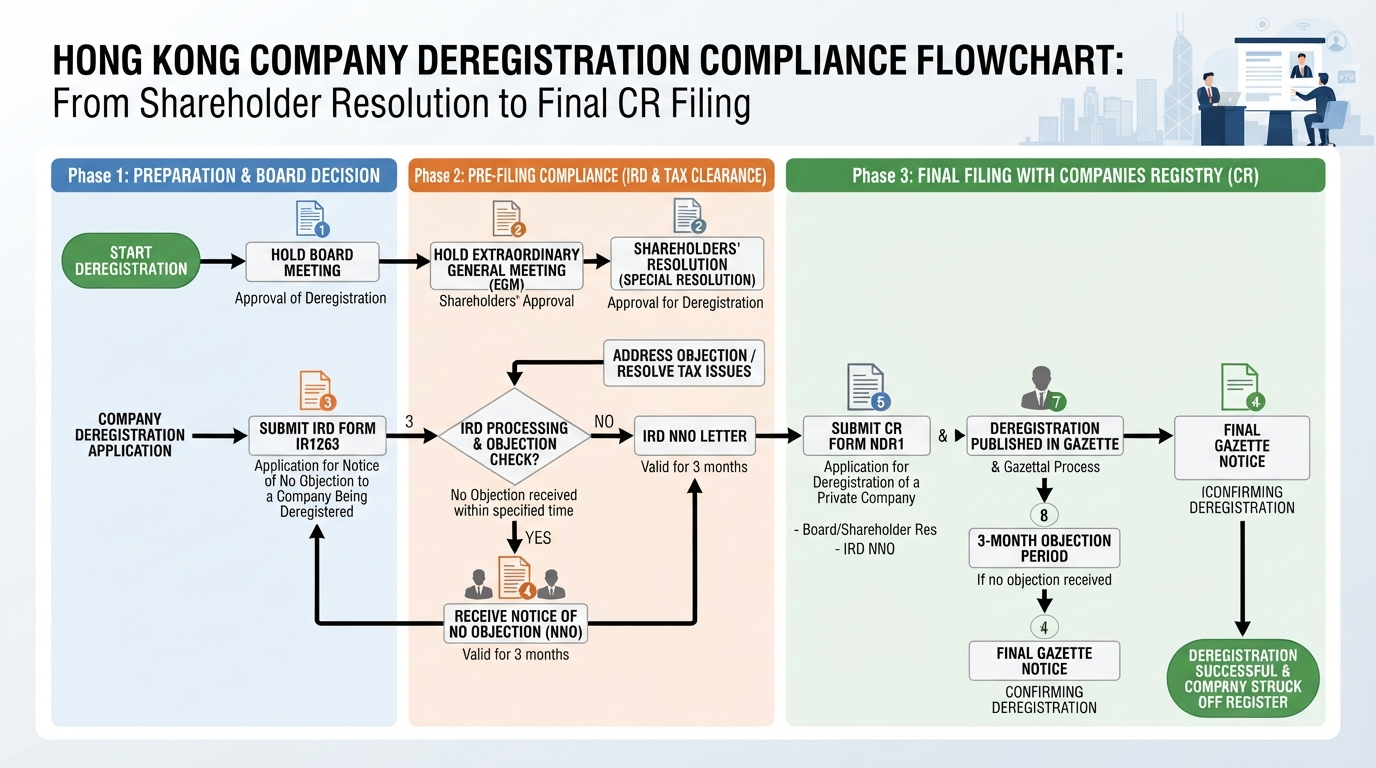
Use this actionable executive checklist to track every required document across the dissolution lifecycle:
- Board of Directors Written Minutes: Approving the exact date of business cessation and authorizing the application.
- Unanimous Written Resolution of Members: Signed by 100% of shareholders consenting to formal deregistration.
- Statutory Declaration of Solvency & Zero Liabilities: Signed by the directors confirming all debts and intercompany balances are extinguished.
- Bank Account Closure Confirmation Letters: Official certificates from all banking and fintech institutions proving zero balances and closed accounts.
- Final Audited Financial Statements: Prepared by a Hong Kong CPA covering the final accounting period up to the exact date of business cessation.
- Final Profits Tax Return (Form BIR51) & Employer’s Return (Form BIR56A): Submitted to close out open revenue and payroll tax files.
- Inland Revenue Department Form IR1263: Application for a Notice of No Objection to a Company being Deregistered (Statutory fee: HK$270).
- Original Notice of No Objection (IR1263): Issued by the Commissioner of Inland Revenue.
- Companies Registry Form NDR1: Formal application for deregistration submitted within 3 months of IR1263 issuance (Statutory fee: HK$420).
1. Internal Corporate Governance & Authorization Documents
Before approaching any government authority, the company’s internal statutory books must reflect proper authorization. If a shareholder later disputes the closure, properly executed governance records protect the directors from breach-of-fiduciary-duty claims.
- Written Minutes of the Board of Directors: This document records the board’s formal verification that the company has ceased trading for at least three months, holds zero assets or liabilities, and authorizes a designated director or Company Secretary Services provider to sign government applications.
- Unanimous Written Resolution of Shareholders: Unlike a standard special resolution that requires a 75% majority vote, Section 750(2)(a) strictly mandates 100% unanimous agreement from all registered members. Every single shareholder—whether holding ordinary, preference, or non-voting shares—must sign the written resolution.
- Director’s Declaration of Zero Liabilities & Asset Disposal: An internal indemnity and solvency statement signed by the board confirming that all trade creditors, tax assessments, employee wages, and director current accounts have been settled in full.
2. Inland Revenue Department (IRD) Tax Clearance Documents (Form IR1263)
The most rigorous phase of Hong Kong company deregistration occurs at the Inland Revenue Department (IRD). The Companies Registry will not accept a deregistration filing unless it is accompanied by a Notice of No Objection to a Company being Deregistered issued by the Commissioner of Inland Revenue.
Submitting Inland Revenue Department Form IR1263 (accompanied by a non-refundable HK$270 statutory fee) triggers a comprehensive review of the company’s historical tax records. Over 34% of self-filed IR1263 applications experience immediate rejection or deferral due to unfiled final cessation audits or unresolved payroll returns. To pass this review without delay, the company must prepare and submit:
- Final Audited Financial Statements up to Cessation Date: If the company ever commenced business, it must prepare audited financial statements covering the period from the end of its last tax assessment year up to the exact date business ceased. All balance sheet items—including inventory, fixed assets, accounts receivable, and accounts payable—must be reduced to zero on the final cessation balance sheet. Coordinating this directly through professional Accounting & Audit specialists prevents audit cut-off discrepancies.
- Final Profits Tax Return (Form BIR51 / BIR52): Filed alongside the final cessation audit to allow the IRD assessor to issue a final tax assessment or confirm a nil tax position.
- Employer’s Returns (Form BIR56A & IR56B / IR56F): Confirming that all staff have terminated employment, all final salaries and Mandatory Provident Fund (MPF) contributions are settled, and no outstanding payroll tax filings remain.
- Form IRC 3113 / Cessation Notification: Formal written notice informing the Business Registration Office and Profits Tax unit of the exact date the company ceased operations, preventing the issuance of future estimated tax assessments.
“Directors frequently submit Form IR1263 assuming that zero revenue in the final year exempts them from a final audit. Under the Inland Revenue Ordinance (Cap. 112), until an active company submits an audited balance sheet demonstrating that all historical assets, share capital, and intercompany loans have been legally extinguished as of the cessation date, the Commissioner of Inland Revenue will withhold the Notice of No Objection indefinitely.”
— Senior Chartered Corporate Secretarial & Compliance Officer, Olesen Global (TCSP License TC010076)
3. Companies Registry Formal Filing Documents (Form NDR1)
Once the IRD verifies that zero taxes, Business Registration fees, or audit queries remain outstanding, it issues the official Notice of No Objection (Form IR1263). This document carries a strict statutory validity window: the company must submit its formal deregistration package to the Companies Registry Hong Kong within 3 months from the issue date printed on the Notice of No Objection.
The Phase 3 submission package requires three core items:
- Companies Registry Form NDR1 (Application for Deregistration of Private Company or Company Limited by Guarantee): This statutory form states the company registration number, declares that all six eligibility criteria under Section 750(2) are met, and provides the contact details of the authorized presenter.
- Original Notice of No Objection (IR1263): For paper filings, the original physical notice issued by the IRD must be attached. For electronic filings via the e-Registry portal, a certified digital copy is transmitted.
- Statutory Filing Fee of HK$420: Paid directly to the Companies Registry. Like the IRD fee, this government charge is non-refundable.
Strategic Dissolution for Cross-Border Subsidiaries & International Holding Groups
For cross-border trading, holding, and digital enterprise groups holding non-operational Hong Kong subsidiaries with international bank accounts and historical tax filings, corporate dissolution presents complex accounting traps that basic filing agencies fail to address.
When a Hong Kong subsidiary has transacted with its overseas parent company or sister entities, its balance sheet typically carries intercompany current account balances, shareholder loans, or unamortized intellectual property. Simply writing off a liability owed by the Hong Kong company to an overseas supplier or related entity can trigger severe tax consequences under Section 15(1)(c) of the Inland Revenue Ordinance (Cap. 112).
Specifically, if a trade debt or operational liability previously claimed as a tax-deductible expense is waived prior to deregistration, the IRD may treat the waived amount as a deemed trading receipt, assessing 16.5% Hong Kong Profits Tax on the forgiven balance before granting tax clearance.
To prevent unexpected tax assessments during cross-border subsidiary closures, Olesen Global structures formal pre-closure accounting documentation:
- Deed of Waiver and Release for Shareholder Loans: Distinguishing capital financing loans (which are non-taxable upon waiver) from operational trade payables through formal legal deeds executed between the parent board and the Hong Kong subsidiary.
- Cross-Border Audit Cut-Off Alignment: Synchronizing the Hong Kong subsidiary’s cessation date with the parent group’s fiscal consolidation calendar so intercompany eliminations balance cleanly across jurisdictions.
- Direct TCSP Execution Moat: Olesen Global provides direct execution under Hong Kong TCSP License TC010076, managing statutory tax clearances, audit reviews, and registry filings internally with zero subcontracting, ensuring absolute regulatory precision and zero hidden fees.
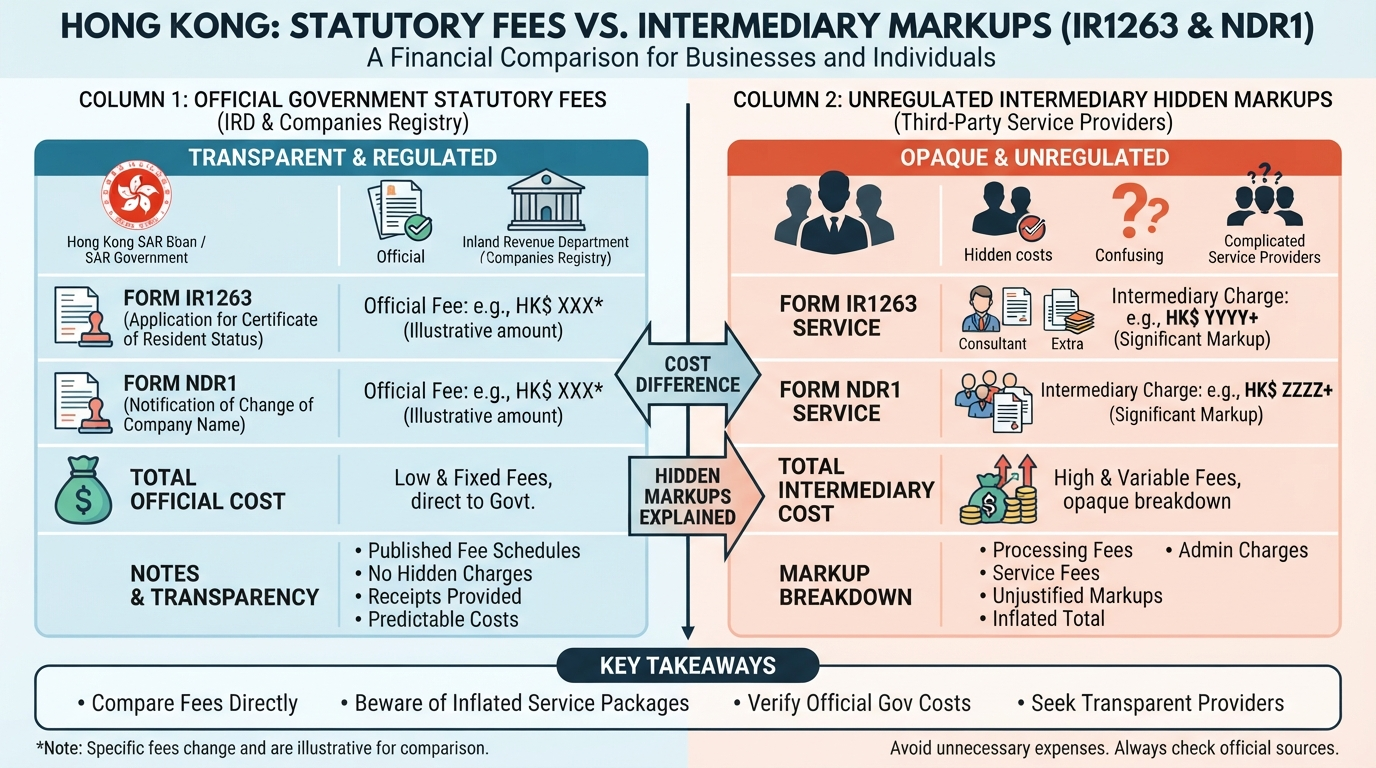
Many international founders fall victim to unregulated corporate brokers who quote artificially low entry prices or inflated bundled packages for corporate maintenance and closure. Below is our empirical cost benchmark comparing statutory official fees against middleman markups across the company lifecycle:
| Statutory Regulatory Item / Requirement | Official Government Fee (Statutory Cost) | Typical Middleman / Broker Quote | Olesen Global Direct Licensed Model (TCSP TC010076) |
|---|---|---|---|
| Form NNC1 Incorporation Filing | HK$1,720 (Paper) / HK$1,545 (e-Registry) | HK$4,500 – HK$6,800 (200%–300% hidden markup) | At exact statutory cost + transparent flat service rate |
| Business Registration Certificate (BRC) | HK$2,150 / HK$2,200 (Annual Levy Rate) | HK$4,800+ (Bundled with unverified shell address fees) | Direct IRD disbursement with zero markup |
| SCR Designated Representative Appointment | HK$0 Government Filing Fee (Internal Register) | HK$2,500 – HK$4,000 separate add-on surcharge | Included in direct licensed secretarial compliance |
| Annual Return (Form NAR1) | HK$105 (On-time filing within 42 days) | HK$1,800 – HK$3,200 artificial “registry handling fee” | Exact HK$105 statutory fee + fixed compliance package |
| Deregistration Filings (Form IR1263 + Form NDR1) | HK$690 Total (HK$270 IRD + HK$420 CR) | HK$8,000 – HK$15,000+ (With non-refundable audit traps) | Exact HK$690 government fee + fixed-fee TCSP execution |
Pre-Deregistration Asset Disposal & The Bona Vacantia Trap (Section 752)
The single greatest financial hazard during Hong Kong company deregistration is failing to dispose of corporate assets before the final dissolution date. Under Section 752 of the Companies Ordinance (Cap. 622), immediately upon dissolution, all property and rights vested in or held on trust for the company automatically become bona vacantia (ownerless goods) and vest legally in the Government of the Hong Kong Special Administrative Region.
Bona Vacantia (Section 752 of Cap. 622): The statutory legal doctrine under which any remaining cash in corporate bank accounts, uncollected refunds, intellectual property, or subsidiary shares still registered in the name of a Hong Kong company at the moment of formal dissolution automatically forfeit to the Hong Kong Government.
Once corporate funds or assets vest in the government as bona vacantia, directors and former shareholders lose all legal standing to access them. Recovering forfeited funds requires petitioning the High Court of Hong Kong for an administrative restoration order under Section 765—a legal process that routinely costs between HK$35,000 and HK$65,000+ in legal fees and court disbursements and takes 6 to 12 months.
| Corporate Asset Class | Compliant Pre-Deregistration Protocol | Consequence of Unsettled Status at Dissolution (Sec. 752) |
|---|---|---|
| Corporate Bank & Fintech Balances | Distribute surplus cash, zero out balance, and secure formal Bank Closure Certificate prior to Form NDR1 filing. | Bank freezes account permanently upon Gazette notice; funds transfer to HK Government Treasury. |
| Registered Trademarks & Patents | Execute formal Deed of Assignment and register ownership transfer with IPD prior to cessation. | IP rights become orphan assets owned by the government; parent group loses legal protection and licensing validity. |
| Equity in Overseas / Mainland Subsidiaries | Complete share transfer instruments, stamp duty clearance, and local registry updates before HK closure. | Subsidiary equity is frozen under a non-existent shareholder; subsidiary cannot change directors, distribute dividends, or close. |
| Tax Refunds & Utility Deposits | Collect all IRD tax overpayments and landlord security deposits before closing the corporate bank account. | Refund checks issued to the dissolved company name cannot be cashed or endorsed to directors. |
Corporate Bank Account Closure Certificate & Balance Distribution
Just as Bank Account Opening in Hong Kong requires rigorous KYC and AML verification (where our pre-screening protocol achieves a 12-business-day turnaround compared to the industry average of 28 days), closing a corporate bank account requires strict documentary sequencing.
Directors must never close the corporate bank account before paying final audit fees, tax liabilities, or receiving anticipated IRD tax refund checks. Conversely, the account must be completely zeroed out and officially closed before the Companies Registry publishes the final dissolution notice in the Gazette.
To execute a compliant bank closure:
- Board Resolution Authorizing Account Closure: Signed in strict accordance with the bank mandate on file.
- Final Balance Distribution: Transferring any remaining cash to shareholders as a return of capital or final dividend prior to the cessation audit cut-off date.
- Official Bank Account Closure Confirmation Letter: Request a written certificate or final zero-balance closing statement from the bank (e.g., HSBC, Standard Chartered, Hang Seng, or Airwallex). Keep this document in the statutory file for at least 6 years to prove proper disposal of company bank account assets.
Intellectual Property Assignments & Subsidiary Share Transfers
Many international holding structures use a Hong Kong entity to hold global brand assets or equity in Mainland China (WFOE) and Southeast Asian subsidiaries. Before initiating deregistration, the company must legally divest all intangible assets:
- Trademark & Patent Assignments: If the company owns registered trademarks in Hong Kong or abroad, it must execute a formal Deed of Assignment transferring ownership to another active group entity or individual. Filing the ownership transfer through professional Trademark Registration specialists ensures the Intellectual Property Department updates the register prior to company dissolution.
- Subsidiary Share Transfers: If the Hong Kong company holds shares in another Hong Kong company, Instruments of Transfer and Bought and Sold Notes must be submitted to the Stamp Office for adjudication and stamping before the parent entity dissolves.
Statutory Timelines, Gazette Notices, and Ongoing Compliance Obligations
From the moment the board signs the cessation resolution to the final publication in the Government Gazette, the end-to-end Hong Kong company deregistration timeline typically spans 6 to 9 months.
Understanding how deregistration fits into the broader corporate compliance calendar prevents accidental penalties. Below is the complete 4-Step Statutory Lifecycle Roadmap alongside a 3-Year Compliance Maintenance Financial Forecast illustrating when companies transition from active maintenance to formal closure:
Statutory Lifecycle & Compliance Roadmap
Statutory Roadmap
Inception & Formation
- Appointment & Form NNC1
- SCR Register Creation
Operations & Governance
- Board Resolutions & Registers
- 15-Day Statutory Event Updates
Anniversary Filings
- Annual Return (Form NAR1)
- 42-Day Regulatory Window
Audit, Tax & Dissolution
- BR Renewal & Profits Tax Return
- IR1263 & NDR1 Dissolution
| Corporate Lifecycle Stage | Core Statutory Filings Required | Statutory Authority | Compliance Objective |
|---|---|---|---|
| Year 1: Incorporation & SCR Setup | Form NNC1, Initial BRC, Significant Controllers Register (SCR), First Board Minutes | Companies Registry & IRD | Establish legal entity and AML/CTF beneficial ownership transparency under Cap. 622. |
| Year 2: NAR1 & BR Renewal | Annual Return (Form NAR1 within 42 days), Annual Business Registration Renewal, First Audit (18th Month) | Companies Registry & IRD | Maintain active good standing and submit initial statutory financial audit. |
| Year 3: Statutory Audit, Tax & Optional Dissolution | Profits Tax Return (BIR51) under Cap. 112; OR Cessation Audit + Form IR1263 + Form NDR1 if closing | IRD & Companies Registry | Settle annual tax obligations or execute clean Section 750 deregistration before next BRC cycle. |
Once Form NDR1 is accepted by the Companies Registry, the registrar issues a formal approval letter and publishes the first Hong Kong Gazette Dissolution Notice. This publication opens a strict 3-month public objection window.
During this 3-month window, any creditor, shareholder, or government department (such as the IRD or Labour Department) may lodge a written objection if they discover an unpaid debt or unfulfilled statutory duty. If zero objections are received after 3 months, the Registrar publishes a second and final Gazette notice declaring the company officially dissolved.
Critical Ongoing Compliance Rule: While waiting for the 3-month Gazette window to expire, the company remains a legally existing corporate entity. Consequently:
- Annual Return (Form NAR1) Mandatory Filing: If the company’s incorporation anniversary falls at any point before the final Gazette notice is published, the company must still file Form NAR1 and pay the HK$105 fee within 42 days. Failing to file Form NAR1 during the deregistration window triggers late penalties ranging from HK$870 to HK$3,480 and halts the dissolution process.
- Business Registration Renewal Waiver Timing: If the company submits Form IR1263 to the IRD before the expiry date of its current Business Registration Certificate, the IRD generally waives the requirement to pay the upcoming year’s Business Registration renewal fee—provided the company does not resume business.
- 6-Year Statutory Record Retention (Section 758): Even after the final Certificate of Deregistration is issued, every person who was a director immediately before dissolution is legally required under Section 758 of Cap. 622 to retain all corporate books, accounting vouchers, bank statements, and statutory registers for at least 6 years after the date of dissolution.
Why Direct Execution by a Licensed TCSP Protects Corporate Directors
Under the Anti-Money Laundering and Counter-Terrorist Financing Ordinance (Cap. 615), only an entity holding an active Trust or Company Service Provider (TCSP) license issued by the Hong Kong Companies Registry is legally permitted to act as a company secretary or manage statutory registry filings in Hong Kong.
Olesen Global anchors its corporate advisory practice in four verifiable pillars: TCSP License TC010076, direct Hong Kong headquarters execution, dedicated compliance officers, and zero hidden statutory disbursement markups. Our resident Hong Kong compliance officers and chartered corporate secretarial personnel manage end-to-end statutory dissolutions across cross-border structures directly from compliant commercial premises in Hong Kong.
“When overseas directors hire an unlicensed offshore marketing agency to close their Hong Kong company, their confidential financial statements and identity documents are subcontracted across multiple layers of third-party brokers. If the IRD raises a technical query on an intercompany balance, unlicensed middlemen simply abandon the file—leaving the foreign director exposed to court summonses without representation.”
— Head of Regulatory Compliance & Secretarial Practice, Olesen Global
Before authorizing any service provider to handle your company’s deregistration documents, use this 3-Step Official TCSP Anti-Middleman Verification Guide to confirm their legal standing:
- Step 1: Access the Official Government Registry Portal: Visit the Hong Kong Companies Registry TCSP Public Register directly at https://www.tcsp.cr.gov.hk/.
- Step 2: Execute a License & Entity Query: Enter TCSP License No. TC010076 or search the licensee name “Olesen Global” in the official search interface.
- Step 3: Verify Active Status & Direct Address Match: Confirm the license status displays as “Active” and verify that the registered office address on the government portal matches the designated secretarial address on your corporate documents—confirming zero third-party broker subcontracting.
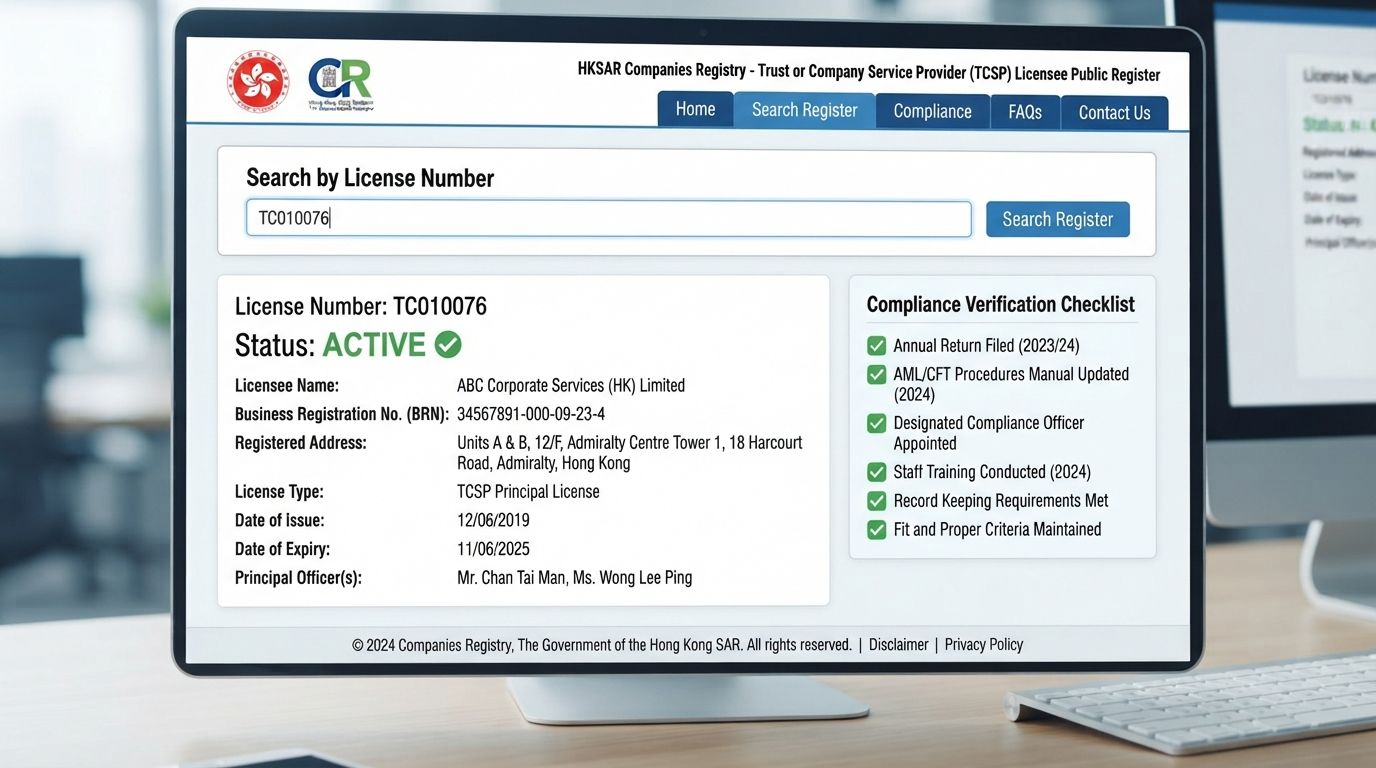
Executing this verification protects your board against three widespread middleman vulnerabilities:
- Unlicensed Subcontracting Markups: Offshore brokers mark up statutory audit and tax clearance fees by 200% to 300% while passing your documents to unknown local sub-agents.
- Unregistered Nominee Shell Addresses: Unlicensed agents frequently bundle virtual P.O. boxes or non-compliant residential addresses, causing official IRD tax clearance notices (IR1263) to be returned undelivered.
- Non-Refundable Pre-Clearance Promises: Brokers collect full deregistration fees upfront without diagnosing historical tax defaults, refusing refunds when the IRD blocks the application.
Frequently Asked Questions on Hong Kong Company Deregistration Documents
What is the difference between formal Hong Kong company deregistration and simply letting a company lapse without renewal?
Letting a Hong Kong company lapse by abandoning annual returns and Business Registration renewals is a statutory offense. The Companies Registry and Inland Revenue Department will issue cumulative court summonses, statutory penalties, and criminal liability against company directors. Formal deregistration under Section 750 of the Companies Ordinance provides a legally binding, clean dissolution that completely releases directors from ongoing statutory exposure.
How can an overseas founder verify if an advisory firm is legally licensed to file deregistration documents in Hong Kong?
Under Hong Kong law, any agent providing company secretarial or dissolution services must hold a valid Trust or Company Service Provider (TCSP) license issued by the Companies Registry. Overseas directors can verify the license status by checking the public TCSP Register on the Hong Kong Companies Registry portal. Olesen Global operates under TCSP License TC010076 with direct physical operations in Hong Kong.
What happens to the company’s bank account balances once the deregistration process begins?
All corporate bank accounts must be settled and formally closed prior to the publication of the final Gazette notice. Upon formal dissolution, any remaining assets, bank accounts, or uncollected funds immediately become bona vacantia and vest legally in the Hong Kong Government, requiring expensive High Court restoration procedures to recover.
Can a Hong Kong company apply for deregistration without an audit if it never opened a bank account?
Yes, provided the company strictly never commenced business operations, never issued an invoice, never signed a commercial contract, and never opened a bank or fintech account since the date of incorporation. In this scenario, the company may file a “Nil” Profits Tax Return alongside a formal director’s declaration of “Never Commenced Business” when submitting Form IR1263. However, if the company conducted even a single commercial transaction—even via a director’s personal account or an overseas group account—a final CPA audit report up to the date of business cessation is legally mandatory.
Initiate Your Compliant Hong Kong Company Dissolution with Olesen Global
Closing a Hong Kong limited company demands exact coordination between your corporate secretary, CPA auditors, and tax assessors. Missing a single cessation audit cut-off date or leaving a bank account open during Gazette publication can expose directors to unnecessary penalties or permanent asset loss.
Olesen Global streamlines corporate dissolution into a friction-free, 3-step execution path for international directors and cross-border enterprise groups:
- Step 1: Submit company registration details for a statutory liability and tax status diagnostic.
- Step 2: Receive a tailored documentation checklist and fixed-fee dissolution execution plan from a licensed compliance advisor.
- Step 3: Authorize direct TCSP execution for IR1263 clearance, NDR1 registry filing, and gazette tracking.
Ready to close your non-operational Hong Kong entity with complete regulatory certainty? Consult a Licensed Compliance Specialist at Olesen Global today to request a complimentary statutory compliance diagnostic and customized deregistration document checklist from a licensed compliance specialist.