Core Vehicle Architectures: Cayman SPC vs BVI PIF vs Hong Kong OFC/LPF
An offshore company for fund management serves as the statutory operational hub that isolates investment risk, centralizes management fees, and optimizes cross-border capital flow between allocators and target portfolio assets. Selecting the appropriate legal form dictates your reporting burdens, institutional capital readiness, and regulatory overhead.
An offshore company for fund management is a legally incorporated corporate or partnership entity established in a tax-neutral jurisdiction (such as the Cayman Islands, BVI, or Hong Kong) structured specifically to manage, advise, or pool assets within collective investment schemes.
Fund sponsors evaluate jurisdictions across three primary operational dimensions: statutory ring-fencing capabilities, institutional investor familiarity, and setup velocity. Structuring mistakes made at inception often result in costly corporate restructuring when onboarding institutional Limited Partners (LPs).
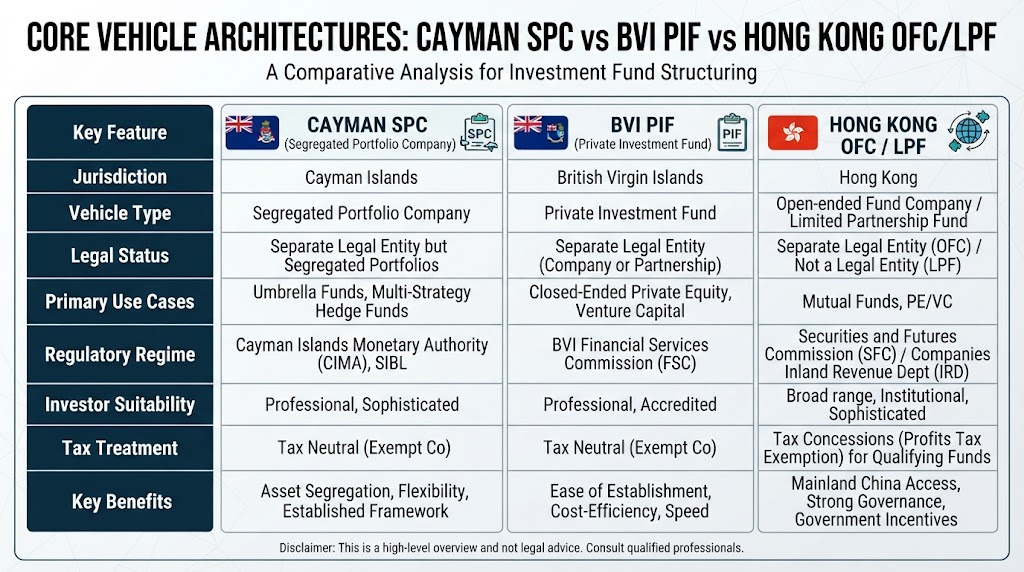
| Vehicle Type | Primary Governing Authority | Structural Segregation | Typical Strategy Focus | Average Formation Speed |
|---|---|---|---|---|
| Cayman Islands SPC | Cayman Islands Monetary Authority (CIMA) | Statutory cell insulation across multi-portfolios | Hedge Funds, Multi-Strategy, Crypto/Web3 | 2-3 Weeks |
| BVI Private Investment Fund (PIF) | BVI Financial Services Commission (FSC) | Standard corporate shield / optional SPC structure | Emerging Managers, Early-Stage VC | 1-2 Weeks |
| Hong Kong Open-ended Fund Co. (OFC) | Hong Kong Securities and Futures Commission (SFC) | Statutory sub-fund liability ring-fencing | APAC Public Equities, Fixed Income, Hedge | 4-6 Weeks |
| Hong Kong Limited Partnership Fund (LPF) | Companies Registry / SFC Oversight | Contractual allocation via GP/LP framework | Private Equity, Real Estate, Venture Capital | 1-2 Weeks |
The Cayman Islands SPC remains the gold standard for global allocators, managing over 70% of offshore alternative investment assets worldwide. However, Hong Kong OFCs and LPFs have seen a 42% compound annual growth rate in new registrations among Asian asset managers looking to leverage government grant subsidies that cover up to 70% of eligible local formation expenses.
Hybrid Master-Feeder Models: Bridging Offshore Vehicles with Hong Kong Sub-Funds
Sophisticated asset managers rarely rely on a single isolated entity. Cross-border capital deployment requires an integrated blueprint that balances Western LP familiarity with Asian market accessibility.
The Nexus-Triad Structuring Methodology
To eliminate tax leakage and dual-layer compliance overhead, institutional managers apply the Nexus-Triad Structuring Methodology. This framework divides operations into three distinct tiers:
- The Pooling Tier (Master Vehicle): An offshore tax-neutral master fund (e.g., Cayman SPC) holding master assets and derivatives books.
- The Allocation Tier (Feeder Vehicles): Domiciled feeders tailored to investor geography—a US LP feeder, an offshore tax-exempt feeder, and an Asian onshore feeder such as a Hong Kong OFC sub-fund.
- The Management Tier (Operating Nexus): A specialized management entity incorporated via direct Hong Kong Company Registration holding operational substance and directing portfolio execution.
For example, a Web3 quantitative hedge fund team operating out of Hong Kong’s Cyberport ecosystem can pool global institutional capital in a Cayman SPC while managing quantitative algorithms and regional trade execution through a fully registered Hong Kong advisory company. This architecture preserves capital neutrality while providing full compliance with local regulatory authorities.
Regulatory Compliance & Licensing: SFC Type 9 vs Offshore Manager Exemptions
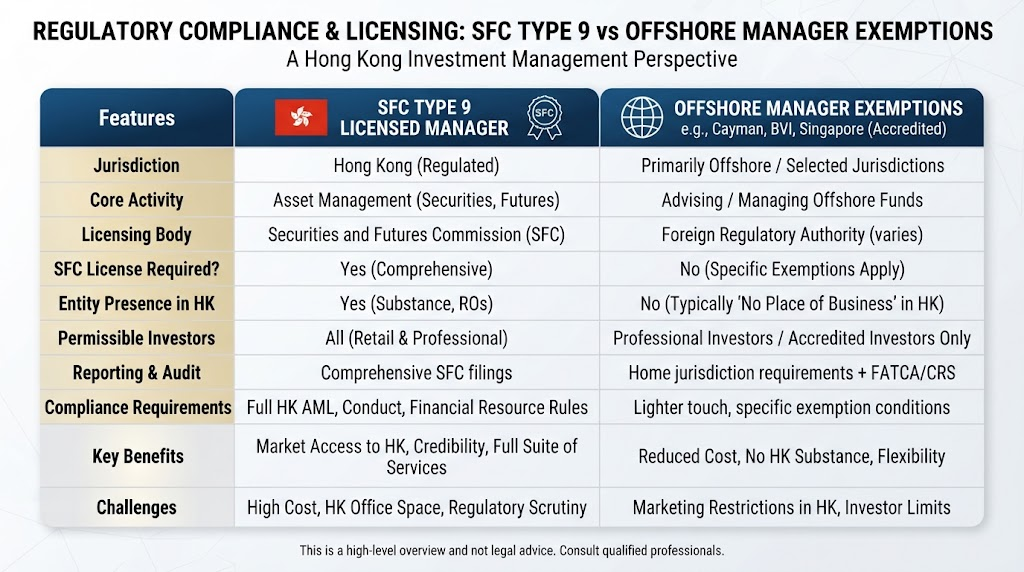
Operating a fund management entity requires navigating clear statutory thresholds between onshore asset management licensing and offshore manager exemption frameworks.
“Regulatory enforcement across Asian financial centers has pivoted decisively toward physical operational nexus. If investment decisions and discretionary trade orders originate in Hong Kong, managers cannot hide behind offshore corporate shields without triggering local SFC licensing requirements.”
— Senior Regulatory Compliance Counsel, Hong Kong Asset Management Forum
If management personnel operate within Hong Kong and exercise discretionary investment authority, the management company must typically obtain a Type 9 (Asset Management) License from the SFC. Conversely, pure offshore fund managers who delegate non-discretionary research or advice to a local team can leverage streamlined frameworks:
- CIMA Registered Person Regime: Governed by the Cayman Securities Investment Business Act (SIBA). Suitable for entities managing funds exclusively for institutional, high-net-worth, or sophisticated investors without a retail public offering.
- BVI Approved Manager Regime: A cost-efficient framework for emerging managers with aggregate assets under management (AUM) caps of $400 million for closed-ended funds and $100 million for open-ended funds.
- Hong Kong Private Fund Manager Carve-Outs: Specific scenarios where a fund manager oversees wholly owned private group assets or single-family assets without offering third-party advisory services.
Economic Substance (ESR), AEOI, and Tax Residency Realities
Global regulatory pressure has rendered nominal, unmanaged shell companies obsolete. Both the Cayman Islands and the British Virgin Islands mandate strict compliance under their respective Economic Substance Regulations.
Entities conducting fund management business as a relevant activity must satisfy the Economic Substance Test by demonstrating that Core Income Generating Activities (CIGA) occur within the jurisdiction of incorporation. This includes:
- Taking decisions on the holding and selling of investments.
- Calculating risk profiles and monitoring portfolio exposures.
- Taking decisions on currency and interest fluctuations.
- Preparing regulatory and investor disclosures under relevant guidelines from the Cayman Islands Monetary Authority.
In practice, many fund sponsors choose to hold the investment fund entity offshore (which is generally excluded from heavy substance burdens as a pure investment fund vehicle) while establishing the investment management company in Hong Kong. Under Hong Kong’s Unified Funds Tax Exemption (UFE) regime, profits generated by qualifying transactions carried out by a specified investment fund are exempt from Hong Kong Profits Tax (standard rate: 16.5%), provided statutory requirements are satisfied.
Furthermore, all fund entities must establish annual automated reporting protocols under the Foreign Account Tax Compliance Act (FATCA) and the Common Reporting Standard (CRS) to maintain standing with international financial networks.
Fund Banking Rails & Custody: Overcoming Institutional Onboarding Bottlenecks
Securing institutional bank accounts and prime brokerage clearing connections is often the single longest operational bottleneck for new fund platforms. Unvetted fund structures regularly face onboarding reviews extending beyond 6 to 9 months.
Institutional tier-1 and digital private banks enforce rigorous Anti-Money Laundering (AML) and Know-Your-Customer (KYC) compliance when reviewing fund structures. Approval hinges on three primary criteria:
- Transparency of Beneficial Ownership: Clear identification of Ultimate Beneficial Owners (UBOs) holding 10% or more equity, backed by audited source-of-wealth documentation.
- Independent Governance: Appointment of experienced, independent directors and verified third-party fund administrators.
- TCSP Verification: Backing by a licensed corporate service provider to guarantee corporate status, register integrity, and certified KYC dossiers.
By engaging institutional Bank Account Opening Services through a verified TCSP provider, fund managers can bypass retail clearing bottlenecks and secure multi-currency capital call, custody, and operational disbursement accounts within a predictable 4-to-8-week window.
Corporate Governance Lifecycle: Statutory Secretarial, NAV, and Annual Audit Protocols
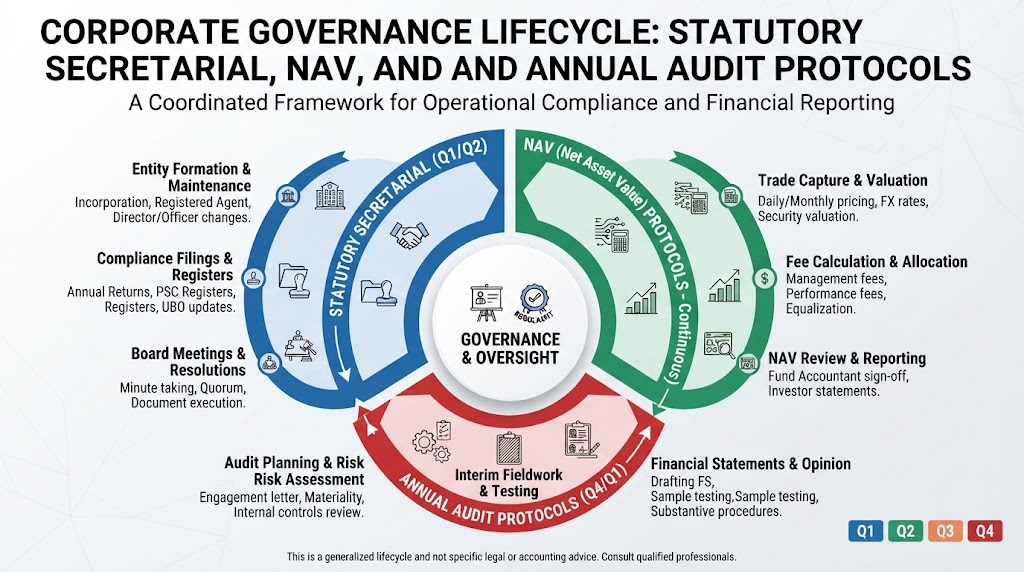
Maintaining institutional standing requires ongoing statutory and corporate governance across the fund management lifecycle.
“Institutional capital demands continuous operational integrity. LPs do not pull capital due to market volatility alone; they pull capital when fund administrators fail NAV delivery or when statutory filings lapse.”
— Head of Operational Due Diligence, Global Sovereign Allocator Network
Ongoing maintenance involves three mandatory operational pillars:
- Licensed Statutory Secretarial Representation: Every corporate structure requires an officially appointed secretary. Engaging licensed Company Secretary Services guarantees compliance with Significant Controllers Registers (SCR), annual returns, and statutory board resolutions.
- Fund Administration & NAV Calculation: Independent calculation of monthly or quarterly Net Asset Value, capital call issuance, management and performance fee reconciliations, and LP statement distributions.
- Annual Audit & Tax Filing: Rigorous statutory audits executed under IFRS or HKFRS standards. Coordinated Accounting & Audit Services ensure timely submissions to the Inland Revenue Department (IRD) or offshore regulatory bodies without incurring statutory penalties.
Direct TCSP Execution vs Intermediary Layering: Eliminating Structural Risk
When launching an investment vehicle, many emerging managers mistakenly engage unlicensed retail agents or middleman brokers. This introduces severe structural vulnerabilities, inflated sub-agent markups, and delayed execution.
Working directly with a primary, licensed Trust or Company Service Provider—such as Olesen Global (TCSP License: TC010076)—removes intermediary risk by ensuring every filing, board charter, and banking application is executed directly by qualified professionals with physical offices in Hong Kong.
| Execution Dimension | Direct TCSP (Olesen Global TC010076) | Unlicensed Intermediary / Broker |
|---|---|---|
| Statutory Licensing | Directly licensed by HK Registry (TC010076) | None (resells third-party services) |
| Fee Transparency | Direct institutional pricing without middleman markups | Multi-tier markups (often 40-100% higher) |
| Execution Timeline | 1-on-1 dedicated manager tracking; direct filings | Information relay delays; fragmented accountability |
| Data Confidentiality | Strict institutional data privacy protocols | Data shared across unvetted broker networks |
Institutional Fund Manager Deployment Checklist
- Phase 1: Structure Architecture — Determine open-ended vs closed-ended vehicle and LP tax nexus.
- Phase 2: Management Registration — Complete corporate registration for the management entity and establish TCSP standing.
- Phase 3: Fund Incorporation — Draft private placement memorandum (PPM), subscription documents, and articles of association.
- Phase 4: Banking & Custody Rails — Submit AML/KYC dossiers for multi-currency operational and custody accounts.
- Phase 5: Regulatory Compliance — Register with relevant bodies (CIMA/SFC), complete FATCA/CRS setup, and execute ESR declarations.
Frequently Asked Questions: Offshore Fund Management Structuring
What is the primary difference between a Cayman SPC and a Hong Kong OFC?
A Cayman Segregated Portfolio Company (SPC) is an offshore umbrella entity that creates legally ring-fenced sub-portfolios under Cayman corporate law, recognized worldwide by institutional allocators. A Hong Kong Open-ended Fund Company (OFC) provides a similar corporate umbrella structure under Hong Kong law with statutory sub-fund segregation, but benefits from local Hong Kong government subsidies, direct Asian market proximity, and potential profit-tax exemptions under the Unified Funds Exemption (UFE).
Can an offshore fund manager operate in Hong Kong without an SFC Type 9 license?
Operating in Hong Kong without an SFC license is only permissible if the local entity strictly confines its operations to non-discretionary investment research, back-office administration, or intra-group advisory services without engaging in active asset management for third parties. If personnel in Hong Kong exercise discretionary investment decision-making, an SFC Type 9 license is required by law.
How long does it take to open a bank account for an offshore fund vehicle?
Standard onboarding through retail or unvetted broker channels can take between 4 to 9 months due to heightened institutional AML/KYC checks. When executed directly by a licensed TCSP provider with fully compiled compliance dossiers, institutional accounts can typically be approved within 4 to 8 weeks.
What are the ongoing compliance obligations for an offshore fund management company?
Mandatory obligations include maintaining an active licensed corporate secretary, annual registered office renewals, annual statutory audits under IFRS/HKFRS, FATCA and CRS tax information exchange reporting, and annual economic substance declarations (ESR) with the relevant monetary authority.
Initiate Your Compliant Fund Management Structure with Olesen Global
Navigating the intersection of offshore flexibility and Hong Kong statutory compliance requires direct, licensed expertise. Olesen Global provides first-hand corporate formation, statutory secretarial governance, accounting, and institutional banking integration directly from our physical Hong Kong headquarters.
Ready to Structure Your Investment Fund Vehicle?
Eliminate middleman fees and regulatory bottlenecks. Consult directly with our licensed TCSP specialists to establish your Cayman, BVI, or Hong Kong fund platform with complete banking and audit integration.