Navigating Multi-Currency Accounting Under Hong Kong Regulatory Standards
Multi-currency bookkeeping for Hong Kong companies requires converting all foreign transactions into a designated functional currency using spot exchange rates on transaction dates, revaluing monetary items at closing rates, and separating realized trading gains from balance-sheet translation movements. This accounting process ensures statutory alignment with HKFRS 21 The Effects of Changes in Foreign Exchange Rates and prevents audit modifications during mandatory annual filings.
Global trading houses, software enterprises, and cross-border retailers routinely utilize Hong Kong as their regional treasury center. The territory imposes no foreign exchange controls, allowing unrestricted movement of funds across international banking corridors.
However, running transactions across multiple foreign denominations creates complex regulatory liabilities under the Hong Kong Companies Ordinance (Cap. 622). Routine bookkeeping software rarely accounts for Hong Kong’s specific statutory framework.

“Multi-Currency Bookkeeping is the structured process of recording, tracking, and translating commercial transactions across multiple foreign denominations into a single functional currency, ensuring compliance with local accounting standards and statutory reporting obligations.”
International entities registered via Hong Kong Company Registration must maintain proper books of account that reflect a true and fair view of the company’s financial transactions. Surface-level bookkeeping records inputs and outputs; statutory accounting prepares those figures for rigorous scrutiny by the Hong Kong Institute of Certified Public Accountants (HKICPA) and the Inland Revenue Department.
The Strategic Framework: Evaluating Multi-Currency Bookkeeping Providers
Founders often make the mistake of choosing a provider based simply on software subscriptions or baseline hourly rates. Evaluating corporate service providers requires assessing their ability to build audit-proof ledgers across international payment corridors.
To eliminate compliance errors, businesses should apply the Quad-Vector Multi-Currency Reconciliation Methodology (QV-MRM). This framework evaluates bookkeeping capabilities across four operational pillars:
- HKFRS 21 and IRD Source Rules Alignment: Accurate separation of foreign currency transactions at historical, daily closing, and average spot rates, eliminating arbitrary conversion shortcuts.
- Direct CPA-Led Audit Coordination: Seamless transition from monthly management accounts to annual statutory review, eliminating the administrative friction created by third-party broker networks.
- Multi-Rail Gateway Integration: Proven operational capacity to reconcile high-volume payment processors (such as Stripe and PayPal) alongside modern fintech rails (Airwallex, Wise) and Tier-1 commercial banks.
- Volume-Tied Pricing Architecture: Transparent billing structures based strictly on transactional load and batch complexity, without hidden conversion surcharges or foreign-currency line-item markups.
“Statutory accounts in Hong Kong fail audit tests not because business logic is broken, but because foreign exchange variations are lumped into arbitrary expense lines rather than segregated under HKFRS 21 rules.”
— Senior Audit Practice Director, Hong Kong Institute of Certified Public Accountants (HKICPA)
When selecting professional Accounting & Audit Services, ensuring direct technical competence across these four vectors safeguards your firm against substantial statutory reporting headaches.
Statutory Foundations: Functional Currency Determination Under HKAS 21 and Cap. 622
A critical initial step under Hong Kong accounting standards is establishing the company’s Functional Currency vs Presentation Currency. These two classifications serve distinct technical functions within statutory reports.
Under HKAS 21 (aligned with HKFRS 21), a company’s functional currency is the currency of the primary economic environment in which it operates. The presentation currency is simply the currency in which the financial statements are presented to directors, shareholders, and regulatory authorities.
| Evaluation Dimension | Functional Currency (HKAS 21.9) | Presentation Currency (HKAS 21.38) |
|---|---|---|
| Core Determination Factor | Mainly influences sales prices for goods/services and operating costs (labor, raw materials). | Freely elected by the company’s board of directors for corporate reporting purposes. |
| Statutory Revaluation Mandate | Mandatory at reporting date: monetary items translated at closing rates; non-monetary items at historic rates. | Assets and liabilities translated at closing rates; income and expenses translated at transaction rates. |
| Treatment of FX Variances | Recognized directly within the Profit and Loss statement (P&L) as operating foreign exchange gains/losses. | Recognized within Other Comprehensive Income (OCI) and accumulated in a separate reserve. |
| IRD Profits Tax Assessment | Forms the baseline ledger for evaluating taxable commercial revenue and assessable profits. | Converted to HKD for the statutory Inland Revenue Department HK Profits Tax Return submission. |
Section 379 of the Hong Kong Companies Ordinance requires directors to lay financial statements before the annual general meeting that comply with applicable accounting standards. If an e-commerce firm makes 90% of its sales in USD and incurs inventory costs in USD, USD serves as its functional currency—even if registered in Hong Kong.
Electing the correct functional currency mitigates wild paper swings in profitability caused by currency conversions. This keeps corporate ledgers stable and clean throughout the accounting period.
Statistical Insights: FX Exposure, Audit Delays, and IRD Penalties in Global Trading
Managing multi-currency operational ledgers presents significant compliance hurdles for global business owners. Data gathered from regional cross-border commerce audits highlights recurrent vulnerabilities across non-resident enterprises:
- 65% Audit Delay Incidence: More than 65% of cross-border SMEs operating in Hong Kong face significant audit delays during their annual reviews due to unreconciled multi-currency balance clearing accounts.
- 12% to 28% Profit Discrepancies: Inaccurate application of foreign exchange rates across multi-currency channels generates between 12% and 28% variances between provisional internal figures and final audited tax positions.
- Section 82A Assessment Penalties: Failure to correctly disclose taxable currency variations on the annual Profits Tax Return (BIR51) can trigger penalties of up to 300% of undercharged tax liabilities under Section 82A of the Inland Revenue Ordinance.
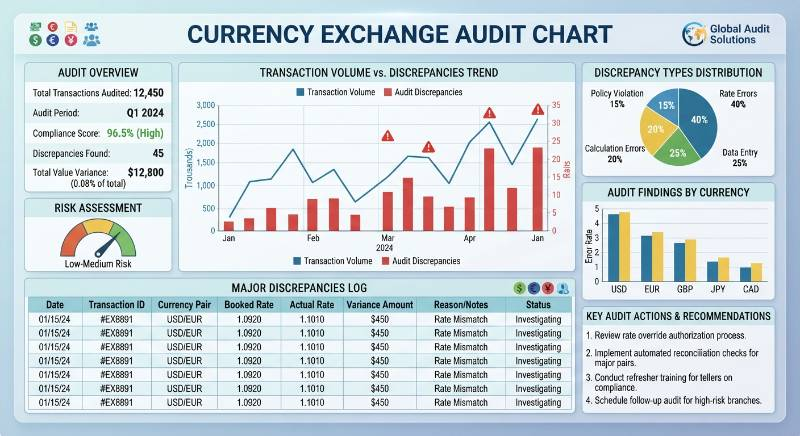
These audit delays typically cascade into missed filing deadlines with the Inland Revenue Department. That breakdown leads to estimated tax assessments, compound penalty interest, and forfeited tax allowances.
Operational Ledger Reconciliation Across Global Banking Rails and Gateways
International corporate operating models require managing diverse financial infrastructure. Founders routinely balance physical bank accounts alongside virtual accounts and digital processors.
Securing a Hong Kong Bank Account Opening with institutions like HSBC or Standard Chartered gives companies access to Tier-1 infrastructure. However, daily international sales often flow through alternative fintech rails.
| Banking / Payment Rail | Primary Currency Holding Capabilities | FX Settlement Timelines | Core Bookkeeping Complexity |
|---|---|---|---|
| Tier-1 Commercial Banks (HSBC, SCB) | 11+ Global Currencies (HKD, USD, EUR, GBP, JPY, CNH, AUD, etc.) | Immediate conversion or segregated multi-currency sub-ledger holding | Handling complex monthly physical bank statements and inter-account sweep transactions. |
| Fintech Infrastructure (Airwallex, Wise) | 40+ Local Clearing Corridors and Multi-Currency Wallets | On-demand programmatic clearing via interbank wholesale spot rates | Matching high-frequency micro-transactions with high-volume digital merchant settlement feeds. |
| Merchant Gateways (Stripe, PayPal) | Multi-Currency checkout with unified batch payouts | Rolling T+2 to T+7 batch settlement transfers to operating accounts | Accurately separating native transaction fees, refund reversals, and gross revenue lines. |
To keep multi-rail operations clean and ready for statutory audits, finance teams should complete this standard operational reconciliation routine monthly:
- Verify opening and closing balances across all foreign currency physical and virtual accounts.
- Extract gross settlement transaction files from payment gateways, isolating processing charges from net sales.
- Reconcile inter-entity sweeps and internal ledger movements to eliminate phantom revenue spikes.
- Apply historical spot conversion rates to real-time asset purchases and revenue entries.
- Post end-of-period HKFRS 21 revaluation entries for all foreign-denominated assets and liabilities.
Niche Scenario: High-Volume E-Commerce and Web3 Entities Handling 5+ Currencies
High-volume cross-border setups present acute bookkeeping challenges. Consider an e-commerce retailer selling through Shopify and Amazon across the US, UK, Eurozone, and Japan, while holding liquid operational reserves in stablecoins or traditional currencies.
This operational footprint involves five or more currencies simultaneously: customer payments in USD, EUR, and GBP; supplier disbursements in CNH; local operational expenditures in HKD; and treasury reserves held in USDT or USDC.
Unlicensed bookkeeping agencies often fail to reconcile these multi-channel footprints. They tend to record only the net payout hitting the primary bank account, completely obscuring gross turnover, merchant interchange deductions, and currency slippage.
This accounting error distorts the company’s gross profit margins and triggers detailed inquiries during annual compliance reviews. In Web3 environments, stablecoin conversions to fiat must also be matched with precise timestamped cryptographic valuations to prevent audit discrepancies.
Olesen Global operates as a first-hand Hong Kong corporate services provider with an active Trust or Company Service Provider license (Licence No. TC010076). Backed by in-house accounting specialists and practicing CPAs, Olesen Global reconciles high-volume multi-currency books directly in Hong Kong, preventing downstream broker outsourcing and ensuring 1-on-1 end-to-end multi-currency audit trail management.
Tax Assessment Under IRD Section 14: Realized vs. Unrealized FX Fluctuations
Under Section 14 of the Inland Revenue Ordinance (Cap. 112), Hong Kong Profits Tax applies to every person carrying on a trade, profession, or business in Hong Kong regarding assessable profits arising in or derived from the territory.
However, foreign currency movements introduce distinct tax considerations. The Inland Revenue Department establishes a clear boundary between capital-nature and revenue-nature currency fluctuations, as detailed in Departmental Interpretation and Practice Notes (DIPN) No. 42.
“Foreign exchange gains and losses are assessed for Hong Kong profits tax strictly on revenue versus capital characterization. Operational trading currency gains are assessable upon realization, while paper balance-sheet adjustments are deductible or taxable only when aligned with approved statutory tax accounting methods.”
— Senior Tax Consultant, Hong Kong Practicing CPA Review Board
The core tax principles apply as follows:
- Realized Foreign Exchange Gains/Losses (Revenue Nature): Gains or losses stemming from day-to-day commercial activities (settling trade payables or collecting customer receivables) are fully taxable or deductible under Hong Kong Profits Tax (taxed at 8.25% on the first HKD 2 million of assessable profits, and 16.5% thereafter under the two-tiered regime).
- Unrealized Foreign Exchange Fluctuations (Paper Entries): Balances revalued on balance sheet dates using year-end closing rates represent unrealized paper swings. For tax assessment, unrealized entries must be appropriately tracked; capital-derived unrealized variances are non-assessable and non-deductible.
- Capital Transactions: Foreign exchange swings on funds held for long-term capital investments or foreign-currency loans secured for capital equipment purchases are non-taxable, as Hong Kong levies no tax on capital gains.
Improper classification of these entries can lead to overpaying profits tax on capital currency appreciation or facing penalties for claiming unsupported revenue losses.
Building Multi-Currency Audit Trails to Defend Offshore Profits Tax Exemption
Many international companies use Hong Kong entities while conducting operations entirely outside the territory, often applying for an Offshore Profits Tax Exemption (claiming zero percent profits tax under Hong Kong’s territorial tax system).
The IRD scrutinizes offshore exemption claims through detailed letters of inquiry. Defending an offshore claim requires producing a verifiable multi-currency audit trail that tracks contracts, payments, and settlements step-by-step.
If a Hong Kong business claims offshore status but settles transactions using non-resident corporate banking rails, the IRD will analyze the exact currency routes. Auditors review the origin of incoming buyer funds and trace disbursements to supplier jurisdictions.
Maintaining a clear multi-currency paper trail proves that operational management, customer sales, and procurement took place entirely outside Hong Kong. Clean ledgers help ensure your offshore tax defense holds up during audits.
The Intermediary Trap: Unlicensed Brokers vs. Direct First-Hand TCSP Providers
The corporate services sector includes many intermediary brokers. Many generic online agencies lack statutory licenses in Hong Kong, instead outsourcing accounting work to downstream sub-agencies.
This layered setup creates operational issues for businesses with multi-currency accounts:
- Inflated Multi-Currency Surcharges: Unlicensed intermediaries often charge arbitrary markup fees for every added currency account, sub-wallet, or foreign bank ledger.
- Disjointed Audit Coordination: Intermediaries often handle day-to-day bookkeeping using external clerks without oversight from practicing CPAs. When annual statutory audits arrive, accounts require extensive rework, doubling client costs.
- Regulatory Non-Compliance: Handing corporate accounting documents to unlicensed third parties creates data security and anti-money laundering risks under the Anti-Money Laundering and Counter-Terrorist Financing Ordinance.
Olesen Global is a verified Trust or Company Service Provider license holder (Licence No. TC010076) overseen by the Hong Kong Companies Registry. Our physical headquarters in Hong Kong houses in-house corporate secretarial, accounting, and audit professionals.
Partnering directly with a licensed provider gives international companies reliable corporate governance, including direct Company Secretary Services, without middleman markup fees.
Frequently Asked Questions About Hong Kong Multi-Currency Accounting
Can automated cloud bookkeeping software replace a licensed Hong Kong accounting provider?
While cloud software like Xero or QuickBooks automates day-to-day entries, the Hong Kong Companies Ordinance (Cap. 622) mandates that every private limited company must submit annual accounts audited by a registered, practicing Hong Kong Certified Public Accountant (CPA). Automated tools often fail to correctly classify unrealized foreign exchange gains under HKFRS 21, resulting in CPA audit adjustments or IRD scrutiny. Engaging a direct TCSP-licensed provider like Olesen Global ensures ledgers remain audit-ready from day one.
How does the IRD determine tax liability on foreign currency gains and losses?
The Inland Revenue Department evaluates foreign exchange fluctuations based on whether they arise from revenue or capital transactions, and whether they are realized or unrealized. Realized currency gains from regular business operations are subject to standard profits tax (8.25% or 16.5%), whereas capital gains are non-taxable. Licensed professionals accurately segment multi-currency revenue streams on the tax return (BIR51) to claim legitimate deductions while preventing statutory penalties.
Why do intermediary agencies charge inflated fees for multi-currency portfolios?
Unlicensed broker agencies frequently outsource accounting and audit work to third-party CPAs, adding markups for every foreign currency account, gateway connection, and manual journal entry. Olesen Global eliminates middleman costs as a first-hand TCSP license holder (TC010076), providing predictable, transparent quotes based on actual transaction volumes and corporate complexity.
Action Path: 3 Steps to Audit-Ready Multi-Currency Compliance with Olesen Global
Establishing an audit-ready multi-currency accounting workflow does not have to be difficult. Olesen Global provides a clear, 3-step compliance process for international operations:
- Submit Financial Feeds and Gateway Statements: Provide your monthly banking data, platform feeds, and multi-currency statements for a preliminary portfolio review.
- Receive a Custom HKFRS 21 Blueprint: Our in-house CPAs map your functional currency setup, establish necessary exchange rate conventions, and provide a clear, direct fee proposal.
- Direct Onboarding and Ongoing Compliance: Our licensed Hong Kong team manages your monthly ledgers, tracks exchange variances, and handles your annual statutory audit smoothly.
Complimentary Multi-Currency HKFRS Compliance Diagnostic
Connect with our in-house Hong Kong corporate accounting specialists to review your currency workflows, identify tax risks, and streamline your annual statutory audit process.