Hong Kong Company Statutory Audit: Regulatory Framework and Obligations
The Hong Kong company audit process is a statutory examination of an incorporated entity’s financial records conducted by an independent, qualified HKICPA certified public accountant. This mandatory audit verifies that financial accounts present a true and fair view in accordance with the Hong Kong Financial Reporting Standards (HKFRS) and the Companies Ordinance (Cap. 622). The resulting audited financial statements must accompany the company’s annual Profits Tax Return submitted to the Inland Revenue Department (IRD).
For international entrepreneurs and enterprise directors, statutory compliance is not optional. Operating a Hong Kong legal entity requires complete adherence to domestic corporate governance protocols from day one.
Whether an entity manages physical logistics or runs as a pure holding company, its financial architecture must endure rigorous third-party assessment to protect corporate standing.

The 4-Pillar Statutory Compliance Evaluation Framework: Beyond the Checkbox
Too many global founders treat the annual audit as an inconvenient operational hurdle. Treating this process as a mere administrative chore exposes international entities to structural vulnerabilities.
Olesen Global frames the statutory audit through the proprietary Corporate Lifecycle Assurance Protocol. This methodology redefines statutory accounting into four critical operational dimensions:
- Pillar 1: Statutory Compliance & Legal Standing under Cap. 622: Maintaining impeccable standing with the Companies Registry, guaranteeing board governance records, register of members, and annual returns align with audited balance sheets.
- Pillar 2: Banking Continuity & Anti-Money Laundering Defense: Establishing clean, audited capital movement trails that satisfy tier-one corporate banking compliance reviews and maintain operational liquidity.
- Pillar 3: Tax Optimization & Offshore Claim Validity: Structuring verifiable accounting audit trails capable of legally substantiating offshore non-taxable profits under territorial tax principles.
- Pillar 4: Transparent Cost & Timeline Predictability: Direct execution with licensed practitioners, eliminating intermediary broker fees, administrative delays, and late-filing surcharges.
“A statutory audit in Hong Kong serves as your company’s sovereign corporate passport. If your transaction narratives cannot withstand scrutiny from a practicing auditor, they will inevitably fail the scrutiny of commercial tier-one banking algorithms.”
— Senior Regulatory Tax Specialist, Olesen Global
Statutory Mandates & Regulatory Shift: Cap 622, Mandatory iXBRL, and AFRC Oversight
The regulatory environment in Hong Kong has transformed dramatically under active oversight from the Accounting and Financial Reporting Council (AFRC) and the IRD.
Section 379 of Cap. 622 mandates that company directors must prepare annual financial statements for every financial year. Furthermore, Section 405 dictates that these accounts must be formally audited before presentation at the company’s Annual General Meeting (AGM).
Mandatory iXBRL Electronic Tax Filing
The IRD has phased in mandatory electronic filing across corporate categories, requiring business accounts and tax computations to be prepared using inline eXtensible Business Reporting Language (iXBRL) taxonomies. According to IRD implementation roadmaps, manual paper filings and non-standardized attachments are systematically being retired across all business tiers.
This technological enforcement eliminates ambiguity. Data elements including gross profit margins, director loans, and cross-border affiliated transactions are parsed directly by IRD assessment algorithms, making professional bookkeeping reconciliation essential.
Step-by-Step Hong Kong Audit Process: From Source Vouchers to Tax Assessment
Executing a flawless audit requires systematic coordination between your internal bookkeeping team and an independent certified auditor. Professional Accounting & Audit Services follow a strict four-stage path:
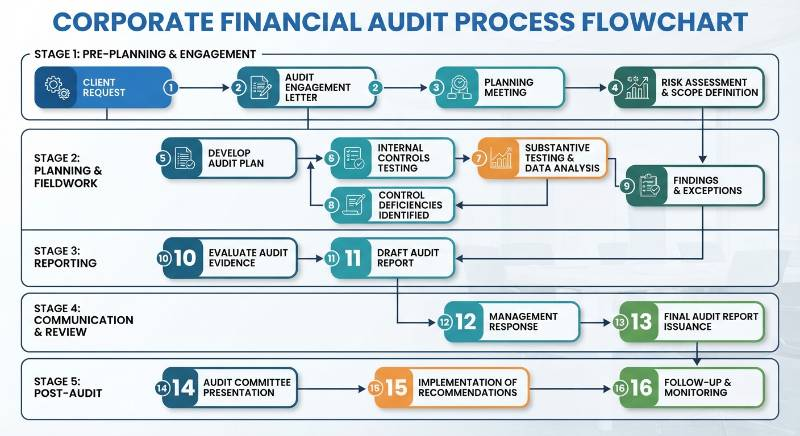
Phase 1: Management Accounts & Ledger Reconciliation
The enterprise prepares complete management accounts, including the general ledger, balance sheet, trial balance, and profit-and-loss statements. Every transaction must tie directly to secondary source vouchers, commercial contracts, and bank confirmation slips.
Phase 2: Audit Working File Compilation & Sampling
The practicing auditor reviews the trial balance and conducts substantive transaction sampling. Material entries over designated risk thresholds are extracted, requiring underlying contracts, customs declarations, and settlement invoices to prove economic substance.
Phase 3: Draft Audit Report Formulation & Director Endorsement
The auditor drafts the comprehensive audit report alongside explanatory statutory notes. Company directors formally inspect the draft, verify the asset valuations, and execute the director endorsement page alongside the representation letter.
Phase 4: Profits Tax Computation & IRD Submission
The tax representative calculates allowable deductions, capital allowances, and assessable profit adjustments to assemble the final tax computation. The complete statutory dossier—signed audit report, tax computation, and Profits Tax Return BIR51—is officially delivered to the IRD.
Complete Statutory Audit Document Checklist for Global Enterprises
Audit turnaround velocity depends entirely on document readiness. Incomplete transaction archives represent the single primary cause of statutory filing delays.
- Corporate Governance Dossier: Certificate of Incorporation, Business Registration Certificate, Articles of Association, and current NAR1 Annual Return.
- Banking Records: 12 months of official bank statements for all corporate multi-currency accounts, merchant gateways (Stripe, PayPal), and credit accounts.
- Revenue Substantiation: Complete sales invoices paired with signed client contracts, sales orders, and corresponding bank deposit slips.
- Procurement Archives: Vendor invoices, purchase orders, subcontractor agreements, and official payout confirmations.
- Logistics Documentation: Bills of Lading, airway bills, customs import/export declarations, and warehouse packing lists (mandatory for trading entities).
- Operational Overheads: Tenancy agreements, office utility invoices, professional software subscriptions, and service fee receipts.
- Employment & Payroll: Employment contracts, payroll schedules, MPF contribution records, and Employer’s Returns (BIR56A/B).
- Director & Intercompany Ledgers: Loan agreements, promissory notes, board resolutions confirming related-party asset movements, and subsidiary holding registers.
High-Risk Compliance Scenarios: Cross-Border E-Commerce, Web3, and Offshore Profit Claims
Standard retail bookkeeping standards fall short when dealing with decentralized operations, cross-border multi-currency trade, and international holding structures.
Cross-Border E-Commerce & Payment Gateways
Enterprises running global storefronts routinely channel multi-currency receipts through platform aggregators before sweeping net funds into their main commercial accounts. Auditors require programmatic reconciliation between platform gross sales reports, processing fee deductions, dispute refunds, and final bank arrivals.
Maintaining solid books ensures your ongoing Corporate Bank Account Opening and continuity operations remain completely dispute-free.
Web3 & Decentralized Asset Custody
Firms holding digital assets, stablecoins, or programmatic token inventories require specialized valuation techniques. Auditors must confirm wallet address ownership through on-chain cryptographic message signing, historical price indexing at the transaction timestamp, and precise separation between corporate holdings and personal director assets.
Offshore Profit Claim Justification
Claiming a 0% corporate tax rate via an offshore non-taxable claim under Section 14 of the Inland Revenue Ordinance requires complete, unassailable documentation. Companies must prove that contracts were negotiated, concluded, and executed outside Hong Kong borders.
If an auditor issues a disclaimer or qualified opinion due to missing travel records, IP logs, or foreign establishment proof, the IRD will summarily dismiss the offshore profit claim and issue standard profits tax assessments.
Audit Readiness Benchmarks: Key Operational Statistics and Common Traps
Data collected across statutory review cycles demonstrates that operational preparedness dramatically impacts corporate survival and compliance overhead.
| Operational Metric | Disorganized Bookkeeping | Licensed Direct TCSP Standard | Regulatory Risk Vector |
|---|---|---|---|
| Average Audit Turnaround | 8 to 16 Weeks | 2 to 3 Weeks | Compounding late filing penalties |
| Bank Account Review Failure Rate | 38.4% Flagged or Suspended | < 0.5% Query Triggered | Operational cash freeze |
| IRD Inquiry & Audit Ratio | 44.2% Formal Tax Inquiries | < 3.1% Standard Desk Queries | Arbitrary estimated assessments |
| Offshore Claim Acceptance Rate | 12.6% (High Rejection) | 91.4% (With Robust Trail) | Retroactive 16.5% standard tax levy |
Industry research shows over 78% of commercial bank account freezes are directly triggered by late or missing annual audited reports during mandatory KYC reviews. Maintaining current books is an operational imperative.

The Statutory Audit & Tax Filing Calendar: Deadlines, Extension Codes, and Timeline Calculator
The IRD issues statutory tax returns based on a strict operational calendar. Missing a deadline can trigger compounding fines, court summons, and bank account reviews.
First Audit Window (18 Months from Incorporation)
Newly incorporated companies receive their first Profits Tax Return roughly 18 months from their legal incorporation date. The company is granted a statutory window of exactly 3 months from the issue date to submit the finalized return, audited financial statements, and tax computation.
Subsequent Fiscal Year Codes (M-Code, D-Code, N-Code)
For established entities, filing deadlines correspond directly to the chosen financial year-end date. Registered tax representatives can apply for statutory extensions under the IRD’s Block Extension Scheme:
| Category Code | Financial Accounting Year-End | Normal IRD Deadline | Block Extension Final Deadline |
|---|---|---|---|
| N-Code | Between April 1 and November 30 | May 2 (1 month from issue) | No extension granted |
| D-Code | December 31 | May 2 of following year | August 15 of following year |
| M-Code | March 31 | May 2 of following year | November 15 of current year |
“Statutory extensions under the M-Code or D-Code schemes are legal privileges managed by certified tax representatives, not automatic rights. Missing the extension window results in instantaneous estimated assessments by the IRD.”
— Practising Member, HKICPA Audit Committee
Direct First-Hand Licensed CPA Execution vs. Unlicensed Middlemen: Risk Mitigation
The corporate services sector includes various unregulated sales agents and third-party intermediaries who outsource audit operations to unaccountable third parties. This introduces significant operational risk.
Broker agencies routinely add 40% to 100% markups to standard auditing fees, while routing private banking records, employee data, and trade secrets through insecure channels.
When discrepancies arise, these brokers cannot legally represent your firm before the Inland Revenue Department or the Companies Registry.
Olesen Global eliminates intermediate brokers entirely. Holding an official Trust or Company Service Provider License (TCSP License No. TC010076) under the Hong Kong Companies Registry, Olesen Global delivers direct, professional statutory execution from our centralized headquarters in Hong Kong.
By pairing direct licensed corporate governance with practising CPA audit execution, enterprises secure complete structural synergy across Hong Kong Company Registration, dedicated Company Secretary Services, international Trademark Registration, and multi-currency banking continuity.
Frequently Asked Questions (FAQs)
Can an active Hong Kong company file a Zero Return (Nil Tax Return) instead of completing a full audit?
No. Under the Inland Revenue Ordinance and Companies Ordinance (Cap. 622), any Hong Kong company that has commercial transactions, active bank records, or revenue generation cannot legally file a Nil Return. Falsely filing a dormant return constitutes tax evasion under Section 80(2), triggering severe penalties, court summons, and bank account termination. A statutory audit conducted by an HKICPA practicing auditor is legally mandatory.
How can business owners verify whether their Hong Kong audit and secretary provider is a legitimate first-hand licensed firm?
Verify licensing directly through official Hong Kong public registries. Check the Companies Registry’s TCSP Licensee Register for valid authorization (such as Olesen Global, License TC010076) and confirm that statutory audit reports are signed exclusively by an HKICPA Certified Public Accountant (Practising). Unlicensed third-party intermediaries cannot legally represent clients before the IRD.
What happens if a Hong Kong company misses the statutory audit and Profits Tax Return deadline?
Missing the IRD deadline triggers automatic compounding late penalties (starting at HKD 1,200 up to HKD 10,000+), an estimated arbitrary tax assessment by the tax assessor, court summons against directors, and immediate compliance flagging by commercial banks, which routinely freezes accounts.
Can a Hong Kong offshore claim be processed without an audited financial report?
No. An offshore tax exemption claim cannot be submitted in isolation. The IRD requires the formal claim to be submitted alongside the completed Profits Tax Return, audited balance sheet, profit-and-loss statement, and comprehensive tax computation compiled by a licensed practicing auditor.
Secure Direct Compliance: 3-Step Hong Kong Audit Action Path with Olesen Global
Professional Corporate Assurance: The Direct Engagement Blueprint
Protect your enterprise from regulatory fines, prevent banking disruptions, and secure your global corporate structure with first-hand TCSP compliance execution.
- Step 1: Preliminary Financial Review: Provide your trailing fiscal balance sheets, trial balance, and transaction statements for a comprehensive audit scope assessment.
- Step 2: Transparent Fixed-Fee Quotation: Receive a tailored audit document checklist, fixed pricing schedule, and legally binding timeline commitment within 24 hours.
- Step 3: Direct CPA Execution & Filing: Collaborate directly with an HKICPA practicing auditor with 1-on-1 milestone tracking through final IRD submission.