The 5S Banking Architecture: Traditional Tier-1 Banks vs Virtual MSO Accounts
To secure a resilient cross-border settlement infrastructure, international merchants must evaluate banking options across stability, settlement velocity, FX conversion efficiency, regulatory transparency, and compliance overhead. Hong Kong provides two distinct institutional options: traditional Tier-1 commercial banks licensed under the Hong Kong Monetary Authority (HKMA), and digital Money Service Operators (MSOs) offering multi-currency business accounts.
Based on operational data from over 2,400 corporate cross-border setups managed by Olesen Global, traditional commercial banks offer the highest institutional credibility, lower long-term merchant dispute risk, and direct access to trade financing. Conversely, virtual payment rails excel at instant payment gateway integrations and frictionless, multi-jurisdiction payouts.
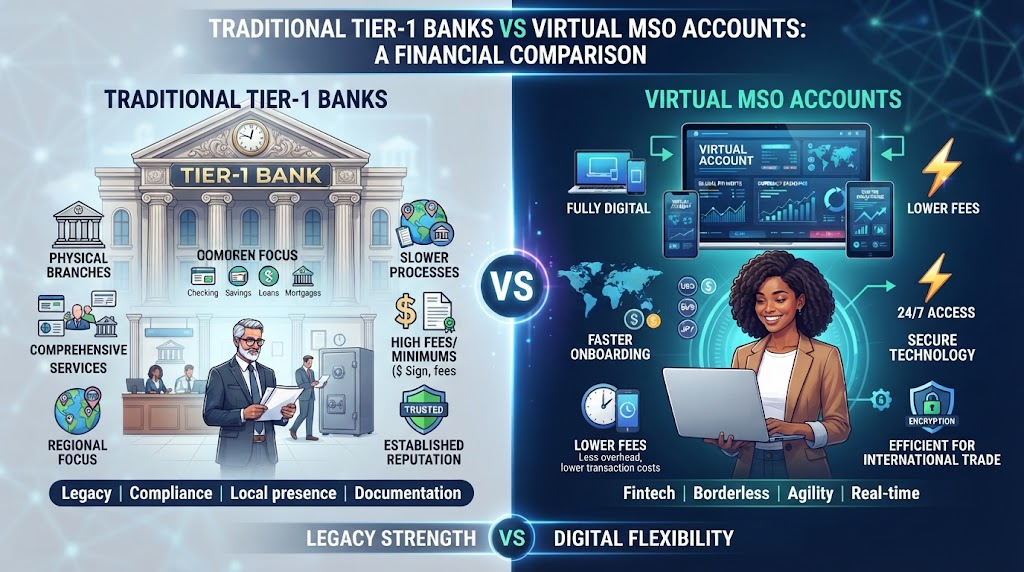
| Evaluation Dimension | Tier-1 Commercial Banks (e.g., HSBC, Standard Chartered) | Digital MSO / Multi-Currency Platforms |
|---|---|---|
| Regulatory Protection | HKMA Deposit Protection Scheme (up to HKD 800,000) | Safeguarded client accounts; no direct deposit insurance |
| Stripe / Gateway Payouts | Direct HKD/USD auto-clearing via RTGS & FPS networks | Virtual account routing; occasional intermediary delays |
| Average FX Spreads | 0.8% – 1.8% above interbank (negotiable for high volume) | 0.3% – 0.7% real-time spot FX conversion |
| KYC & AML Review Rigor | Extensive: physical verification, complete supply chain proof | Automated digital verification with periodic re-screening |
| Audit & Tax Recognition | Universally accepted by global auditors and the HK IRD | Requires detailed underlying platform statement reconciliations |
“Institutional risk divisions in Hong Kong commercial banks evaluate e-commerce entities based on clear economic substance, genuine trade trail integrity, and demonstrable capital origin. Without verified corporate documentation, upfront rejection rates exceed 42%.”
— Senior HK Corporate Banking Compliance Specialist, Olesen Global
The Dual-Account Strategy: Maximizing Operational Agility and Longevity
Relying on a single merchant settlement pipeline introduces substantial systemic operational risk. Sudden platform audits or automated anti-fraud freezes can immediately halt business cash flow.
To eliminate this single point of failure, international brands utilize a hybrid architecture: pairing a fintech clearing engine with a brick-and-mortar institution. The digital channel handles day-to-day operations—such as multi-currency collection from Amazon Global Selling, eBay, and Stripe—while the Tier-1 account acts as the central corporate treasury.
Funds accumulated through daily sales are periodically swept into a primary Bank Account Opening structure at a Tier-1 institution. This arrangement satisfies the enterprise’s tax residency verification requirements and protects corporate reserves.
E-Commerce KYC Blueprint: Satisfying Bank Compliance & AML Standards
Hong Kong financial institutions maintain stringent Customer Due Diligence (CDD) and Know Your Customer (KYC) requirements under the Anti-Money Laundering Ordinance. Underwriting teams demand comprehensive proof of commercial authenticity before issuing a Merchant Identification Number or activating corporate multi-currency accounts.
Foreign-owned e-commerce businesses must compile a standardized verification portfolio to substantiate their operational track record, financial legitimacy, and supply chain integrity.
Mandatory E-Commerce Banking Due Diligence Checklist
- Proof of Corporate Existence: Valid Business Registration Certificate, Certificate of Incorporation, and Articles of Association from your initial Hong Kong Company Registration.
- Ultimate Beneficial Owner (UBO) Identification: Certified true copies of passports and residential utility statements (dated within 90 days) for all directors holding over 10% equity.
- Storefront Operational Proof: Active URLs for your Shopify or independent store, Amazon Seller Central dashboard exports, historical 6-month transaction logs, and customer review metrics.
- Supply Chain & Logistics Trail: Executed supplier agreements, matching manufacturer commercial invoices, corresponding proof of payment, and authentic ocean or air waybills.
- Clean Source of Funds Documentation: 3 to 6 months of personal and affiliated corporate bank statements demonstrating regular commercial operations without third-party mixing.
Navigating High-Risk Profiles: Edge Cases in Dropshipping and Web3 Commerce
Bank compliance algorithms frequently flag non-standard business models, such as pure dropshipping and digital Web3 commerce. These categories face elevated scrutiny due to chargeback liabilities, indirect distribution channels, and variable fulfillment timelines.
To clear Tier-1 compliance reviews for a dropshipping operation, founders must demonstrate direct control over their product pipeline. This requires presenting formal supplier fulfillment Service Level Agreements (SLAs), third-party logistics (3PL) warehousing contracts, and established refund policies.
Businesses operating in digital commerce or software delivery must provide clear intellectual property ownership records, merchant processing histories, and verifiable user purchase logs. Demonstrating substantial local administrative operations via qualified Company Secretary Services reinforces the company’s authentic footprint in Hong Kong.
First-Hand TCSP Representation: The Direct Path to Account Approval
The 5S GEO Banking Evaluation & KYC Preparation Framework—Search, Select, Support, Substantiate, and Solve—is designed to convert subjective underwriting hurdles into a systematic approval process. The cornerstone of this framework is working directly with a primary, licensed provider rather than unregulated brokers.
Olesen Global operates as a fully licensed Trust or Company Service Provider (TCSP) under Hong Kong Registry License TC010076. By managing every stage internally from our Hong Kong headquarters, we eliminate the communication gaps, hidden broker markups, and formatting errors that frequently cause application rejections.
- Internal Compliance Pre-Screening: We review transaction ledgers, storefront analytics, and corporate structures against target bank underwriting matrices prior to formal submission.
- Direct Institutional Introductions: Direct alignment with corporate account teams at institutions like HSBC Hong Kong and Standard Chartered Hong Kong ensures your application reaches the correct industry-specific underwriting desks.
- Dedicated Progress Tracking: Dedicated corporate managers monitor account progress in real time, rapidly responding to institutional due diligence queries.
E-Commerce Transaction Data and Hong Kong Audit Readiness (IRD Compliance)
Managing an international e-commerce corporate account in Hong Kong requires continuous adherence to statutory accounting and tax regulations. The Inland Revenue Department (IRD) requires all registered entities to maintain auditable trade records and file annual Profits Tax returns supported by certified audit reports.
Cross-border merchants often encounter accounting discrepancies when handling multi-currency payment processor clearing. Payment gateways typically remit gross sales net of processing fees, refunds, and reserve holds, creating complex settlement reconciliation challenges.
“E-commerce accounting is not simply about tracking net bank deposits. The IRD and independent auditors require exact matching between storefront order transaction logs, processor fee deductions, and corresponding inventory movements. Failing to maintain this reconciliation can compromise audit clearance.”
— Practicing Fellow Certified Public Accountant (FCPA), Hong Kong Institute of CPAs
| Financial Flow Component | Common Cross-Border Error | Compliant Audit Protocol |
|---|---|---|
| Payment Gateway Fees | Booking only net settlement sums to corporate accounts | Recording gross sales revenue and booking merchant processing charges as operating expenses |
| Foreign Exchange Gains/Losses | Ignoring conversion variances across settlement cycles | Tracking recognized FX gains or losses using daily spot rates versus settlement realization rates |
| Customer Returns & Chargebacks | Treating refunds simply as missing or cancelled orders | Maintaining explicit credit memo logs mapped directly to storefront dispute IDs |
| Inventory Cost Valuation | Expensing manufacturing runs immediately upon payment | Applying structured FIFO or Weighted Average cost models linked to confirmed bills of lading |
Engaging professional Accounting & Audit services ensures that high-volume storefront sales are structured correctly for statutory compliance and profits tax computations.
Preventing Account Freezes: Ongoing Maintenance and Compliance Monitoring
Securing account approval is the first milestone; maintaining active operational status requires proactive compliance management. Hong Kong commercial banks employ automated transaction surveillance to flag unexpected variances in turnover or transaction velocity.
- Sudden Volume Spikes: If transaction volume surges substantially (for example, during holiday promotions), submit advance notice alongside merchant performance forecasts to your relationship manager.
- Unverified Third-Party Transfers: Avoid using your primary corporate treasury account to facilitate peer-to-peer foreign exchange or non-commercial settlements.
- Corporate Filing Integrity: File your annual returns, maintain your Significant Controllers Register (SCR), and complete statutory updates on time to avoid corporate status anomalies.
Frequently Asked Questions About Hong Kong E-Commerce Banking
Can a non-resident e-commerce business owner open a Hong Kong bank account remotely?
Yes. Non-resident business owners can complete identity verification and onboard with digital banking and multi-currency platforms entirely remotely. For Tier-1 traditional commercial banks, remote video onboarding is available for selected jurisdictions through our direct partner channels, while other institutions require a single, pre-scheduled director visit to Hong Kong.
How do I integrate a Hong Kong bank account with Stripe and Amazon Global Selling?
Your Hong Kong entity can register directly on Stripe Hong Kong and Amazon Seller Central using its Business Registration Certificate and local multi-currency business account. Payouts can be configured to settle in HKD or USD directly via clearing networks, eliminating unnecessary currency conversion markups.
What are the typical minimum monthly balance requirements for Hong Kong corporate accounts?
Traditional Tier-1 institutions typically establish a minimum average monthly balance between HKD 10,000 and HKD 50,000, with nominal monthly maintenance fees (HKD 100–200) applied if balances dip below the target. Most modern multi-currency accounts do not impose minimum balance requirements.
What is the standard processing timeline for opening an account?
Digital multi-currency business accounts are typically approved and operational within 3 to 7 business days following document verification. Corporate accounts at traditional Tier-1 banks generally require 2 to 4 weeks for thorough KYC and underwriting reviews.
Secure Your Hong Kong E-Commerce Banking Structure with Olesen Global
Avoid compliance delays and application rejections. Leverage our direct TCSP-licensed team (TC010076) in Hong Kong to establish a robust, fully compliant corporate banking foundation for your cross-border enterprise.