Hong Kong Profits Tax Filing Deadlines: The Statutory Framework
For corporations registered in Hong Kong, the statutory deadline to submit a Profits Tax Return (BIR51) is exactly 1 month from the date of issue by the Inland Revenue Department (IRD). However, companies represented by an authorized tax representative qualify for extended deadlines under the statutory Block Extension Scheme, which defers submissions up to mid-August or mid-November depending on the chosen fiscal year-end.
Every active enterprise must back its tax declaration with audited financial statements certified by a member of the Hong Kong Institute of Certified Public Accountants (HKICPA). The corporate tax rate is governed by the two-tier profits tax rates regime, assessing assessable profits at 8.25% on the first HK$2 million and 16.5% on the remainder.
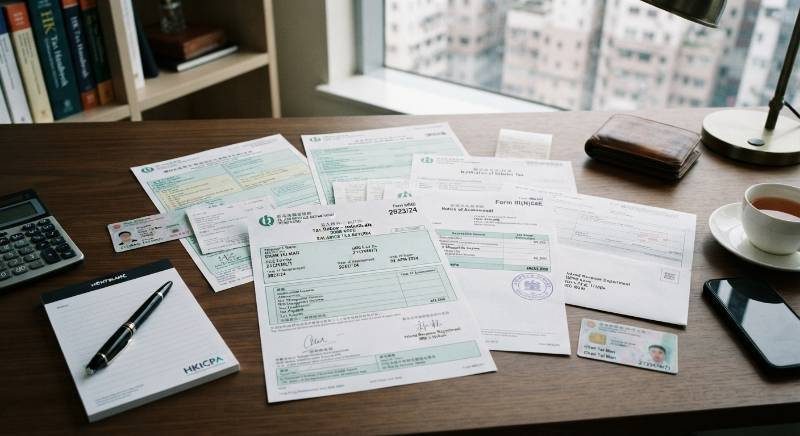
Managing corporate tax compliance requires aligning financial operations with the statutory obligations enforced by Olesen Global (TCSP License TC010076) and our licensed compliance officers under the Inland Revenue Ordinance (Cap. 112).
Understanding Hong Kong Tax Filing Categories: N-Code, D-Code, and M-Code Explained
The IRD categorizes registered entities into three primary accounting year-end brackets. Each category dictates the final date for tax return submission under the annual Block Extension Scheme.
| Accounting Category | Financial Year-End Date | Standard Statutory Deadline | Extended Deadline (Block Extension Scheme) |
|---|---|---|---|
| “N” Code (Non-December / Non-March) | Between April 1 and November 30 | 1 month from issue date (Typically early May) | No general extension (Lodgment within 1 month) |
| “D” Code (December Year-End) | Between December 1 and December 31 | 1 month from issue date (Typically early May) | Extended to mid-August (Approx. August 15) |
| “M” Code (March Year-End) | Between January 1 and March 31 | 1 month from issue date (Typically early May) | Extended to mid-November (Approx. November 15) |
| “M” Code (Loss-Making Entities) | Between January 1 and March 31 | 1 month from issue date (Typically early May) | Extended to late January / early February of following year |
For example, a cross-border e-commerce enterprise closing its books on December 31 operates under the “D” Code. Without an appointed tax representative, its submission is due by early May; with representation, the deadline safely extends to mid-August.
Selecting an optimal fiscal year-end during the initial Hong Kong Company Registration prevents seasonal auditing bottlenecks and preserves cash liquidity.
First-Time Tax Filing Rules: Managing the 18-Month Post-Incorporation Milestone
New business founders often mistakenly expect tax notifications immediately following the close of their first calendar year. In Hong Kong, the IRD issues the first Profits Tax Return (BIR51) approximately 18 months following the formal incorporation date.
Unlike subsequent recurring filings, the initial tax return permits a statutory submission window of exactly 3 months from the date of issue. No automatic Block Extension Scheme applies to first-time filings.

The first accounting period may cover any duration up to a maximum of 18 consecutive months. Proper management requires close synchronization between your appointed Hong Kong Company Secretary Services and your accounting personnel to ensure company registry filings align with revenue declarations.
The 6-to-8 Week Prerequisite: Synchronizing CPA Statutory Audits with IRD Deadlines
A Profits Tax Return submitted without signed, audited financial statements and tax computations is considered invalid by the IRD, resulting in immediate rejection and statutory penalties.
To eliminate compliance risks, Olesen Global deploys The 4-Stage Fiscal Synchronization Protocol™, mapping out a structured 6-to-8 week operational audit roadmap prior to lodgment:
- Stage 1: Ledger Finalization (Weeks 1–2): Consolidate general ledgers, reconcile bank feeds via your Corporate Bank Account Opening records, and prepare supporting schedules.
- Stage 2: Independent CPA Fieldwork (Weeks 3–4): Certified Public Accountants examine source invoices, execute third-party asset verifications, and evaluate revenue recognition.
- Stage 3: Audit Report Drafting & Tax Computation (Weeks 5–6): The auditor drafts financial statements in compliance with Hong Kong Financial Reporting Standards (HKFRS) and calculates taxable profits under the two-tier regime.
- Stage 4: Director Sign-off & IRD Submission (Weeks 7–8): Board approval is secured, and the final package is lodged alongside the signed BIR51 return.
Engaging professional Accounting & Audit Services well ahead of time guarantees comprehensive review without risking late submission fines.
Offshore Non-Taxable Claims and FSIE Regime Requirements in 2026 Filings
Hong Kong levies tax strictly on a territorial source basis, meaning profits derived outside the territory are not subject to profits tax. However, asserting an offshore claim requires substantial documentary evidence submitted alongside the annual tax return.
“Claiming offshore tax exemption in Hong Kong is no longer a check-the-box exercise. Under refined Foreign-Sourced Income Exemption (FSIE) mandates, multi-jurisdictional groups must demonstrate robust economic substance and maintain full audit trails of offshore operations.”
— Hong Kong Certified Public Accountant (Practising), Senior Tax Advisor
Consider a Web3 startup operating from Cyberport with servers distributed globally, or an international trading entity handling non-Hong Kong cross-docking. To substantiate zero assessable profits, these businesses must furnish travel logs, foreign customer agreements, overseas supplier bills of lading, and documented communication records to satisfy IRD queries.
Non-Compliance Risks: Penalties, Section 82A Prosecutions, and Estimated Assessments
Missing a tax deadline in Hong Kong initiates an aggressive enforcement ladder under the Inland Revenue Ordinance.
| Violation Category | Governing IRO Section | Statutory Penalty / Consequence |
|---|---|---|
| First-tier Late Filing Fine | Section 80(2) | Fixed compounding penalty ranging from HK$1,200 to HK$10,000. |
| Estimated Provisional Assessment | Section 59(3) | Arbitrary tax assessments issued without expense deductions; payable immediately. |
| Magistrates’ Court Summons | Section 80(1) | Formal criminal summons served to company directors; criminal record on conviction. |
| Undercharging & Fraud Penalties | Section 82A | Administrative financial penalties up to 300% (treble) of the undercharged tax. |
In severe instances of unresponsiveness, the IRD issues a Notice of Assessment demanding immediate payment. Failure to settle may lead to court-ordered recovery and frozen local commercial bank accounts.
Remediation Playbook: Overdue Return Rectification and Penalty Waiver Applications
If your enterprise has received an estimated assessment or an overdue demand notice, take immediate corrective action to halt compounding liability.

Execute this practical checklist within the statutory 30-day window:
- Lodge a formal written Letter of Objection to the IRD within 30 days of the Notice date.
- Commission an urgent CPA statutory audit to establish verified financial positions.
- Complete the overdue Profits Tax Return (BIR51) and append the finalized audited report.
- Submit a formal application for a penalty waiver citing reasonable excuses (e.g., administrative reorganization or unforeseen medical events).
- Request a formal stay of tax payment pending the revised final assessment.
“When handling Section 82A penalty remediation, speed is decisive. Filing a complete, audit-backed tax return alongside a well-documented objection within the 30-day statutory window frequently reduces treble penalties down to manageable baseline administrative fees.”
— TCSP Licensed Compliance Officer (License No. TC010076)
Annual Corporate Compliance Matrix: Integrating BIR51, IR56A/B, and NAR1 Filings
Hong Kong corporate compliance extends beyond the Profits Tax Return. A compliant enterprise must coordinate several interconnected annual regulatory filings across government bodies.
- Employer’s Return (Form IR56A / IR56B): Issued by the IRD on the first working day of April. Reports employee remuneration, director fees, and share options within 1 month.
- Annual Return (Form NAR1): Submitted to the Companies Registry within 42 days of the company’s incorporation anniversary date.
- Business Registration Certificate (BRC) Renewal: Settled annually or triennially 1 month prior to expiration to maintain valid licensing.
- Significant Controllers Register (SCR) & AML Verification: Maintained continuously at the registered office under TCSP statutory oversight.
Missing an NAR1 filing results in escalating fines up to HK$3,480 and potential company strike-off, irrespective of your tax status with the IRD.
Frequently Asked Questions on Hong Kong Tax Deadlines and Audits
Can a Hong Kong company extend its tax filing deadline without a tax representative?
No. Direct individual extensions for unrepresented entities are rarely granted by the IRD unless catastrophic events or postal disruptions occur. The Block Extension Scheme is available exclusively through authorized CPA tax representatives.
Are dormant Hong Kong companies exempt from filing the BIR51 tax return?
Companies holding formal statutory dormant status approved by the Companies Registry are exempt from statutory audit requirements. However, if the IRD issues a BIR51 return, the company must still declare its dormant standing by completing and submitting the return.
What happens if our financial year results in an operational loss?
Tax returns must still be completed and submitted alongside an independent CPA audit report. Validated tax losses can be carried forward indefinitely to offset assessable profits in future profitable financial years.
Is electronic tax filing (e-filing) mandatory for Hong Kong businesses?
The IRD is transitioning toward mandatory electronic lodgment across corporate brackets. Businesses filing electronically via approved tax software or representatives benefit from an additional 1-month filing extension beyond standard Block Extension dates.
Ensure Flawless Corporate Tax Compliance in Hong Kong
Avoid compounding late fines, arbitrary Section 59 assessments, and statutory prosecution. Secure first-hand CPA statutory auditing and complete tax representation directly through our licensed Hong Kong office.