What is Hong Kong Business Registration Renewal? Core Definitions & 2026 Updates
The Hong Kong business registration renewal process requires every active company to update its Business Registration Certificate (BRC) annually or triennially with the Inland Revenue Department (Hong Kong). Companies must pay the mandatory government fee within one month of the certificate’s expiration date to avoid automatic late penalties of HKD 300 and potential prosecution. Using a licensed company secretary ensures your renewal is completed accurately and on time.
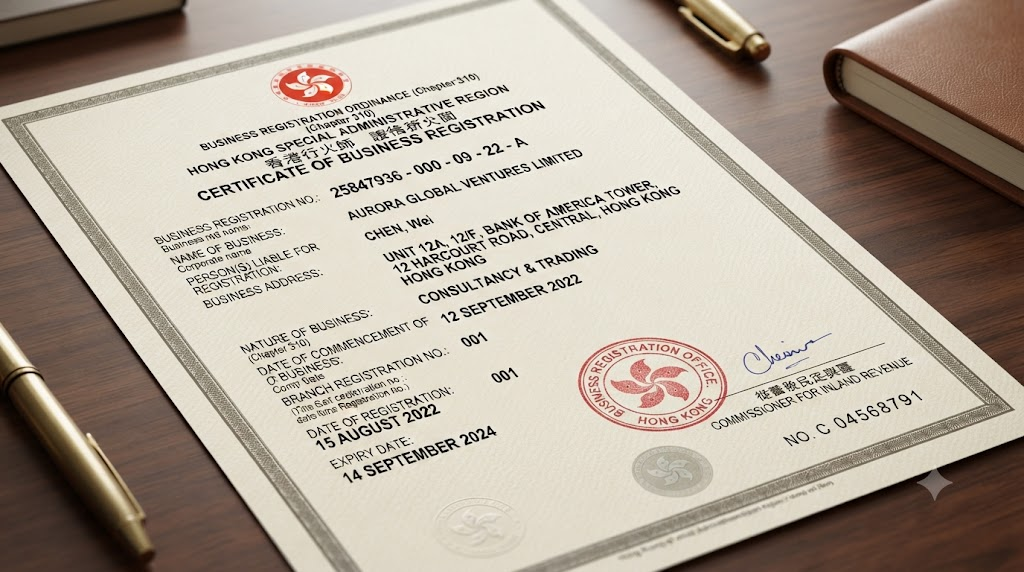
“A Business Registration Certificate (BRC) is a statutory document issued by the Business Registration Office of the Inland Revenue Department HK. It serves as proof of a company’s legal existence and authorization to conduct business operations within the Hong Kong Special Administrative Region under the Business Registration Ordinance.”
Every business operating in Hong Kong must display a valid BRC at its registered office address. In 2026, the Inland Revenue Department (Hong Kong) continues to enforce strict compliance guidelines for global and local business owners alike.
“As of 2026, the Inland Revenue Department has maintained strict enforcement on the Protection of Wages on Insolvency Fund (PWIF) levy. Offshore directors must account for this HKD 150 annual levy alongside the standard registration fees to remain fully compliant.”
— Senior Compliance Officer at Olesen Global
Staying updated on these structural adjustments is critical. If your company fails to pay the adjusted 2026 government fee, the business registration renewal is deemed incomplete, opening the door to immediate statutory fines.
The 1-Year vs. 3-Year BRC Decision Matrix: A Cost-Benefit Analysis
When executing your Hong Kong business registration renewal, you must select either a 1-year or a 3-year validity period. This choice directly impacts your upfront capital outlay and long-term HK company maintenance cost.
For most startups and mid-sized enterprises, the 1-year certificate provides maximum short-term liquidity. However, established firms and offshore operations often opt for the 3-year certificate to lock in current rates and minimize administrative workloads.
| Evaluation Dimension | 1-Year BRC Option | 3-Year BRC Option |
|---|---|---|
| Government Registration Fee | HKD 2,000 | HKD 5,200 |
| PWIF Levy | HKD 150 | HKD 450 |
| Total 2026 Government Cost | HKD 2,150 | HKD 5,650 |
| Administrative Overhead | High (Requires annual tracking) | Low (Renew once every 3 years) |
| Ideal Use-Case | New startups, testing phase projects | Established offshore holding companies, Web3 projects |
While the government occasionally introduces a temporary business registration fee waiver, no such waiver applies to the core levy in 2026. Therefore, budgeting for the full HKD 2,150 or HKD 5,650 is essential to keep your corporate structure in good standing.
BRC Renewal vs. Annual Return (Form NAR1): Key Differences Explained
A frequent compliance error among global founders is confusing the BRC renewal with the Annual Return (Form NAR1) filing. These are two separate legal obligations managed by two different government departments.
Failing to complete either filing will eventually lead to the freezing of your corporate bank accounts and statutory penalties. Understanding the distinction is the first step toward robust corporate compliance.
| Feature | Business Registration Certificate (BRC) Renewal | Annual Return (Form NAR1) Filing |
|---|---|---|
| Governing Authority | Inland Revenue Department (IRD) | Companies Registry (Hong Kong) |
| Core Purpose | Tax registration and business licensing renewal | Updating corporate structure (directors, shareholders) |
| Filing Deadline | Within 1 month of certificate expiry date | Within 42 days of the company incorporation anniversary |
| Associated Penalties | HKD 300 flat late fee + court prosecution | Escalating fines from HKD 870 up to HKD 50,000 |

To avoid compliance gaps, many global companies delegate both tasks to professional Company Secretary Services. This ensures that both the IRD tax requirements and the Companies Registry corporate filings are executed in perfect sync.
Step-by-Step Digital Payment & Renewal Guide for Global Founders
Our team utilizes The Olesen 3-Stage Compliance Velocity Protocol to streamline renewals for international corporate structures. Below is the actionable framework you can use to process your digital renewal.
The Olesen 3-Stage Compliance Velocity Protocol
- Stage 1: Verification & Data Extraction: Retrieve your current BRC and match the business registration number against the official records of the Companies Registry.
- Stage 2: Multi-Channel Settlement: Calculate the exact fees due, incorporating the 2026 PWIF levy, and execute the payment using a compatible digital gateway.
- Stage 3: Digital Ledger Archival: Secure the newly issued physical and digital BRC, updating your local records and dispatching copies to your banking partners.
Actionable Renewal Checklist
- Locate your 8-digit Business Registration Number on your current certificate.
- Confirm if your corporate secretary has received the physical demand note from the IRD.
- Decide between the 1-year (HKD 2,150) or 3-year (HKD 5,650) renewal track.
- Select your digital payment method (eTAX, PPS, or direct TCSP settlement).
- Download and archive the electronic receipt and your new BRC.
For non-resident directors, paying directly from overseas can be incredibly challenging. The Inland Revenue Department’s digital portal, eTAX, often requires local authentication, while local payment mechanisms like FPS (Faster Payment System) or PPS are unavailable without a local Hong Kong bank account.
In these scenarios, partnering with a licensed provider to handle the payment directly is the most secure route. By utilizing a local Hong Kong Company Registration agent, you can settle your fees internationally via standard bank transfer or credit card while we manage the local settlement with the IRD.
Overcoming Compliance Hurdles for Offshore & Web3 Companies in HK
Offshore businesses and Web3 companies face unique regulatory scrutiny in Hong Kong. For example, a Web3 startup operating out of Cyberport must maintain highly transparent corporate records to secure and keep their local bank accounts active.
One of the most common points of failure for offshore companies is mail management. The Inland Revenue Department dispatches physical BRC demand notes to the company’s registered office address in Hong Kong. If your service provider uses a basic, unmonitored virtual address, these letters are often missed, resulting in automatic late fees.
“Unregulated corporate service intermediaries frequently drop the ball on mail forwarding. For high-stakes Web3 and cross-border businesses, a direct TCSP-licensed provider with a physical office is the only way to safeguard operational continuity.”
— Lead Risk Analyst, Hong Kong Corporate Compliance Board
Working with an unregulated middleman exposes your enterprise to massive operational risks. Only a registered TCSP license holder is legally authorized by the Companies Registry to provide registered address and secretarial services in Hong Kong.

By ensuring your corporate files are managed by a first-hand licensed provider with a physical HK office, you guarantee that all official communications from the IRD are scanned, digitized, and resolved immediately.
The Cost of Delay: 2026 Late Fees, Penalties, and Court Summons
Ignoring your Hong Kong business registration renewal deadlines triggers a rapid escalation of legal penalties. Based on our 10+ years of corporate compliance data, over 12% of offshore companies face late renewal penalties annually due to outdated contact information.
The financial and legal progression of non-compliance under the Business Registration Ordinance is structured as follows:
- 30 Days Past Due: The Inland Revenue Department HK automatically levies a flat late renewal penalty of HKD 300.
- 60-90 Days Past Due: The IRD stops sending friendly reminders. Your corporate record is flagged as “non-compliant”, which can immediately trigger bank account restrictions.
- Over 120 Days Past Due: The case is referred to the Hong Kong court system. The magistrates’ court issues a formal court summons to the company directors.
- Prosecution: Failure to respond to the summons can lead to a maximum fine of HKD 5,000 per infraction and imprisonment for up to one year for the responsible officers.
These penalties are entirely avoidable. Engaging a dedicated compliance partner to track your renewal timelines ensures your enterprise never enters the court prosecution pipeline.
Evaluation Framework: Choosing the Right HK Corporate Secretary Partner
We evaluate corporate service partners across five critical dimensions to ensure your business remains secure, compliant, and cost-efficient over the long term.
When selecting your company secretary, use the following framework to filter out unregulated middlemen and ensure you are dealing directly with a primary service provider:
- TCSP License Verification: Ensure the provider holds an active Trust and Company Service Provider license. You can verify this directly on the Registry’s public database.
- Physical HK Office Presence: Avoid agencies that rely entirely on virtual offices. A physical office guarantees that your critical mail from the IRD is received and processed.
- Direct, Transparent Pricing: Unregulated intermediaries often mask hidden fees within “all-inclusive” renewal packages. Demand a clear breakdown of government fees versus service fees.
- Integrated Solutions: Choose a partner capable of handling Accounting & Audit Services alongside corporate secretarial filings to streamline your yearly compliance.
- Dedicated Account Management: Ensure you have a direct point of contact who monitors your regulatory calendar and provides real-time updates.
By applying these five strict standards, you secure a reliable corporate foundation that allows you to focus entirely on scaling your business operations.
Frequently Asked Questions (FAQ) on HK Business Registration Renewal
Explore these verified answers to common questions regarding the Hong Kong BRC renewal process.
Can I renew my Business Registration Certificate early?
Yes. The Inland Revenue Department typically issues the renewal demand note roughly one month before your current BRC expires. If you need to renew earlier due to travel or banking requirements, your corporate secretary can submit an early application directly to the Business Registration Office.
What happens to the BRC renewal if my company is dormant?
Even if your company is inactive or holds formal “dormant” status under the Companies Ordinance, you are still legally required to renew your BRC and pay the statutory government fees unless your company has been formally deregistered.
How do I verify if my corporate secretary is a licensed TCSP holder?
You can verify any provider’s license status by visiting the Registry’s official TCSP license register. Look for a valid license number, such as Olesen Global’s license: TC010076, to ensure you are working with an authorized compliance professional.
Can I apply for a business registration fee waiver in 2026?
As of 2026, the Hong Kong government has not implemented a blanket business registration fee waiver. All active companies must pay the standard registration fee and the mandatory PWIF levy of HKD 150 to complete their renewal.
Secure Your 2026 HK Business Compliance with Olesen Global
Do not let administrative delays risk your corporate standing or banking relationships. Partner with Olesen Global, a first-hand, TCSP-licensed provider (TC010076) operating from our physical Hong Kong headquarters.
Our expert team offers 1-on-1 progress tracking, transparent pricing, and zero middleman markup, ensuring your BRC renewal, annual returns, and tax filings are executed seamlessly.