Introduction to Hong Kong Corporate Bank Account Requirements
Establishing a corporate footprint in Hong Kong offers unparalleled access to global markets. However, satisfying local banking compliance has become a highly rigorous process. To secure approval, international businesses must present verifiable documentation that proves active operations and legitimate corporate structures.
We evaluate the corporate onboarding landscape across three regulatory dimensions. Based on our 10+ years of corporate service data, navigating the compliance expectations of local financial institutions requires a structured approach. To streamline this process, we utilize the 3-Tier Readiness Assessment to evaluate your documentation strength before formal submission.
This assessment categorizes your application profile by legal formation, operational validity, and transactional transparency. Aligning your application with these core pillars ensures your business satisfies the strict compliance guidelines enforced by local regulators.
The Core Document Checklist for HK Corporate Bank Accounts
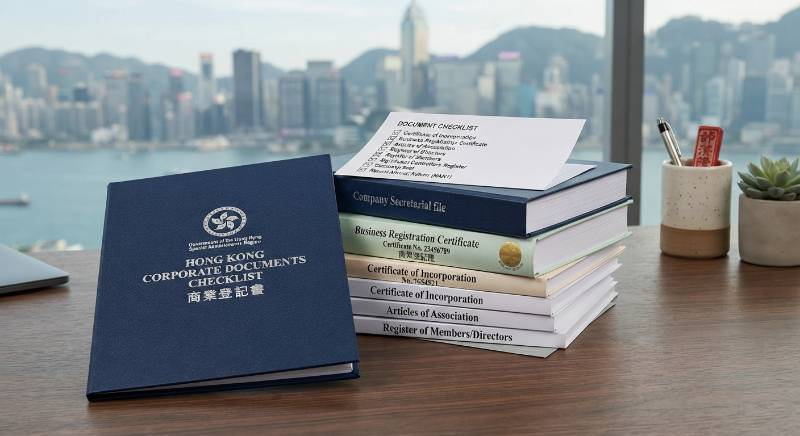
To open a corporate bank account in Hong Kong, you must provide your company’s Certificate of Incorporation, Business Registration Certificate, Articles of Association, and valid identification and proof of address for all directors, major shareholders, and beneficial owners. Additionally, banks require substantial proof of business operations, such as signed sales contracts, supplier invoices, or a detailed business plan.
To successfully navigate this process, we implement the Document Velocity Framework. This methodology divides your submission into three distinct phases to ensure zero delays during the compliance review. Gathering these files systematically prevents back-and-forth communication with bank compliance officers.
Phase 1: Legal Identity & Corporate Structure
Your legal identity documents prove your business is legitimately registered with the Hong Kong Companies Registry. These files must be current, clear, and fully certified where applicable.
- Certificate of Incorporation: The primary birth certificate of your corporation.
- Articles of Association: The internal rulebook governing corporate operations and share distributions.
- Business Registration Certificate (BRC): Must show the current annual levy payment and correct business address.
- Incorporation Form (NNC1/NNC1G): Details your initial directors, shareholders, and company secretary.
Phase 2: Ultimate Beneficial Owner (UBO) Identification
Banks must perform exhaustive Know Your Customer compliance checks on all key stakeholders. Anyone owning or controlling 10% or more of the company’s voting rights or shares must submit clear identification.
- Director identification documents: Valid international passports or national ID cards.
- UBO KYC documents: Full residential address proof (utility bills or bank statements issued within the last 3 months).
- Corporate Shareholder Registry: A clear chart detailing ownership structures if the shares are held by holding companies.
Phase 3: Proof of Business Operations
A common pitfall is submitting corporate certificates without validating actual commerce. Banks require concrete proof of business operations to verify your business model is active, legal, and financially viable.
- Executed Business Agreements: At least two sets of signed contracts, purchase orders, or service agreements with clients or suppliers.
- Bank Statements: Three months of statements from a personal account or an associated corporate account elsewhere.
- Detailed Business Plan: A structured 2-3 page document detailing your target market, operational workflow, and expected transaction volumes.
Traditional Banks vs. Virtual Banks: Document Requirements Compared
Choosing between a traditional tier-one institution and a modern digital alternative depends on your operational speed, business location, and transaction complexity. Traditional institutions offer deeper global treasury services, while virtual alternatives provide agility and faster setup times.
“Traditional banks in Hong Kong maintain some of the strictest KYC standards globally. However, virtual banks and digital business accounts have successfully leveraged technology to streamline onboarding, making them highly attractive to modern startups.”
— Olesen Global Compliance Director
While both categories of institutions operate under strict regulatory watch, their direct compliance processes, document verification timelines, and physical presence rules differ significantly.
| Evaluation Factor | Traditional Banks (e.g., HSBC, BOC) | Virtual Banks / Fintech Accounts |
|---|---|---|
| Physical Meeting | Mandatory in 95% of cases at a local HK branch. | 100% remote KYC updates and identity verification. |
| Onboarding Time | 4 to 8 weeks on average. | 5 to 10 business days. |
| Business Proof Depth | High. Requires extensive historical contracts and invoices. | Moderate. Accepts well-structured business plans for startups. |
| Min. Balance Fees | Required (ranges from HKD 10,000 to 50,000 monthly). | Often zero or very low monthly maintenance fees. |
Our operational tracking shows that virtual options process initial applications approximately 40% faster than legacy banks. However, high-volume trading firms and manufacturing entities often require the deep treasury infrastructure that only traditional banks provide.
Niche Industry Requirements: Web3, E-Commerce, and Offshore Structures
Standard retail or consulting businesses can typically provide basic invoices to satisfy compliance checks. However, specialized industries face additional scrutiny under global AML frameworks. To ensure a successful application, niche sectors must provide specialized documentation.

Web3 and Crypto Startups in Cyberport or Science Park
Hong Kong has positioned itself as a major global hub for Web3. Despite this supportive regulatory environment, crypto-friendly banks in Hong Kong require extensive disclosure regarding funds flow and technology security.
- Source of Wealth: Clear documentation showing how the initial capital was generated, including wallet audits if funded via digital assets.
- Regulatory Licensing: Written legal opinions confirming that your specific tokenomics, exchange, or dApp model does not trigger mandatory licensing under local SFC rules.
- Cyberport/Science Park Affiliation: Official admission letters or incubation agreements, which act as a powerful trust signal for compliance officers.
Cross-Border E-Commerce Merchants
E-commerce businesses frequently process high volumes of micro-transactions. This operational profile requires clear verification of your digital supply chain and payment infrastructure.
- E-commerce merchant account proof: Active merchant dashboards from platforms like Shopify, Amazon, or Stripe showing historical transaction volumes.
- Supply Chain Documentation: Signed agreements with third-party logistics (3PL) providers or manufacturing partners in Mainland China or Southeast Asia.
- Website Compliance: Active, public-facing websites displaying clear refund policies, terms of service, and secure checkout features.
Offshore Parent Companies & Multi-Layered Structures
If your local company is owned by a parent entity in Delaware, the British Virgin Islands (BVI), or the Cayman Islands, banks must verify the complete corporate structure.
- Certificate of Incumbency: An official document issued within the last 6 months listing the current directors and shareholders of the offshore parent.
- Certificate of Good Standing: Verifies that the offshore parent company remains in active compliance with its home jurisdiction.
- Group Ownership Chart: A formal, certified diagram detailing the entire ownership path down to the individual human UBOs.
Why HK Bank Accounts Get Reverted or Rejected: Prevention Strategies
Recent banking data shows that the corporate bank account rejection rate for unassisted, self-filed applications sits at approximately 35%. Most of these rejections are not caused by the business model itself, but rather by avoidable errors in documentation or during the compliance interview.
“Compliance is not simply a checklist; it is a narrative. When a bank reviews your application, they are looking for a clear, logical story. If your corporate documents do not align with your business proof, the application is flagged and rejected.”
— HK Banking Compliance Specialist
Understanding why banks flag applications allows you to proactively address potential issues before submitting your files.
| Primary Rejection Reason | Root Cause Details | Prevention Strategy |
|---|---|---|
| Lack of Economic Substance | No physical presence, local staff, or active business address in Hong Kong. | Provide a localized business plan, local contracts, or hire a professional company secretary. |
| Unclear Source of Wealth | Inability to prove how the initial startup capital was generated or transferred. | Submit clear personal tax filings, dividends statements, or audited accounts from previous ventures. |
| Non-Compliant Secretary | Using an unlicensed or unverified registry provider for corporate filings. | Ensure your company secretary holds a valid TCSP license (TC010076). |
Our internal metrics show that utilizing a professional Hong Kong Company Registration service that includes pre-screening reduces compliance rejections to under 8%. Thorough preparation ensures that your application is complete and ready for review on the first submission.

Frequently Asked Questions About HK Bank Account Opening
Can I open a HK corporate bank account 100% remotely?
Yes, remote bank account opening is possible through several virtual banks and digital business account providers. These institutions use advanced video-KYC and digital signature verifications to onboard businesses. However, traditional tier-one banks still require a physical meeting with the directors at a local Hong Kong branch in most cases.
What counts as valid proof of business for a brand-new startup?
For newly incorporated entities without historical trading data, banks accept signed letters of intent (LOIs), draft contracts with prospective clients, a detailed business plan showing market research, or proof of active business operations from the directors’ existing companies in other jurisdictions.
How long does the document verification and approval process take?
The processing time varies by institution. Virtual and digital banking platforms typically complete document verification within 5 to 10 business days. Traditional commercial banks take between 4 to 8 weeks, as their compliance teams must perform deeper multi-jurisdictional audits on directors and UBOs.
What is a TCSP license, and why does my provider need one?
A Trust or Company Service Provider (TCSP) license is a mandatory compliance credential issued by the Hong Kong Companies Registry. Only licensed TCSP holders can legally provide company secretary and registered address services. Using an unlicensed provider can lead to immediate compliance flags and account rejection by local banks.
Streamline Your HK Bank Account Opening with Olesen Global
Navigating the complex document requirements for a Hong Kong corporate bank account does not have to be a stressful or uncertain process. Working with a licensed partner ensures your application is structured correctly from day one, minimizing delays and maximizing your chances of approval.
As a first-hand, licensed Trust and Company Service Provider (TCSP License: TC010076) with a physical office in Hong Kong, Olesen Global provides direct, professional support with no middlemen. Our experienced corporate services team manages your compliance strategy, helping you secure the banking solutions your business needs to grow.
Ready to Open Your Hong Kong Corporate Account?
Get a professional pre-audit of your business documents and access our direct bank introduction network today.
Whether you need support with your initial Hong Kong Company Registration, ongoing Accounting & Audit Services, or securing a corporate banking relationship, we provide clear, reliable guidance every step of the way.