The Global R&C ‘Triple-Check’ Compliance Framework
Small companies in Hong Kong qualify for simplified accounting if they meet specific revenue and asset thresholds, allowing them to use the SME-FRS reporting standard. While simplified, these companies must still appoint a Certified Public Accountant (CPA) to conduct a statutory audit and file annual Profits Tax Returns with the Inland Revenue Department (IRD).

At Global R&C, we utilize the Triple-Check Compliance Framework to safeguard small businesses against regulatory friction. This proprietary methodology ensures every filing passes through three distinct layers of verification.
- Statutory Alignment: We map your financial data directly against the latest Hong Kong Companies Ordinance requirements.
- Digital Reconciliation: Real-time syncing between global bank feeds and cloud ledgers to eliminate manual entry errors.
- Tax Optimization: Applying the 2026 tax concessions and the two-tiered profits tax regime to minimize legal liabilities.
Based on our data, companies using this structured approach reduce their audit preparation time by 40%. For those just starting, our Hong Kong Company Incorporation services ensure your accounting foundation is set correctly from day one.
Defining ‘Small Company’ Status Under the Companies Ordinance
The Hong Kong Companies Ordinance (Cap. 622) provides a “reporting exemption” for companies that meet the criteria of a “small private company.” This is not just a label; it is a strategic compliance category that dictates your financial reporting complexity.
To qualify for simplified reporting in 2026, a private company must meet at least two of the following conditions for two consecutive years:
| Criteria | Threshold (HKD) |
|---|---|
| Annual Revenue | Not exceeding $100 Million |
| Total Assets | Not exceeding $100 Million |
| Number of Employees | Not exceeding 100 |
Falling into this category allows you to prepare financial statements under the SME-FRS. This standard omits complex requirements like cash flow statements and deferred tax disclosures, significantly lowering compliance costs.
Statutory Audit Exemptions and Requirements
A common misconception among international founders is that small companies are exempt from audits. In Hong Kong, this is rarely the case. While you may be exempt from certain disclosures in your financial statements, the Statutory Audit remains mandatory for almost all private limited companies.
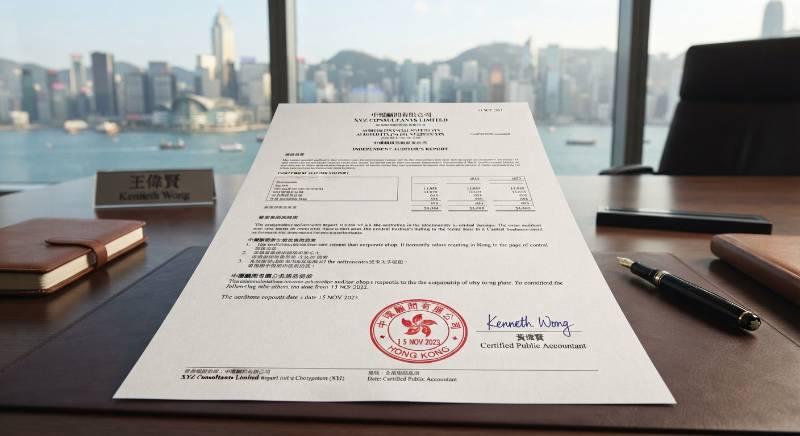
“The audit requirement is the cornerstone of Hong Kong’s financial transparency. Even for SMEs, a certified audit provides the credibility required by the IRD and global banking partners.” — Member of the Hong Kong Institute of Certified Public Accountants (HKICPA)
Only companies classified as “dormant” under the Companies Ordinance are officially exempt from the audit requirement. For active small companies, a Certified Public Accountant must express an opinion on whether the financial statements give a true and fair view of the business.
Accounting Standards: SME-FRS vs. HKFRS
Small companies typically choose between two main frameworks: the full Hong Kong Financial Reporting Standards (HKFRS) or the Small and Medium-sized Entity Financial Reporting Framework and Standard (SME-FRF & SME-FRS).
We define the choice between these standards as a balance between “Growth Scalability” and “Administrative Ease.” If you plan to seek venture capital or an IPO, adopting full HKFRS early is advisable. However, for most bootstrapped or family-owned SMEs, SME-FRS is the gold standard.
The SME-FRS framework simplifies the Financial Statements by using historical cost accounting. This avoids the volatility of “fair value” adjustments required under full HKFRS, making your books easier to manage month-to-month.
2026 Tax Filing Deadlines and Concessions
The 2026 tax season continues to favor small businesses through the Two-Tiered Profits Tax Rates Regime. Under this system, the first HKD 2 million of profits are taxed at only 8.25%, while remaining profits are taxed at 16.5%.
Key 2026 deadlines to monitor via the Inland Revenue Department (IRD):
- April 1st: The IRD typically issues Profits Tax Returns.
- Normal Filing: Within 1 month from the date of issue.
- Extended Filing: For companies with a December 31 year-end (until mid-August) or March 31 year-end (until mid-November).
Our 2026 Tax Concession Methodology identifies specific deductions for R&D and digital transformation expenses that many small firms overlook. For a deep dive into saving on your bill, see our HK Profits Tax Guide.
Hong Kong vs. Singapore: Accounting Comparison
For remote founders deciding where to anchor their Asian operations, the accounting burden is a deciding factor. While Singapore offers an “Audit Exemption” for small companies, Hong Kong’s audit process is often more cost-effective due to a high density of qualified professionals and simplified e-filing through the Companies Registry.
| Feature | Hong Kong (SME) | Singapore (SME) |
|---|---|---|
| Audit Requirement | Mandatory | Exempt (if criteria met) |
| Tax Rate (First Tier) | 8.25% | ~4.25% – 17% (Partial) |
| Record Keeping | 7 Years | 5 Years |
In our testing, Hong Kong’s territorial tax system—where offshore profits may be exempt from tax—often offsets the cost of the annual audit for international trading companies.
Integrating Cloud Accounting: Xero and QuickBooks in HK
Maintaining physical ledgers in a Hong Kong office is a relic of the past. For the remote international founder, cloud software like Xero Hong Kong or QuickBooks HK is essential. These platforms allow for real-time Tax Compliance monitoring from anywhere in the world.

The IRD accepts digital records, provided they are readily convertible into a readable format. By integrating your bank feeds directly into your accounting software, you ensure that your Corporate Secretarial Services and accounting teams have the data needed for the annual return filing without chasing missing receipts.
Need help setting up your digital stack? Explore our Corporate Secretarial Services for integrated compliance management.
Frequently Asked Questions
Can I do my own accounting in Hong Kong?
You can maintain your own books using software like Xero. However, you cannot perform your own statutory audit. By law, a third-party Certified Public Accountant (CPA) must audit your financial statements before they are submitted to the IRD.
What are the penalties for late filing?
Late filing of the Profits Tax Return can result in fines ranging from HKD 1,200 to HKD 10,000, plus a surcharge on the tax payable. Persistent non-compliance may lead to prosecution or “estimated assessments” by the IRD, which are often significantly higher than your actual tax liability.
How long must I keep accounting records?
Under the Inland Revenue Ordinance, every person carrying on a trade, profession, or business in Hong Kong must keep sufficient records of their income and expenditure for at least 7 years.
Ready to Simplify Your HK Compliance?
Take the 3-step Compliance Health Check today and ensure your small company is 2026-ready.
- Review your current revenue against SME-FRS thresholds.
- Sync your cloud accounting bank feeds.
- Schedule a 15-minute consultation with our Senior Compliance Specialist.