The 5-Pillar Evaluation Framework for Offshore Entity Selection
Choosing between a BVI and a Marshall Islands entity depends on your commercial objective, target investors, and cross-border banking infrastructure. BVI offers institutional recognition and UK common-law precedent, whereas the Marshall Islands provides US Delaware-modeled corporate speed, maritime dominance, and statutory recognition for decentralized organizations.
Based on our direct client portfolio data spanning hundreds of cross-border corporate formations in Hong Kong, selecting an offshore entity without a rigorous diagnostic model leads to banking friction, unexpected compliance costs, and restructuring delays. We assess cross-border entity feasibility using the Corporate Jurisdictional Alignment Index (CJAI) across five dimensions:
- Legal Predictability & Case Law: The maturity of local commercial courts and their reliance on established legal traditions (English Common Law vs. US Corporate Law).
- Economic Substance Requirements: The regulatory overhead involved in complying with local economic substance tests, annual reporting filings, and relevant activity classifications under OECD BEPS standards.
- Global Banking Accessibility: The likelihood of securing Tier-1 multi-currency accounts and clearing services with international commercial banks.
- Ownership Transparency vs. Privacy: Compliance with international non-public beneficial ownership registries, competent authority exchange channels, and public record disclosures.
- Total Cost of Ownership (TCO): Five-year total operational expenditure, including mandatory annual registered agent retainers, government annual returns, local registry levies, and accounting verification fees.
“Selecting an offshore jurisdiction based entirely on baseline incorporation speed or minor fee differences is an expensive mistake. If institutional counterparties, venture capital investors, or international tier-1 settlement banks reject the structural jurisdiction, restructuring costs often run 3 to 4 times the initial setup budget.”
— Senior Cross-Border Structuring Counsel, Olesen Global Legal Advisory Group
Statutory Legal Frameworks: BVI Business Companies Act vs RMI Associations Law
The British Virgin Islands (BVI) operates under the BVI Business Companies Act (as amended). Rooted in English common law, the territory maintains a dedicated Commercial Court within the Eastern Caribbean Supreme Court system, with final appellate recourse to the Judicial Committee of the Privy Council in London.
The Republic of the Marshall Islands (RMI) operates under the Marshall Islands Business Corporations Act (BCA), codified within the RMI Associations Law. The Marshall Islands deliberately modeled its corporate statute after the General Corporation Law of the State of Delaware (DGCL). This makes RMI corporate governance, board resolutions, and member liability mechanics immediately familiar to US attorneys and institutional investors.
| Feature / Statutory Metric | British Virgin Islands (BVI BC) | Republic of the Marshall Islands (RMI BCA / LLC) |
|---|---|---|
| Foundational Legal System | English Common Law (Privy Council appeal) | US Corporate Law (Delaware statutory model) |
| Primary Statutory Instrument | BVI Business Companies Act | RMI Business Corporations Act 1990 / LLC Act |
| Entity Structures Available | Company Limited by Shares, Segregated Portfolio Company (SPC), Unlimited Company | Corporation (BCA), Limited Liability Company (LLC), Series LLC, General/Limited Partnership |
| Minimum Directors / Shareholders | 1 Director (Individual or Corporate) / 1 Shareholder | 1 Director (Individual or Corporate) / 1 Shareholder |
| Public Inspection of Register of Directors | Available to registered VIRRGIN users (Search fee applies) | Not publicly accessible; held privately by Registered Agent |
| Statutory Recognition for DAOs | Commonly wrapped via BVI Company Limited by Guarantee or Private Trust | Direct legal recognition via the Decentralized Autonomous Organization Act |

Economic Substance, Beneficial Ownership, and Tax Compliance Standards
Both the BVI and the Marshall Islands operate within international anti-tax avoidance and anti-money laundering (AML) frameworks. Cross-border structures must comply with standard reporting requirements across both jurisdictions.
Economic Substance Requirements (ESR)
Both jurisdictions enforce Economic Substance Regulations (ESR) under the supervision of the OECD Forum on Harmful Tax Practices. Entities carrying out “Relevant Activities”—such as pure equity holding, fund management, banking, intellectual property holding, shipping, financing, and leasing—must demonstrate adequate substance.
For Pure Equity Holding Entities (PEHEs), reduced economic substance obligations apply. The vehicle must comply with statutory corporate filing requirements and maintain adequate local physical or registered personnel to manage holding activities.
Annual Financial Return Filings
Under the BVI Business Companies Amendment Act, all BVI companies must submit an Annual Financial Return to their Registered Agent within 9 months following the end of their financial year. The return includes a balance sheet and income statement (which are not made public).
The Marshall Islands requires entities to maintain reliable accounting records and underlying documentation under the RMI Associations Law. These records must be preserved for at least 5 years and be capable of disclosing the financial position with reasonable accuracy for competent authority inspections.
Beneficial Ownership Registries and Global Exchange
Neither jurisdiction allows bearer shares or anonymous ownership. Beneficial ownership information is securely filed via licensed registered agents and accessible to regulatory bodies via confidential exchange agreements.
- BVI: Operates the Beneficial Ownership Secure Search System (BOSSs), accessible strictly to domestic law enforcement and regulatory authorities.
- Marshall Islands: Maintains beneficial ownership details with the Maritime & Corporate Administrator, accessible to regulatory authorities under the OECD Common Reporting Standard (CRS) and US FATCA international treaties.
Niche Scenario Analysis: Venture Capital, Token Projects, DAOs, and Maritime Assets
Selecting an offshore entity depends on matching the specific characteristics of your industry sector to the jurisdiction’s regulatory strengths.
1. Venture Capital, Institutional SPVs, and Token Foundations: The BVI Advantage
The BVI is the standard jurisdiction for international venture capital, cross-border joint ventures, and token foundations. Institutional venture investors in North America, Europe, and Asia regularly work with BVI investment structures. This makes downstream Series A-C capitalization, convertible instrument execution (SAFE/SAFT), and offshore holding restructuring straightforward for institutional legal teams.
2. Maritime Shipping and Vessel Ownership: The Marshall Islands Domain
The Marshall Islands operates the third-largest ship registry in the world. As a full member of the International Maritime Organization (IMO), RMI BCA entities and foreign maritime entities (FMEs) integrate directly with the International Registries, Inc. (IRI) system. This setup makes the Marshall Islands the default global standard for registering commercial vessels, ocean tankers, container fleets, and luxury motor yachts.
3. Decentralized Autonomous Organizations (DAOs): Statutory RMI Innovations
The Marshall Islands enacted the Decentralized Autonomous Organization Act, establishing legal personality for on-chain DAOs as specialized non-profit or for-profit LLCs. This statute allows decentralized protocols, governance token holders, and Web3 foundations to form an incorporated entity that limits member liability, holds physical/digital assets, and executes legal contracts without forcing a traditional corporate board model.
Corporate Banking Feasibility and Multi-Tier Structuring via Hong Kong Hubs
Standalone offshore corporations in the BVI or Marshall Islands often encounter friction during standalone Bank Account Opening onboarding at major international financial institutions. International corporate anti-money laundering (AML) controls discourage opening standalone accounts for offshore companies that lack clear operational substance in their registration jurisdiction.
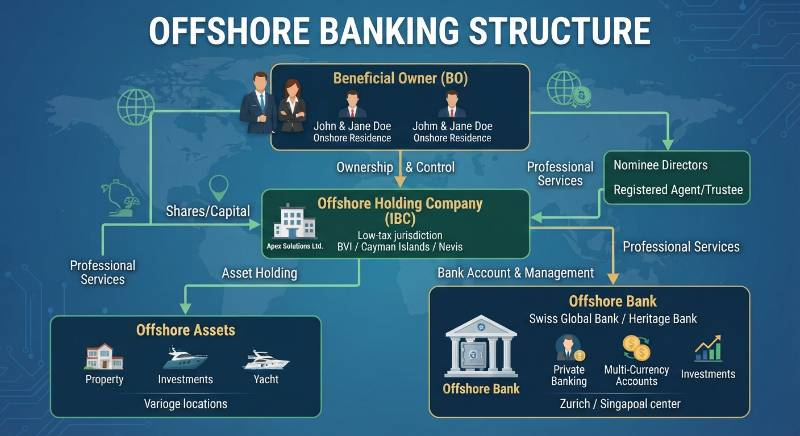
Our analysis of corporate banking operations shows that standalone BVI and Marshall Islands entities face approval rates below 15% at Tier-1 commercial banks in Hong Kong and Singapore. However, using a multi-tier cross-border structure increases banking approval rates to 88% or higher.
The Multi-Tier Hong Kong Operating Architecture
To secure reliable international treasury operations, founders typically pair their offshore holding entity with an operational Hong Kong company:
- TopCo Holding Vehicle (BVI or RMI): Holds core intellectual property, equity stakes, retained earnings, and cross-border investor cap tables.
- Operating Subsidiary (Hong Kong): Handles regional commercial contracts, local employee arrangements, merchant settlement infrastructure, and customer invoicing through Hong Kong Company Registration under the Hong Kong Companies Registry.
- Professional Compliance Layer: Retains a licensed Company Secretary Services provider and maintains professional Accounting & Audit systems to satisfy Hong Kong Inland Revenue Department (IRD) compliance and international corporate tax guidelines.
“Global corporate banking has moved decisively away from standalone shell entities. International institutions require local commercial substance, verifiable invoicing, and professional governance. Pairing an offshore parent with an operating subsidiary in a financial hub like Hong Kong creates a functional, compliant structure that satisfies Tier-1 compliance desks.”
— Head of Institutional Corporate Structuring, Olesen Global
Annual Maintenance, Government Fees, and Total Cost of Ownership
Ongoing maintenance costs represent a key factor when managing an offshore vehicle over a 3- to 5-year operational lifecycle. While initial incorporation expenses are broadly similar, ongoing registry levies, registered agent retainers, and regulatory compliance fees diverge based on capital structure and entity type.
| Cost Component | BVI Business Company (Standard 50k Shares) | Marshall Islands BCA Corporation / LLC |
|---|---|---|
| Standard Incorporation Package | $1,800 – $2,800 (includes government fees & agent setup) | $1,600 – $2,500 (includes registration & agent setup) |
| Annual Government Registry Fee | $550 (up to 50,000 shares) / $1,350 (>50,000 shares) | $450 – $500 flat annual fee |
| Annual Registered Agent & Office Retainer | $1,000 – $1,800 / year | $900 – $1,500 / year |
| Annual Financial Return / Compliance Verification | $400 – $900 (Mandatory agent filing review) | $300 – $600 (Internal accounting certification) |
| Economic Substance Annual Filing | $350 – $800 (varies by relevant activity categorization) | $300 – $700 (standard annual portal reporting) |
| Estimated 5-Year Aggregate Ownership Cost | $11,500 – $18,500 | $9,500 – $15,000 |
Step-by-Step Offshore Structuring Checklist
Follow this operational checklist to evaluate, incorporate, and operationalize your cross-border corporate structure:
- Step 1: Jurisdiction & Legal Model Selection — Select BVI for institutional venture capital financing, token foundation SPVs, or English common-law joint ventures. Select Marshall Islands for commercial maritime operations or statutory DAO legal entities.
- Step 2: Corporate Architecture Mapping — Outline the relationship between the offshore asset-holding parent and local operating companies (such as a Hong Kong operating subsidiary).
- Step 3: Verification & KYC Collection — Collect certified passport copies, proof of residential address (within 3 months), and verified source-of-wealth documentation for all beneficial owners and directors holding ≥10% equity.
- Step 4: Statutory Incorporation Filing — Draft Articles of Association, register the corporate vehicle with the respective Registrar, and appoint the statutory Registered Agent.
- Step 5: Operational Sub-Tier Formation — Complete Hong Kong Company Registration to establish commercial presence and regional operational substance.
- Step 6: Treasury & Banking Deployment — Prepare multi-tier KYC profile documentation, trade verification contracts, and customer agreements to submit for international multi-currency Bank Account Opening.
- Step 7: Annual Regulatory Maintenance — Schedule recurring ESR submissions, registered agent retainers, BVI Annual Financial Returns, and Hong Kong annual statutory audit filings.
Frequently Asked Questions: BVI vs Marshall Islands Entities
Is BVI better than the Marshall Islands for international investment?
For international venture capital, cross-border institutional financing, and private equity exits, BVI is widely preferred. Global institutional investors, tier-1 law firms, and international stock exchanges are familiar with BVI Business Companies Act structures, simplifying downstream investment and legal due diligence.
Can a Marshall Islands company open a bank account in Hong Kong?
Yes, but standalone Marshall Islands companies face strict review due to bank anti-money laundering (AML) protocols regarding offshore entities. Securing approval typically requires establishing a multi-tier structure—pairing the Marshall Islands parent with a Hong Kong operating subsidiary, backed by verified business contracts and local commercial operations.
Are director details publicly visible for BVI and Marshall Islands companies?
In the BVI, registered users of the VIRRGIN electronic filing system can run searches on the Register of Directors for a government search fee. In the Marshall Islands, director and officer registers remain confidential with the Registered Agent and are not accessible on a public register.
What are the mandatory annual accounting requirements for BVI companies?
BVI companies must submit an Annual Financial Return (comprising a balance sheet and income statement) to their Registered Agent within 9 months of their financial year-end. While not filed with the public registry, failure to provide this return to the agent risks fines and potential entity striking.
Structure Your Cross-Border Corporate Vehicle with Olesen Global
Olesen Global is a direct Hong Kong TCSP-licensed corporate service provider (License No. TC010076). We deliver first-hand, transparent cross-border entity incorporation, licensed company secretarial governance, accounting compliance, and multi-currency commercial bank account onboarding without middlemen.