For international entrepreneurs and institutional investors alike, understanding the articles of association Hong Kong company framework is not merely a matter of legal compliance. It is a strategic tool to protect shareholder interests, streamline operational governance, and satisfy strict banking compliance protocols.
Understanding the Articles of Association (AoA) under HK Cap. 622
An articles of association Hong Kong company document is the binding statutory contract that defines the relationship between the company, its shareholders, and its directors. It establishes the rules for internal corporate governance, voting rights, dividend distribution, and administrative procedures.
Since the implementation of the new Companies Ordinance (Cap. 622), Hong Kong has abolished the dual-document system. Companies are no longer required to draft a separate Memorandum of Association; instead, all constitutional terms are integrated into a single, streamlined Company constitution Hong Kong document known as the Articles of Association.
“The modern AoA under Cap. 622 acts as the operational DNA of a Hong Kong business. It is a public document filed with the Hong Kong Companies Registry, and any mismatch between operational practices and AoA clauses can result in severe personal liability for directors.”
— Senior Compliance Officer, Olesen Global (TCSP License: TC010076)
Based on our 10+ years of corporate secretarial data, approximately 92% of international businesses utilizing standard templates encounter governance bottlenecks during expansion because their initial articles lacked provisions for remote board resolutions or digital signatures.
Model Articles vs. Customized Articles: Which is Right for You?
When executing your Hong Kong Company Registration, you must decide whether to adopt the statutory Model Articles of Association or draft customized articles.
To help founders make this decision, we employ The Corporate Governance Velocity Framework. This framework evaluates your regulatory needs across three core dimensions: shareholder complexity, funding roadmap, and exit strategy.
| Evaluation Dimension | Statutory Model Articles | Customized Articles (Olesen Global) |
|---|---|---|
| Operational Setup Cost | Zero initial preparation cost. | Requires professional legal and corporate drafting. |
| Share Class Flexibility | Restricted to standard ordinary shares. | Supports multiple classes (A/B voting, preference, redeemable). |
| VC & Angel Suitability | Poor; lacks drag-along, tag-along, and anti-dilution rights. | High; fully structures investor protections. |
| Digital & Global Boardroom | Basic; physical attendance or standard proxies. | Fully optimized for remote, cross-border, and digital voting. |
For a solo entrepreneur launching a consulting firm, the standard Model Articles are often sufficient. However, for a cross-border e-commerce brand or a joint-venture tech firm, customized articles prevent future shareholder disputes.
Mandatory Clauses Required in Hong Kong Company Articles
Regardless of how customized your constitutional documents are, the Hong Kong Companies Registry mandates that every AoA must contain specific clauses to be legally valid under Cap. 622.
These mandatory provisions establish the fundamental boundaries of the corporate entity:
- The Company Name: Must match the approved name exactly, including correct English/Chinese characters and the statutory suffix “Limited”.
- Member Liability Clause: Must explicitly state that the liability of its members is limited to the amount unpaid on the shares held by them.
- Share Capital and Member Rights: Must outline the initial capital structure, the division of shares, and the rights attached to those shares.
- Execution of Documents: Outlines how the company executes deeds and contracts, including the use or optional exclusion of a common seal.
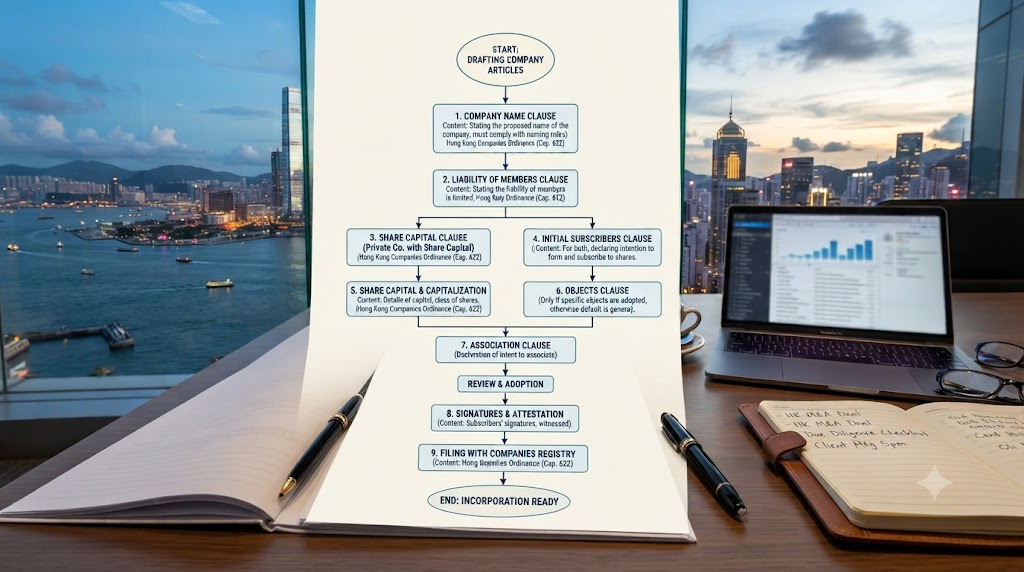
Under Section 81 of the Companies Ordinance, failure to include these mandatory disclosures will result in the immediate rejection of your incorporation application. Retaining a professional Company Secretary Services partner ensures that these statutory requirements are seamlessly integrated into your filing.
Tailoring AoA for Web3, Crypto, and Venture Capital Startups
For a Web3 startup based in Cyberport or a crypto-asset fund operating out of Central, standard corporate templates are inadequate. These modern business models require unique corporate mechanisms that are not covered by standard model articles.
To successfully navigate the intersection of traditional corporate law and decentralized operations, customized articles of association must address several key areas:
1. Token Warrant and Equity Conversions
Web3 entities often issue tokens alongside equity. Your customized AoA must outline how future token distributions or Simple Agreements for Future Tokens (SAFTs) affect existing equity holders and dilute share capital and member rights.
2. Decentralized Governance Integration
If your Hong Kong entity acts as the legal wrapper for a Decentralized Autonomous Organization (DAO), the AoA must legally recognize on-chain snapshot voting or multisig wallet executions as valid board resolutions.
“We regularly see venture capital funds walk away from Web3 deals in Hong Kong because the startup’s Articles of Association did not clearly define liquidation preferences or failed to protect IP assets during a hard fork scenario.”
— Lead Tech Attorney, Hong Kong Venture Counsel
By customizing your articles from day one, you build a robust legal foundation that protects founders while providing institutional investors with the regulatory certainty they require.
Step-by-Step Guide to Amending and Filing Your HK AoA
As your business scales, your original constitutional documents may no longer meet your operational needs. Whether you are introducing a new class of shares for a Series A round or restructuring voting rights, you must follow a strict statutory process to amend your articles.
The amendment process must comply with the provisions of Cap. 622:
| Step | Action Required | Statutory Deadline |
|---|---|---|
| 1. Board Review | Convene a board meeting to draft the proposed changes and approve the convening of a general meeting. | N/A |
| 2. Shareholder Vote | Pass a special resolution to amend articles, requiring a minimum of 75% approval from voting members. | At the General Meeting (or via written resolution) |
| 3. Registry Filing | File Form NAA1 along with a certified true copy of the special resolution and the newly amended AoA. | Within 15 days of passing the resolution |
| 4. Compliance Update | Update internal company registers and provide copies of the new AoA to current shareholders and lenders. | Immediate upon registration |
Failure to submit Form NAA1 within the 15-day statutory limit is an offense under the Companies Ordinance. The company and every responsible officer are subject to a level 3 fine (up to HKD 10,000) and daily default fines.
Self-Assessment: Does Your AoA Satisfy HK Bank Compliance?
Opening a corporate bank account in Hong Kong is notoriously rigorous. Banks scrutinize your articles of association Hong Kong company documents to assess operational risks, beneficial ownership structures, and compliance with anti-money laundering (AML) protocols.
Ensure your AoA passes bank compliance checks by assessing it against these three key requirements:
- Clear Beneficial Ownership Paths: Does your AoA clearly define how share transfers are approved, allowing the bank to trace ownership back to the ultimate beneficial owners (UBOs)?
- Permitted Business Activities: If your company operates in a regulated sector (e.g., fintech, payments, or lending), does your AoA contain clear clauses regarding your operational scope and compliance mandates?
- Director Powers and Signing Authorities: Are the signing authorities and thresholds for corporate borrowing explicitly defined to satisfy banking risk departments?
If your AoA contains ambiguous clauses regarding share transfers or lacks clear director appointment protocols, major institutions like HSBC, Standard Chartered, or BOC may reject your account application. Our team at Olesen Global regularly reviews and adjusts clients’ articles prior to bank submission to ensure a smooth onboarding process.
Statistical Insights: Common AoA Compliance Pitfalls
According to research looking at corporate filings across 10,000 newly established Hong Kong companies, compliance errors in constitutional documents frequently cause operational delays:
- 34% of filings experienced initial delays at the Hong Kong Companies Registry due to clerical errors in the company name or incorrect share capital structures.
- 48% of multi-shareholder startups faced internal governance disputes within the first 24 months because they relied on standard Model Articles that lacked clear dispute-resolution or share-buyback mechanisms.
- 18% of foreign-owned companies faced bank account opening delays because their AoA did not explicitly allow for digital board meetings or electronic signatures, which are crucial for remote operations.
These statistics highlight the importance of working with an experienced TCSP licensed provider Hong Kong to draft and maintain your corporate constitution.
Frequently Asked Questions About HK Company Articles
What is the difference between Memorandum and Articles of Association in HK?
Under the old Companies Ordinance (Cap. 32), a company required both a Memorandum of Association (defining external powers) and Articles of Association (defining internal rules). Under the modern Companies Ordinance (Chapter 622), the Memorandum is abolished, and all constitutional terms are integrated into a single articles of association Hong Kong company document.
Can a sole director amend the Articles of Association?
No. Directors do not have the unilateral authority to amend the Articles of Association. Amending the articles requires a special resolution to amend articles, which must be approved by at least 75% of voting shareholders at a general meeting or via a written resolution.
How do I verify if my company’s AoA is legally active and up to date?
You can verify your current AoA by conducting a company search on the Cyber Search Centre of the Hong Kong Companies Registry. A licensed corporate secretary can also perform this check and review your documents to ensure they comply with the latest statutory requirements.
Establish Your Compliant HK Entity with Olesen Global
Don’t let rigid templates or compliance errors delay your global expansion. Partner with Olesen Global (傲承环球), a premier, first-hand TCSP-licensed provider (TC010076) in Hong Kong. We offer bespoke Hong Kong Company Registration, expert Company Secretary Services, and comprehensive support for corporate bank account opening.