Executing a compliant offshore corporate structure requires clear alignment between statutory corporate maintenance, commercial substance, and international taxation guidelines. Structuring your business properly from day one protects your corporate standing and unlocks sustainable international expansion.
The 4-Pillar Hong Kong Offshore Feasibility and Substance Audit Framework
Establishing a legally sound offshore structure in Hong Kong requires evaluating operational substance, statutory licensing, international tax rules, and banking feasibility before submitting incorporation filings. Foreign founders must balance corporate agility with strict compliance under local legislation.
The 4-Pillar Hong Kong Offshore Feasibility and Substance Audit Framework serves as an objective evaluation system for international businesses planning non-resident operations:
- 1. First-Hand TCSP Licensing & Local Substance: Engagement directly with a registered license holder (such as Hong Kong Company Registration provider Olesen Global, License TC010076) rather than multi-layered agents. This ensures strict compliance with Anti-Money Laundering (AML) standards and verified physical address maintenance.
- 2. FSIE Compliance and Offshore Claim Viability: Objective assessment of contract formation points, server locations, overseas supplier interactions, and management decision trails under the revised Foreign Source Income Exemption (FSIE) framework.
- 3. Multi-Tier Corporate Banking Probability: Pre-vetting corporate profiles against risk appetites of tier-1 traditional commercial banks, virtual financial institutions, and multi-currency EMIs.
- 4. Transparent End-to-End Cost Governance: Full upfront disclosure of initial government statutory fees, licensed corporate secretarial fees, annual accounting, and independent CPA audit costs without hidden markups.
“True offshore corporate efficiency is not about avoiding statutory governance; it is about building unassailable operational trails that substantiate where economic activity occurs.”
— Senior Corporate Compliance Director, Olesen Global
Navigating Hong Kong’s Expanded FSIE Regime: Offshore Profit Exemption Rules
Hong Kong operates on a strict territorial principle of taxation under the Inland Revenue Department (Hong Kong) Ordinance. Only profits arising in or derived from a trade, profession, or business carried on in Hong Kong are subject to profits tax (standard rate of 16.5%, or 8.25% under the two-tier regime for the first HKD 2 million).
Offshore Profit Claim: A formal statutory claim submitted alongside an audited tax return asserting that business revenue is derived completely outside Hong Kong, legally qualifying it for a 0% profits tax assessment.
Hong Kong’s enhanced Foreign Source Income Exemption (FSIE) regime aligns local tax laws with international standards set by the European Union and the OECD. Passive income (dividends, interest, equity disposal gains, intellectual property income) and specified active cross-border transactions require adequate economic substance or proof of foreign business nexus to secure exemption.
Key parameters scrutinized by the IRD when assessing an offshore claim include:
- The exact geographical location where contracts of purchase and sale are negotiated, signed, and executed.
- The location of physical inventory storage and direct delivery routes that bypass Hong Kong ports.
- The place of physical residence and day-to-day operations of key managerial decision-makers.
- Payment receipt channels and physical absence of Hong Kong-based personnel or dedicated local facilities.
Niche Scenario: 0% Offshore Tax Structuring for Non-Resident Web3 & Cross-Border SaaS Founders
Digital-native businesses—including cross-border SaaS, distributed Web3 infrastructure providers, and software consulting agencies—operate across decentralized physical nodes. These operational models present distinct advantages when organizing under Hong Kong corporate law.
For a non-resident founder managing an engineering team in Europe while serving global enterprise clients, establishing an offshore tax stance requires meticulous documentation:
- Decentralized Infrastructure: Document cloud hosting configurations (e.g., AWS, GCP) operating outside Hong Kong data centers.
- Remote Board Resolutions: Formalize key corporate resolutions and software release approvals with timestamps showing execution outside Hong Kong borders.
- Client Agreements: Ensure cross-border SaaS Terms of Service and sales contracts specify governing jurisdictions reflecting international counterparty locations.
- Audit Verification: Pair internal records with professional Accounting & Audit Services to present an unambiguous transaction ledger to the IRD.
“When defending a non-resident SaaS or digital asset corporate structure, contemporaneous communication logs and non-local payment routing trails are just as vital as the legal contracts themselves.”
— International Tax Advisory Group, Hong Kong
Statutory Incorporation Requirements & Governance Standards
Under the Companies Ordinance (Cap. 622) administered by the Hong Kong Companies Registry, every private company limited by shares must satisfy concrete structural thresholds.
- Shareholders & Directors: At least one natural person or corporate director (any nationality/residency) and one shareholder. 100% foreign ownership is fully permitted.
- Company Secretary: Mandatory appointment of a local resident or a verified corporate entity holding a valid TCSP License (such as TC010076). A sole director cannot concurrently serve as company secretary.
- Registered Office: A physical Hong Kong commercial address for statutory and legal communications (P.O. boxes are legally invalid).
- Significant Controllers Register (SCR): An internal register identifying beneficial owners holding over 25% voting rights or capital, accessible upon inspection by local law enforcement.
- Designated Representative: A designated contact person (typically the licensed Company Secretary or a Hong Kong resident) to provide legal assistance with the SCR to registry inspectors.
Direct TCSP Licensees vs Unlicensed Intermediaries: Critical Risk & Cost Comparison
Foreign founders frequently encounter online agents who broker setup requests through multiple sub-contractors. Engaging directly with a licensed TCSP provides legal protection, transparent communication, and regulatory certainty.
| Evaluation Dimension | Direct TCSP Licensee (Olesen Global TC010076) | Unlicensed Third-Party Broker |
|---|---|---|
| Statutory License Status | Directly verified under Hong Kong Registry Registry (TC010076) | Unlicensed; acts as an unverified sales middleman |
| Data Security & KYC Handling | Encrypted direct processing under Anti-Money Laundering Ordinance | Passport and ID data exposed across unvetted sub-contractors |
| Filing Velocity | Same-day electronic e-Registry submission (24-48 hour turnaround) | Extended delays due to multi-tier agent relay (5-10 business days) |
| Pricing & Annual Maintenance | 100% transparent upfront pricing; zero hidden audit or renewal markups | Low initial hook pricing offset by excessive year-two renewal fees |
| Direct Accountability | Dedicated licensed corporate secretary and in-house CPA support | Dispersed support channels with no legal accountability in Hong Kong |
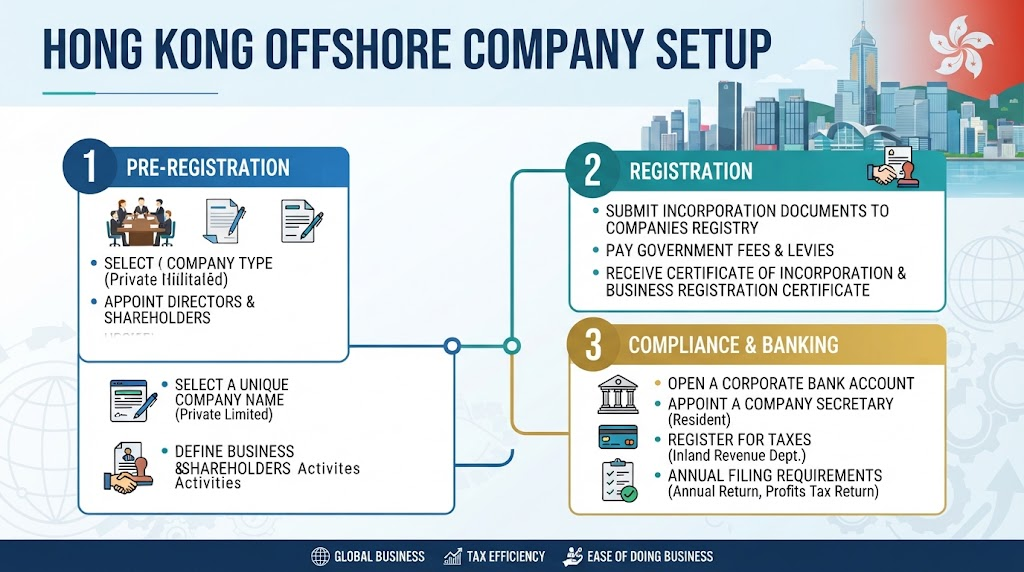
Step-by-Step Hong Kong Company Registration Workflow
The incorporation process moves efficiently when company documents and compliance clearances are arranged sequentially. Working alongside licensed Company Secretary Services keeps filing lead times to a minimum.
Below is the structured registration process for international applicants:
- Step 1: Company Name Clearance: Perform a real-time availability search against the Hong Kong Companies Registry database to ensure uniqueness and regulatory compliance.
- Step 2: Corporate Structure Finalization: Define share capital allocations (standard: HKD 10,000 divided into 10,000 shares), director appointments, and official business scope descriptions.
- Step 3: Identification & KYC Verification: Submit notarized passport copies and address proofs (dated within 3 months) for all directors and ultimate beneficial owners (UBOs).
- Step 4: Statutory Document Drafting: Prepare Articles of Association (NNC1 Form), statutory consent forms, and official appointment declarations.
- Step 5: Electronic Filing & Fee Remittance: Transmit corporate files via the direct TCSP e-Registry channel and pay official government fees.
- Step 6: Issuance of Legal Certificates: Receive the formal Certificate of Incorporation (CI) and Business Registration Certificate (BRC).
- Step 7: Brand Protection: Protect intellectual assets across global target markets through direct Trademark Registration.
Multi-Tier Corporate Banking Strategy for Foreign Non-Resident Directors
Opening a commercial bank account represents a crucial step for offshore company operations. Regulatory oversight under the Hong Kong Monetary Authority (HKMA) requires banks to maintain strict Customer Due Diligence (CDD) procedures.
Relying on a single banking channel introduces operational risk. A diversified multi-tier strategy ensures reliable transaction flows:
- Tier 1 — Traditional Hong Kong Retail/Commercial Banks: Institutions such as HSBC, Standard Chartered, and Bank of China (Hong Kong). These accounts offer high prestige, broad credit facilities, and comprehensive merchant processing, though they typically require a face-to-face interview or thorough proof of business nexus.
- Tier 2 — Hong Kong Licensed Virtual Commercial Banks: Institutions including ZA Bank, PAObank, and Livi Bank. These platforms provide fully remote digital onboarding, seamless integration with Hong Kong’s Faster Payment System (FPS), and lower opening hurdles for digital-first businesses.
- Tier 3 — Global Electronic Money Institutions (EMIs): Cross-border fintechs such as Airwallex, Currenxy, and Statrys. These services deliver rapid multi-currency settlement capabilities, diverse local clearing routes (ACH, SEPA, CHAPS), and swift initial account deployment.
Leveraging tailored Bank Account Opening Support allows foreign founders to match their business model with the right banking partners, streamlining approvals and compliance reviews.
Post-Incorporation Compliance: Annual Returns, CPA Audit, and Tax Returns
Hong Kong companies must complete regular statutory filings to maintain good standing and protect their legal status.
1. Annual Return (Form NAR1)
Mandatory annual filing with the Hong Kong Companies Registry within 42 days of the company’s incorporation anniversary date. It confirms director details, shareholder allocations, and registered office records.
2. Business Registration Certificate (BRC) Renewal
Annual or three-year renewal through the Inland Revenue Department’s Business Registration Office. The current certificate must be retained on corporate record.
3. Mandatory Certified Public Accountant (CPA) Annual Audit
Every Hong Kong incorporated company must prepare financial statements audited by an independent Hong Kong Certified Public Accountant (Practicing) under Section 429 of Cap. 622. Even companies claiming offshore profits tax exemption must complete a formal annual CPA audit.
4. Profits Tax Return (PTR) Filing
Submission of the completed PTR to the Inland Revenue Department alongside audited financial statements and tax computations. The first PTR is generally issued 18 months post-incorporation.
Key Benchmarks: 2026 Hong Kong Offshore Incorporation Metrics and Timelines
Understanding statutory processing times and operational milestones simplifies corporate planning for international operations.
| Statutory Process / Milestone | Typical Timeline | Regulatory Authority | Key Compliance Requirement |
|---|---|---|---|
| Electronic Company Incorporation | 24 to 48 Hours | Companies Registry | NNC1 e-Filing & Name Verification |
| Virtual Bank Account Approval | 5 to 10 Business Days | Licensed Virtual Banks | Remote KYC & Business Proofs |
| Traditional Bank Account Opening | 3 to 6 Weeks | Commercial Banks | In-Person or Video CDD Interview |
| Annual Return (NAR1) Filing | Within 42 Days of Anniversary | Companies Registry | Statutory Corporate Return |
| First Profits Tax Return (PTR) | Within 3 Months of Issuance | Inland Revenue Department | Audited Financials & Computation |
Frequently Asked Questions (FAQs)
Is it better to use a direct TCSP-licensed agency or an online intermediary for Hong Kong offshore company setup?
Direct TCSP-licensed providers like Olesen Global (License TC010076) handle statutory filings directly without third-party markups. This ensures full compliance with the Anti-Money Laundering Ordinance, clear accountability, and secure handling of corporate identity documents. Unlicensed intermediaries introduce data privacy risks and added middleman fees.
Can a foreign-owned Hong Kong company still qualify for a 0% offshore tax exemption?
Yes. Under Hong Kong’s territorial tax system and updated FSIE rules, income substantiated as generated purely outside Hong Kong can qualify for an offshore profits tax exemption. Complete transaction logs, overseas contracts, cross-border logistics trails, and proper CPA audit documentation must be maintained for Inland Revenue Department review.
How can I verify if a Hong Kong company secretary is legally licensed?
You can verify any provider’s authenticity on the Hong Kong Companies Registry Trust and Company Service Providers (TCSP) online public register. Olesen Global operates under official license number TC010076 with physical operations in Hong Kong.
Can I open a Hong Kong business bank account completely remotely as a non-resident?
Yes. Hong Kong licensed virtual banks (e.g., ZA Bank, PAObank) and global EMIs offer fully remote identity verification and digital account opening for non-resident directors. Traditional commercial banks may still require an in-person meeting or extensive business proof.
Launch Your Hong Kong Offshore Company with Olesen Global
Set up your Hong Kong corporate entity on a compliant foundation. Olesen Global (License TC010076) provides direct execution, transparent pricing, and professional compliance support:
- Step 1: Submit your proposed company name and business scope for free pre-screening.
- Step 2: Receive a tailored incorporation and FSIE tax structuring blueprint from licensed TCSP specialists.
- Step 3: Complete fast e-Registry filing and banking pre-qualification with direct 1-on-1 support.
Official Sources & References
- IRD – Territorial Source Principle Official IRD explanation of Hong Kong's territorial tax system
- IRD – DIPN 21: Locality of Profits Departmental Interpretation and Practice Note on offshore profits
- OECD – BEPS Framework International anti-avoidance framework affecting offshore structures
Hong Kong Tax & Compliance Guide
- Hong Kong Profits Tax Rate 2026
- Hong Kong Offshore Company Setup GuideNow
- Annual Return Filing in Hong Kong
- Hong Kong vs. Singapore: Which is Better?
Our Related Services
Continue Reading
Ready to Register Your Hong Kong Company?
Our TCSP-licensed advisors (TC010076) are ready to help you navigate the process. Get a free consultation today.
Free Consultation