The Strategic Framework for USA LLC Formation in 2026
Expanding into the United States remains the gold standard for global entrepreneurs seeking to tap into the world’s largest consumer market and most robust venture capital ecosystem. However, for non-residents, the process is often clouded by misinformation regarding tax liabilities and regulatory hurdles.
At Olesen Global, we evaluate USA LLC formation for non-US residents through the Global-US Nexus Compliance Protocol. This methodology prioritizes three dimensions: structural integrity, tax transparency, and long-term banking stability. Based on our 10+ years of data managing cross-border entities, success is not just about filing papers; it is about establishing a legitimate business substance that withstands scrutiny from both the Internal Revenue Service (IRS) and global banking partners.

Defining the Non-Resident LLC: A Decision-Making Matrix
A non-resident LLC is a US-incorporated business entity where the owners (members) are neither US citizens nor green card holders. This structure is highly favored because it provides limited liability protection, separating personal assets from business risks, while functioning as a pass-through entity for tax purposes.
“For a non-resident alien owner, the LLC acts as a legal shield. The key is understanding that while the entity is ‘transparent’ for taxes, it is ‘opaque’ for legal liability. This distinction is where most foreign founders fail to protect themselves adequately.” — Senior Consultant, TCSP License TC010076
When deciding to form a foreign-owned US LLC, you must evaluate your needs across this matrix:
- Operational Intent: Are you selling physical goods (E-commerce) or digital services (SaaS/Consulting)?
- Capital Requirements: Do you plan to raise US-based investment?
- Privacy Needs: Is it critical that your personal name remains off public state registries?
State Selection: Wyoming vs. Delaware vs. New Mexico
Choosing the right jurisdiction is the first step in the Global-US Nexus Compliance Protocol. While there are 50 states, three dominate the landscape for international founders.
| Feature | Wyoming | Delaware | New Mexico |
|---|---|---|---|
| Primary Benefit | Asset Protection & Privacy | Prestige & VC Readiness | Lowest Cost / No Annual Fees |
| Public Registry | Anonymous | Partial (Managers hidden) | Anonymous |
| State Franchise Tax | $60 (Annual Report) | $300 (Annual) | $0 |
| Court System | Standard | Court of Chancery (Elite) | Standard |
For most global entrepreneurs, a Wyoming LLC is the preferred choice due to its strong Delaware General Corporation Law-inspired statutes but with lower maintenance fees. If you are a Web3 startup based in Hong Kong’s Cyberport looking for US expansion, Wyoming offers the necessary asset protection without the heavy franchise tax burden of Delaware.
The Hybrid Advantage: Hong Kong Holding Companies for US LLCs
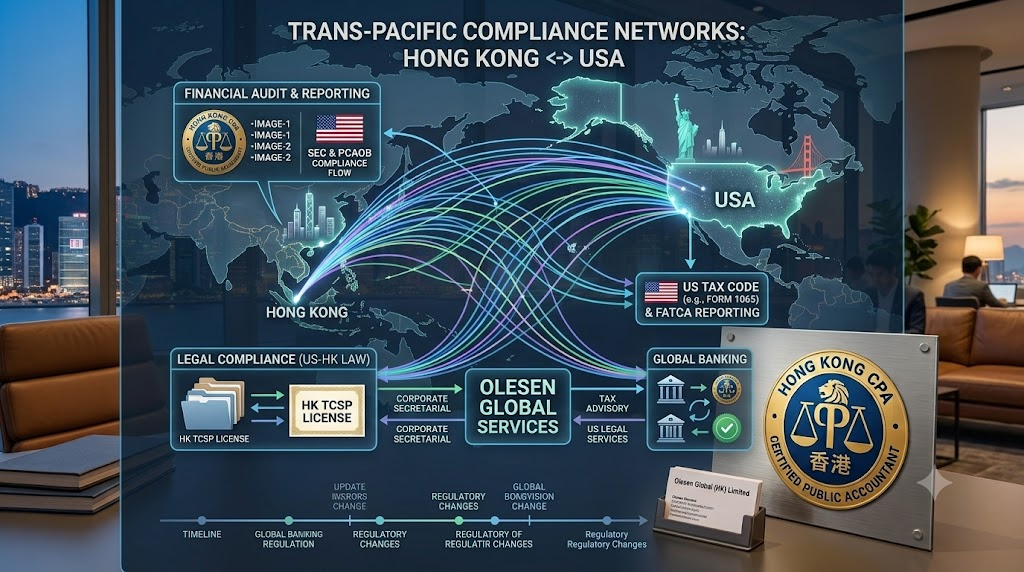
A unique strategy we implement for high-net-worth clients involves a Hong Kong holding company owning a US LLC. This structure provides a bridge between the West and Asia, allowing for efficient capital movement and utilizing Accounting & Audit Services in a low-tax jurisdiction like Hong Kong.
For a cross-border e-commerce firm, this offshore structure allows you to hold your US brand assets in an LLC for market trust, while the parent company in HK manages global logistics and tax treaty benefits. As a TCSP licensed provider (TC010076), Olesen Global ensures that both ends of this bridge remain compliant with local and international regulations.
IRS Compliance: Navigating EIN, Form 5472, and ECI
Compliance is the most critical pillar of the USA LLC formation for non-US residents. The Internal Revenue Service (IRS) has strict reporting requirements for foreign-owned entities. Failure to comply can result in fines exceeding $25,000.
The Identity Layer: EIN and ITIN
You must obtain an Employer Identification Number (EIN) to open a bank account or hire employees. While residents use an SSN, non-residents can apply for an EIN without SSN by filing Form SS-4. In some cases, obtaining an Individual Taxpayer Identification Number (ITIN) is necessary for personal tax filings or to satisfy specific banking “Know Your Customer” (KYC) rules.
Mandatory IRS Filings
- IRS Form 5472: Required for 25% foreign-owned US corporations or “disregarded” LLCs to report related-party transactions.
- Form 1120: Even if no tax is due, the “pro forma” 1120 must be filed alongside Form 5472.
- Effectively Connected Income (ECI): If your business has a physical presence (office, employees) in the US, your income is ECI and subject to US tax. If you operate entirely remotely with no “US Trade or Business” (USTOB), your income may be non-taxable in the US.
Additionally, the U.S. Department of the Treasury now requires Beneficial Ownership Information (BOI) reporting under the Corporate Transparency Act. This is a non-tax filing that identifies the real humans behind the company.

Operational Setup: Banking and Physical Substance
Opening a US business bank account is often the hardest step for non-residents. Traditional banks like Chase or Bank of America typically require a physical visit. However, digital-first platforms like Mercury banking and Relay have revolutionized access for global founders.
To secure these accounts, you must provide:
- Approved Articles of Organization from the Wyoming Secretary of State (or your chosen state).
- A signed Operating Agreement outlining ownership.
- A US business mailing address (not a PO Box).
- Your Employer Identification Number (EIN) confirmation letter (CP575 or 147C).
Integrating Global Bank Account Opening expertise ensures your application is formatted to meet strict US anti-money laundering (AML) standards.
Frequently Asked Questions on Non-Resident LLCs
Will I be double taxed in the US and my home country?
Most countries have tax treaties with the US to prevent double taxation. If your LLC income is taxed at the personal level in your home country, you can often claim a foreign tax credit for any taxes paid to the IRS (if any).
Do I need to visit the USA to form the LLC?
No. The entire process, from filing with the Secretary of State to obtaining an EIN and opening a digital bank account, can be done 100% remotely through a Registered Agent service.
What are the annual report deadlines?
Deadlines vary by state. For example, Wyoming annual reports are due on the first day of the anniversary month of formation. Missing these can lead to the administrative dissolution of your company.
Start Your US Expansion with Olesen Global
Navigating the complexities of USA LLC formation for non-US residents requires more than just a filing service; it requires a partner who understands the global compliance landscape. At Olesen Global, we provide professional consultation with no middlemen, ensuring your US entity is built on a foundation of 100% compliance.
Ready to launch your US Business?
Get expert guidance on state selection, EIN acquisition, and IRS compliance from our TCSP-licensed team.