Choosing Your Business Structure in Hong Kong: An Overview
Deciding between a Hong Kong limited company and a sole proprietorship is the most critical hurdle for any entrepreneur entering the Asia-Pacific market. This choice dictates your personal risk, your tax obligations, and your ability to scale operations globally.
In 2026, regulatory scrutiny by the Inland Revenue Department (IRD) has intensified. Selecting a structure is no longer just about administrative ease—it is about long-term survival and compliance in a digital-first financial ecosystem.

Defining the Entities: Limited Company vs. Sole Proprietorship
A Hong Kong limited company is a separate legal entity that shields owners from personal liability, while a sole proprietorship is a direct extension of the individual owner. Choosing the right structure depends on whether you prioritize asset protection and scalability over administrative simplicity and lower initial costs.
“Under the Hong Kong Companies Ordinance, a limited company possesses its own legal personality, allowing it to own property, enter contracts, and incur debt independently of its shareholders.”
A sole proprietorship, governed by the Business Registration Ordinance, offers no such distinction. The owner and the business are one and the same in the eyes of the law. If the business fails or faces a lawsuit, the owner’s personal savings, home, and assets are fully exposed.
The Olesen “Five-Factor Compliance Framework” for Business Selection
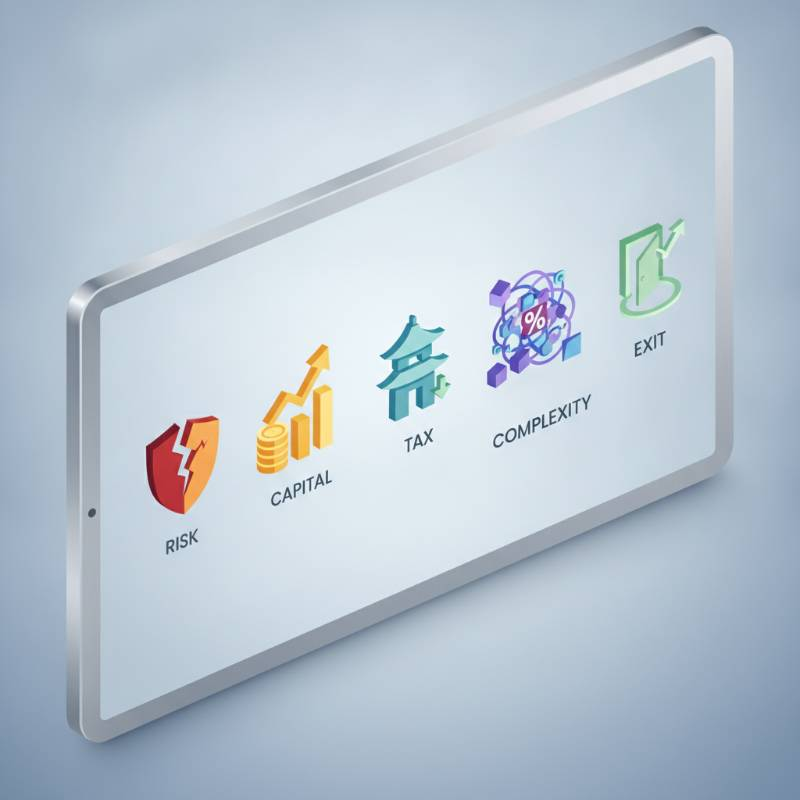
Based on our years of experience as a TCSP-licensed provider, we developed the Olesen Five-Factor Compliance Framework. We use this data-driven approach to help clients determine their ideal structure:
- Risk Tolerance: High-risk industries or those with significant debt requirements must opt for a limited company to safeguard personal wealth.
- Capital Requirements: If you plan to seek venture capital or outside investors, a limited company is mandatory for equity distribution.
- Tax Efficiency: While both enjoy low rates, the limited company allows for more sophisticated tax planning and expense deductions.
- Operational Complexity: Sole proprietorships are easier to maintain but lack the professional “backbone” required for global trade.
- Future Exit Strategy: It is significantly easier to sell a limited company (via share transfer) than to sell the assets of a sole proprietorship.
Legal & Liability Comparison: Protecting Your Personal Assets
The concept of limited liability is the cornerstone of modern commerce. When you complete your Hong Kong Company Registration, you create a “corporate veil.” This veil ensures that your personal liability is limited to the amount of capital you have invested in the company.
Conversely, a sole proprietor faces unlimited liability. In the event of a commercial dispute or bankruptcy, creditors can pursue the owner’s personal bank accounts and property. This risk is often too high for international entrepreneurs who cannot personally oversee every daily operation in Hong Kong.
Taxation and Financial Compliance in 2026
Hong Kong remains one of the world’s most tax-friendly jurisdictions. Both structures benefit from a two-tiered profits tax system. For limited companies, the first HKD 2 million in profits is taxed at just 8.25%, with the remainder at 16.5%.
However, the 2026 IRD Compliance Methodology now mandates digital filing for all corporations. A major differentiator is the Accounting & Audit Compliance requirement. Every limited company must appoint a certified public accountant (CPA) to perform an annual audit. While this adds a cost, it provides the transparency needed for HK bank account opening and international credibility.
| Feature | Limited Company | Sole Proprietorship |
|---|---|---|
| Profits Tax Rate | 8.25% / 16.5% | 7.5% / 15% |
| Mandatory Audit | Yes (Annual) | No |
| Digital Filing | Mandatory (2026) | Optional / Simplified |
Operational Setup: Company Secretary and Registered Office
To maintain a limited company, you must adhere to strict statutory requirements. This includes maintaining a registered office address in Hong Kong (not a P.O. box) and appointing a Company Secretary Services provider who is a local resident or a TCSP licensee.
Sole proprietorships are significantly simpler to set up, requiring only a Business Registration Certificate from the IRD. However, this simplicity often prevents the business from successfully applying for an HK visa for entrepreneurs or securing commercial leases from major landlords.
Transition Roadmap: Converting a Sole Proprietorship to a Limited Company
Many of our clients begin as sole proprietors to test the market and later transition as they grow. This process, which we call “Structural Scaling,” involves several key steps:
- Incorporating a new limited company.
- Formally transferring all business contracts and assets from the individual to the new entity.
- Closing the original sole proprietorship registration.
- Opening a new corporate bank account under the limited company’s name.
Failure to follow this roadmap correctly can result in “Tax Gaps” where the IRD may challenge the continuity of your business expenses. We recommend professional guidance to ensure a seamless asset transfer.
Why Olesen Global is Your Direct Licensed Partner
Working with Olesen Global means you are dealing with a first-hand service provider. Unlike many online agencies, we hold a physical office in Hong Kong and a verified TCSP License (TC010076). We eliminate the middlemen, providing you with direct access to compliance experts.
“In our experience, the primary reason HK businesses fail in their first three years isn’t a lack of profit—it’s a lack of compliance. A limited company is a tool for protection, but it requires a licensed hand to steer it through the IRD’s evolving requirements.”
— Senior Consultant, Olesen Global (HK Chartered Secretary)
Our “Five Core Services” ensure that from the moment you register your company to your first Profits Tax Return, you are backed by a team that understands the nuances of the Inland Revenue Department and the Companies Registry.
Frequently Asked Questions about HK Business Structures
Can a foreigner open a sole proprietorship in Hong Kong?
Technically yes, but it is extremely difficult to open a bank account or obtain a work visa as a sole proprietor. For foreign investors, a limited company is almost always the preferred choice for operational viability.
What is the cost of maintaining a limited company?
Maintenance includes annual renewal of the business registration, company secretary fees, and the mandatory annual audit. While higher than a sole proprietorship, the tax savings and liability protection often outweigh these costs as revenue grows.
Does a limited company help with a Hong Kong Visa?
Yes. The Immigration Department views a limited company as a more stable and committed investment. It is much easier to sponsor an Investment Visa or a Top Talent Pass (TTPS) through a structured corporate entity.
Ready to Structure Your Success?
Don’t leave your personal assets at risk. Get a free consultation with our TCSP-licensed experts today.