Singapore vs Hong Kong Company Registration: Executive Verdict
Choosing between Singapore and the Hong Kong Special Administrative Region depends on your operational footprint, governance preferences, and supply chain ties. Hong Kong delivers unmatched cost-efficiency, 100% foreign directorship flexibility, and direct integration with mainland China and global capital markets. Singapore offers a prestigious springboard into Southeast Asian (ASEAN) markets, balanced by stricter statutory residency mandates.
For international founders seeking lean corporate holding structures, international trade gateways, or Web3 ventures, Hong Kong offers lower structural friction and simpler directorship requirements. If your focus centers primarily on localized Southeast Asian government tenders or specialized ASEAN venture capital funds, Singapore remains a viable alternative.
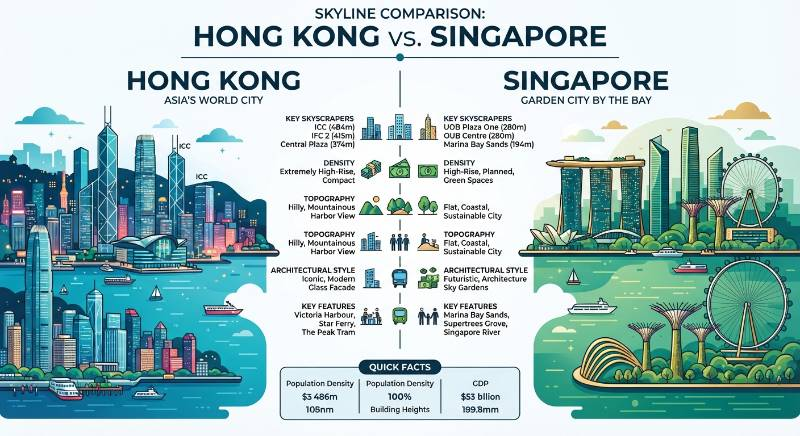
The 5-Pillar Jurisdiction Arbitrage Framework
Based on our decade of practitioner data managing over 3,000 corporate structures at Olesen Global, evaluating an Asian corporate seat requires looking beyond headline corporate tax figures. Founders must evaluate five structural pillars before committing capital:
- Statutory Governance Burden: Does the jurisdiction require resident directors, and what liabilities do nominee arrangements create?
- Effective Tax Realization: How does territorial tax source assessment compare against single-tier modified corporate tax with exemptions?
- Banking Capital Velocity: What is the document threshold and onboarding timeline for Tier-1 physical and multi-currency digital banks?
- Regulatory Friction: What are the mandatory filing schedules, statutory CPA audit requirements, and annual compliance overheads?
- Regional Market Proximity: Does the location offer superior integration with the Greater Bay Area supply chain or ASEAN trade agreements?
“Selecting a jurisdiction purely on headline tax rates overlooks statutory liabilities. A mandatory nominee director requirement in Singapore introduces operational drag and recurring annual security deposits that do not exist under Hong Kong company law.”
— Senior Corporate Governance Counsel, Olesen Global
Taxation Models Compared: Territorial Source vs. Single-Tier Corporate Tax
Tax architecture differs fundamentally between the Hong Kong Inland Revenue Department (IRD) and the Inland Revenue Authority of Singapore (IRAS).
Hong Kong Two-Tier Profits Tax & Territorial Sourcing
Hong Kong operates under the Inland Revenue Ordinance (Cap. 112), enforcing a strict territorial tax principle. Profits are taxed based on where the profit-generating operations physically take place, not where the entity is incorporated.
- Two-Tier Profits Tax Regime: Corporations are taxed at 8.25% on their first HKD 2,000,000 of assessable profits, and 16.5% on assessable profits beyond that threshold.
- Zero Withholding Tax: Dividends distributed to domestic or foreign shareholders face 0% withholding tax.
- Zero Capital Gains & VAT: No capital gains tax, no value-added tax (VAT), and no goods and services tax (GST).
- Offshore Tax Exemption Claims: Under qualifying Foreign Sourced Income Exemption (FSIE) rules, profits demonstrably sourced entirely outside Hong Kong may apply for formal offshore status.
Singapore Single-Tier Territorial/Remittance System
The Republic of Singapore levies a flat headline Corporate Income Tax (CIT) rate of 17%. Singapore adopts a modified territorial basis where foreign-sourced income is taxable once remitted or deemed remitted into Singapore, unless specific exemptions apply under Section 13(8) of the Singapore Income Tax Act.
- Partial Tax Exemption (PTE): Standard companies receive a 75% exemption on the first SGD 10,000 of normal chargeable income and a 50% exemption on the next SGD 190,000.
- Start-Up Tax Exemption Scheme (SUTE): Eligible qualifying new entities receive a 75% exemption on the first SGD 10,000 and 50% on the next SGD 90,000 for their first three consecutive tax years.
- Goods and Services Tax (GST): Levied at 9% on standard-rated domestic supplies and imported services.
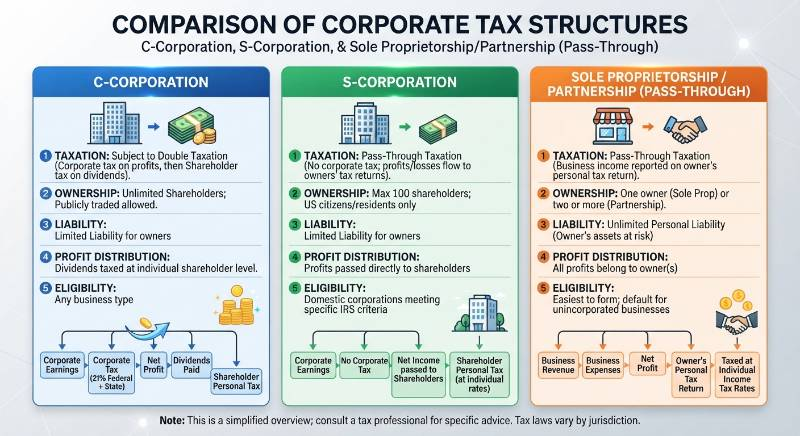
Statutory Formation Requirements: Nominee Directors, Company Secretaries, and Timelines
The statutory mechanics governed by the Companies Registry Hong Kong versus the Accounting and Corporate Regulatory Authority (ACRA) Singapore represent the biggest structural divergence for foreign shareholders.
The Singapore Resident Director Requirement
Under Section 145(1) of the Singapore Companies Act 1967, every private limited company must have at least one director who is ordinarily resident in Singapore (a Singapore Citizen, Permanent Resident, or EntrePass/Employment Pass holder). For foreign owners without local staff, this requires engaging a paid local nominee director, which involves:
- Substantial annual nominee service fees (often SGD 2,000 to SGD 4,500 annually).
- Refundable security indemnity deposits (typically SGD 3,000 to SGD 5,000 held in escrow).
- Restricted power-of-attorney governance and extra compliance documentation for basic banking authorizations.
Hong Kong: 100% Foreign Directorship
Under the Hong Kong Companies Ordinance (Cap. 622), there is no requirement for a local resident director. A sole foreign individual or foreign corporate entity can maintain 100% directorship and ownership. The statutory requirements are clean and transparent:
- Directors & Shareholders: Minimum 1 individual director of any nationality or residency. 100% foreign ownership is fully permitted.
- Statutory Company Secretary: Must be a Hong Kong resident or a licensed corporate service provider holding a valid Company Secretary Services license issued by the Companies Registry.
- Registered Office Address: Must maintain a physical registered address in Hong Kong (PO boxes are prohibited).
- Significant Controllers Register (SCR): Maintained at the registered office for regulatory inspection to ensure compliance with international AML standards.
Founders can complete Hong Kong Company Registration 100% remotely within 1 to 2 business days without visiting the city.
3-Year Total Cost of Ownership (TCO): Hidden Costs and Real Compliance Benchmarks
Many founders mistakenly calculate setup fees using only Year 1 incorporation rates. True cost efficiency is revealed across a 3-year operating horizon when statutory recurring filings, audit thresholds, and nominee retainers are calculated.
| Cost Category | Hong Kong (Direct TCSP Provider) | Singapore (Foreign Founder Model) |
|---|---|---|
| Year 1 Setup & Incorporation | $800 – $1,200 (Government fee + TCSP Secretary) | $1,800 – $3,500 (Incorporation + Nominee Director Fee) |
| Nominee Director Security Deposit | $0 (Not Required) | $2,000 – $4,000 (Refundable Escrow Lockup) |
| Year 2 Maintenance & Statutory Filings | $700 – $1,100 (Annual Return NAR1 + Registered Office) | $2,500 – $4,200 (Annual Return + Nominee Retainer) |
| Year 3 Maintenance & Statutory Filings | $700 – $1,100 (Annual Return NAR1 + Registered Office) | $2,500 – $4,200 (Annual Return + Nominee Retainer) |
| Statutory Audit & Tax Filing (3-Year Avg) | $2,400 – $4,500 (Annual CPA Audit Mandatory) | $1,500 – $6,000 (Exempt if <SGD 10M revenue, otherwise high) |
| Estimated 3-Year Total Outlay | $4,600 – $7,900 | $10,300 – $21,900 |
While Singapore offers statutory audit exemptions for private companies qualifying as “small companies” under the Companies Act (revenue under SGD 10 million, assets under SGD 10 million, and under 50 employees), the recurring nominee director retainers quickly outpace Hong Kong’s annual CPA audit costs.
In Hong Kong, all companies must prepare audited financial statements under the Companies Ordinance. Through structured Accounting & Audit Services, Hong Kong entities gain transparent, audited balance sheets that Tier-1 global institutions and institutional investors accept without friction.
Corporate Banking Reality: Hong Kong vs Singapore Account Opening Success Rates
A corporate registration is only as functional as its underlying settlement infrastructure. Both jurisdictions host premier financial hubs, but their banking account onboarding procedures differ in KYC speed and non-resident acceptance.
| Feature | Hong Kong Corporate Banking | Singapore Corporate Banking |
|---|---|---|
| Tier-1 Traditional Banks | HSBC, Standard Chartered, Bank of China (HK), Hang Seng | DBS, OCBC, UOB, Standard Chartered SG |
| Fintech & Multi-Currency Neobanks | Airwallex, Statrys, Currenxie, Neat | Aspire, Wise Business, Revolut Business |
| Non-Resident Remote Opening | High (via direct TCSP fast-track video KYC or digital neobanks) | Moderate to High (frequently requires in-person or local director attestation) |
| Typical Account Setup Time | Fintech: 3–7 business days; Physical: 2–4 weeks | Fintech: 5–10 business days; Physical: 3–6 weeks |
| Initial Deposit Demands | HKD 10,000 – HKD 50,000 (Bank dependent) | SGD 10,000 – SGD 100,000 (Higher for foreign entities) |
The key to securing a multi-currency corporate bank account is establishing clean economic substance. Banks in both cities adhere strictly to Financial Action Task Force (FATF) anti-money laundering regulations. To expedite review times, founders can use expert Corporate Bank Account Opening support to assemble clean business plans, proof of business contracts, and clear source-of-wealth documentation before submission.
Industry-Specific Scenarios: Web3, Cross-Border E-Commerce, and Tech Scale-Ups
Selecting between these two hubs is rarely one-size-fits-all. Regulatory policies favor different business models in specific ways.
Scenario A: Web3, Fintech, & Digital Asset Protocols
Hong Kong has positioned itself as an international digital asset hub through its Securities and Futures Commission (SFC) licensing regimes and clear stablecoin sandbox frameworks. A Web3 protocol team establishing operations in Hong Kong (e.g., at Cyberport or Hong Kong Science and Technology Park) benefits from clear token classification guidelines and access to Asian crypto liquidity.
Singapore’s Monetary Authority of Singapore (MAS) enforces stringent licensing under the Payment Services Act (PSA), which involves longer review timelines and higher compliance capital requirements for retail-facing crypto businesses.
Scenario B: Cross-Border E-Commerce & Physical Supply Chains
For merchants operating on Amazon, Shopify, TikTok Shop, or regional platforms, Hong Kong is directly adjacent to the manufacturing and fulfillment centers of Shenzhen, Dongguan, and Guangzhou in the Greater Bay Area. Hong Kong entities integrate directly with mainland logistics corridors, trade financing institutions, and payment gateways without foreign exchange controls.
Scenario C: Regional IP Holding & Software Scale-Ups
Enterprise SaaS platforms targeting Indonesia, Malaysia, Vietnam, and Thailand often use Singapore holding companies to leverage Singapore’s extensive network of over 90 Double Taxation Avoidance Agreements (DTAs). However, holding companies with global revenue models find Hong Kong’s 8.25% introductory rate and zero dividend withholding tax equally competitive.
Direct Licensed Provider vs. Aggregator: Why Direct TCSP Oversight Matters
Many digital incorporation platforms act merely as marketing intermediaries or offshore aggregators. They white-label services to local agencies, adding price markups and causing communication delays during regulatory audits.
“Using an unlicensed intermediary risks regulatory non-compliance. Under Hong Kong law, company formation and corporate secretarial management must be handled directly by a licensed Trust or Company Service Provider (TCSP) to guarantee legal compliance.”
— Compliance Director, Olesen Global (TCSP License TC010076)
Working directly with a first-hand licensed provider like Olesen Global (Trust or Company Service Provider License TC010076) guarantees:
- No Middleman Markups: Direct-tier pricing for statutory registrations, annual return filings, and registered office facilities.
- Physical Local Office: Dedicated compliance teams physically based in Hong Kong to receive official government service of process and manage statutory registers.
- 1-on-1 Dedicated Support: Direct communication with certified company secretaries and accounting specialists who manage your account from end to end.
- Audit-Proof Statutory Records: Strict adherence to the Companies Ordinance and AML regulations to keep your entity in good standing.
Interactive Entity Formation Checklist
Follow this actionable step-by-step checklist to prepare for your Hong Kong or Singapore company formation:
- Company Name Search: Confirm name availability through the Hong Kong Cyber Search Centre or Singapore ACRA BizFile.
- KYC Identification Assembly: Prepare passport copies and proof of residential address (issued within 3 months) for all beneficial owners and directors.
- Corporate Architecture Formulation: Define share capital allocation (e.g., standard HKD 10,000 / SGD 10,000) and ownership percentages.
- Statutory Appointments: Appoint a licensed TCSP Company Secretary in Hong Kong or engage a local resident nominee director in Singapore.
- Statutory Submission: Submit incorporation forms (NNC1 in Hong Kong) and Articles of Association to the Companies Registry.
- Commercial Banking Onboarding: Submit certified incorporation packages and business proof to corporate banks or digital neobanks.
Frequently Asked Questions
Can I re-domicile an existing Singapore company to Hong Kong?
Yes. The Hong Kong Companies Ordinance provides an inward re-domiciliation regime. This allows foreign-incorporated entities, including Singapore private limited companies, to transfer their place of incorporation to Hong Kong while preserving their corporate history, legal identity, and contractual agreements.
Do I need to travel to Hong Kong to open a corporate bank account?
Not necessarily. While traditional Tier-1 physical banks (such as HSBC or Standard Chartered) occasionally request an in-person director interview, digital banking institutions (such as Airwallex, Statrys, and Aspire) and select traditional bank programs allow 100% remote identity verification via video KYC when coordinated by a licensed TCSP provider.
What are the capital gains tax rules in Hong Kong vs Singapore?
Neither Hong Kong nor Singapore levies tax on capital gains derived from the disposal of capital assets, shares, or property, provided the transaction is not deemed “trading in nature.” Both jurisdictions offer clear structural advantages for holding companies managing asset portfolios.
Are annual audits legally required in both jurisdictions?
In Hong Kong, all private limited companies must have their financial statements audited annually by a certified Hong Kong Certified Public Accountant (CPA). In Singapore, private companies meeting the “small company” exemption criteria (under SGD 10M revenue/assets and under 50 staff) are exempt from statutory audit requirements, though they must still compile unaudited compilation reports.
Launch Your Compliant APAC Entity with Direct TCSP Support
Expanding across Asia requires an experienced, on-the-ground compliance partner. As a first-hand licensed Trust or Company Service Provider (TCSP License No. TC010076), Olesen Global helps international founders handle company registration, corporate secretarial compliance, annual audits, and bank account opening without middlemen markups.
Speak Directly with a Licensed Hong Kong Corporate Specialist
Set up your Hong Kong corporate entity with predictable pricing, end-to-end statutory compliance, and dedicated one-on-one progress tracking.