Why Small Businesses Outsource Accounting in Hong Kong
Managing financial compliance in Asia’s premier financial hub can be a daunting task for foreign entrepreneurs, cross-border e-commerce brands, and fast-growing startups. The regulatory framework established by the Inland Revenue Department (IRD) requires precise bookkeeping and mandatory annual audits. For a small business, attempting to navigate these requirements internally often leads to administrative bottlenecks, filing delays, and severe financial penalties.
To help business owners evaluate their current setup, we analyze compliance health across three core dimensions: transaction traceability, regulatory alignment, and tax optimization readiness. Based on our 10+ years of corporate service data in Hong Kong, businesses that establish a structured accounting framework early save an average of 40% in long-term compliance penalties.
The Interactive HK Compliance Roadmap: From Registration to CPA Audit
Outsourcing your accounting allows you to hand over complex compliance duties to certified professionals. This ensures your business remains fully aligned with the strict standards of the Hong Kong Institute of Certified Public Accountants (HKICPA) while freeing up internal resources to focus on growth.
To streamline this process, we utilize the 3-Tier Compliance Velocity Protocol. This systematic approach synchronizes your daily transactions, corporate secretarial records, and CPA audit preparation into a single, automated workflow, eliminating the friction typical of annual tax seasons.
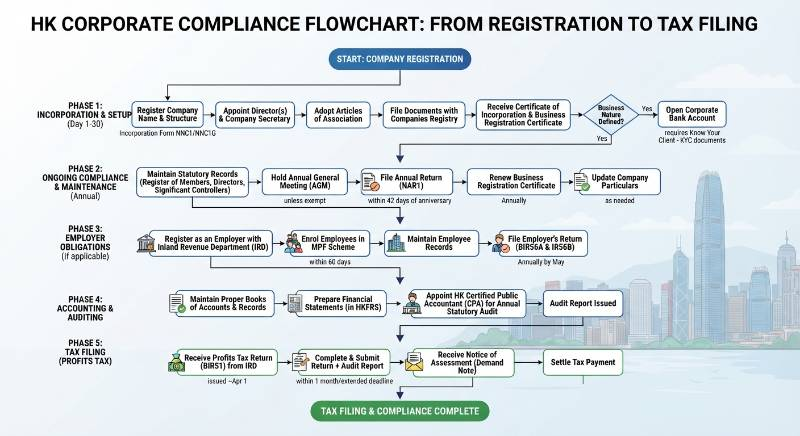
A compliant corporate structure in Hong Kong operates as a continuous cycle. The roadmap below outlines how these components interact throughout the financial year:
- Step 1: Hong Kong Company Registration: The foundation of your business entity, establishing your official incorporation date and initial fiscal year-end.
- Step 2: Appoint Company Secretary Services: A statutory requirement under the Companies Ordinance to manage ongoing corporate governance and file annual returns.
- Step 3: Continuous Bookkeeping: Tracking daily transactions, categorizing expenses, and reconciling multi-currency bank accounts.
- Step 4: Annual CPA Audit: Preparing final financial statements for review by an independent practicing CPA to verify accuracy and compliance.
- Step 5: IRD Profits Tax Return Filing: Submitting the audited financial statements alongside your tax return to the IRD before the deadline.
For small businesses, keeping these steps synchronized is critical. A delay in bookkeeping inevitably stalls the CPA audit, which can result in hefty late-filing fines from the IRD.
In-House vs. Outsourced HK Accounting: A Cost-Benefit Analysis
Many small business owners debate whether to hire a dedicated in-house accountant or outsource their bookkeeping and tax compliance. In Hong Kong, the financial differences between these two paths are stark.
As of 2026, the average salary for a qualified junior accountant in Hong Kong is approximately HKD 25,000 to HKD 35,000 per month. When you factor in mandatory MPF contributions, employee insurance, office space, and specialized accounting software licenses, the true cost of an in-house hire easily exceeds HKD 400,000 annually.
“Small businesses often underestimate the strictness of the HK IRD. Outsourcing isn’t just about saving money; it’s about avoiding the 300% penalty on undeclared profits.”
— Albert Chen, Practicing CPA in Hong Kong
By contrast, outsourcing to professional Accounting & Audit Services allows you to access a team of compliance experts for a fraction of that cost. The table below compares these two approaches across key operational areas:
| Evaluation Factor | In-House Accountant | Outsourced Accounting Firm |
|---|---|---|
| Average Annual Cost | HKD 350,000 – HKD 500,000+ | HKD 10,000 – HKD 50,000 (Based on volume) |
| Software & Infrastructure | Company must purchase and maintain licenses | Fully included in the service package |
| Regulatory Compliance | Dependent on a single person’s knowledge | Managed by a team of licensed CPAs |
| Scalability | Difficult; requires hiring more staff | Seamlessly scales with transaction volume |
| Audit Management | Requires coordinating with external auditors | Direct, end-to-end audit handling |
The ‘Middleman’ Markup Trap: Why First-Hand Licensed Providers Matter
The corporate services market in Hong Kong is filled with consulting agencies, virtual platforms, and overseas intermediaries. Many of these agencies do not actually employ local CPAs or hold the required local licenses. Instead, they act as middlemen—subcontracting your bookkeeping and audit preparation to third-party firms while marking up the price by 150% to 300%.
This middleman model creates several major challenges for small businesses:
- Communication Gaps: Any questions you have about your accounts must pass through an intermediary, leading to delayed responses and potential misunderstandings.
- Data Security Risks: Your sensitive financial details, bank statements, and customer data are shared with unauthorized third parties.
- Hidden Compliance Costs: Middlemen often quote low upfront fees, only to add unexpected charges for audit coordination, tax adjustments, and IRD correspondence later on.
By working directly with a licensed provider like Olesen Global, you bypass these intermediaries entirely. As a direct, first-hand provider holding Trust and Company Service Provider (TCSP) License No. TC010076, we manage your accounting, corporate secretarial tasks, and audits from our physical Hong Kong office. This direct setup ensures clear communication, strict confidentiality, and transparent pricing with no hidden markups.

Step-by-Step: How to Verify a TCSP License on the Hong Kong Registry
Under Hong Kong law, any business offering corporate services must hold a valid TCSP license issued by the Hong Kong Companies Registry. Verifying your provider’s credentials is a critical step to ensure your company remains compliant and secure.
Follow this step-by-step checklist to verify a provider’s license status before sharing any sensitive financial information:
- Access the Official Portal: Visit the Registry’s dedicated verification portal at TCSP Licensee Register.
- Enter the Search Details: Enter the provider’s registered name or their specific license number (for example, “TC010076” for Olesen Global).
- Verify the Active Status: Check that the search results display “Active” under the license status column.
- Confirm the Registered Address: Ensure the registered business address matches the office address listed on the provider’s official website.
Partnering with a fully licensed provider guarantees that your corporate filings are handled by accredited professionals, protecting your business from regulatory liabilities.
Niche Accounting Solutions: Web3, E-Commerce, and Offshore Claims
Standard accounting practices often fall short for modern business models. Virtual assets, cross-border retail, and complex international trade structures require specialized compliance expertise.
“For cross-border and Web3 businesses, transaction volume can overwhelm standard accounting frameworks. A dedicated local partner ensures compliance before the annual audit cycle begins.”
— Sarah Wong, Senior Compliance Officer
For example, a Web3 startup operating from Cyberport must manage high-frequency cryptocurrency transactions, decentralized protocol revenues, and token-based payroll. These activities must be carefully reconciled into fiat valuations that comply with the strict reporting standards of the IRD.
Similarly, cross-border e-commerce brands face the challenge of reconciling sales across multiple international platforms (like Shopify, Amazon, and Stripe) in various currencies. This requires robust tracking of payment processing fees, shipping costs, and inventory values across different tax jurisdictions.
| Business Model | Primary Accounting Challenge | Key Compliance Requirement |
|---|---|---|
| Web3 & Crypto Startups | High-frequency on-chain transaction matching | Real-time fiat valuation and cost-basis tracking |
| Cross-Border E-Commerce | Multi-currency sales and gateway reconciliation | Accurate cost of goods sold (COGS) and inventory valuation |
| Offshore Trading Entities | Proving operations are conducted outside Hong Kong | Compiling comprehensive transaction trails for offshore claims |
Furthermore, businesses seeking an offshore tax exemption claim must meet strict evidentiary requirements. The IRD scrutinizes these applications closely, requiring complete transaction trails, contract negotiations, and shipping logs to prove that no operations or decisions occurred within Hong Kong.
Frequently Asked Questions About HK Small Business Accounting
What is the deadline for filing a Profits Tax Return (PTR) in Hong Kong?
For newly incorporated companies, the first PTR is typically issued 18 months from the incorporation date and must be filed within 3 months. For existing companies, the standard deadline depends on your financial year-end: April 30 of the following year for March 31 year-ends, and November 15 of the same year for December 31 year-ends.
Can a Hong Kong company do its own audit?
No. Under the Hong Kong Companies Ordinance, the annual audit must be conducted by an independent Certified Public Accountant (CPA) who holds a practicing certificate issued by the HKICPA. Internal staff cannot sign off on the official audit report.
What documents are required to prepare for a Hong Kong company audit?
You need to provide complete bank statements, sales invoices, purchase invoices, expense receipts, contracts, general ledgers, trial balances, and any corporate secretarial records (such as updated registers of directors and shareholders).
What are the penalties for late tax filing in Hong Kong?
Late filings can result in immediate fines starting at HKD 1,200 to HKD 10,000, along with court summonses. In cases of prolonged delays, the IRD may issue estimated tax assessments and impose additional punitive taxes of up to triple the original tax amount owed.
Streamline Your HK Compliance with Olesen Global
As a direct, TCSP-licensed provider with physical offices in Hong Kong, Olesen Global provides end-to-end accounting, bookkeeping, and audit coordination services tailored specifically for growing small businesses. Our team of local compliance experts ensures your company remains fully aligned with IRD guidelines, helping you avoid middleman markups and secure your financial operations.

Ready to simplify your Hong Kong accounting and ensure hassle-free tax compliance? Contact our team today for a transparent, customized service plan designed for your business.