Establishing an offshore company for fund management requires balancing tax neutrality, regulatory oversight, speed to market, and operational credibility. Modern institutional allocators no longer tolerate opaque, zero-substance shell entities. Today’s fund managers must establish institutional-grade cross-border vehicles that withstand scrutiny from global regulators, tax authorities, and international banking underwriting teams.
The 5-Pillar Decision Framework: Selecting Your Fund Jurisdiction
An offshore company for fund management acts as the legal and operational core holding investment capital, mitigating tax leakage, and segregating investor liabilities. Selecting the proper jurisdiction requires evaluating limited partner (LP) tax residency, treaty access, economic substance obligations, local licensing rules, and banking feasibility. We assess every cross-border structure through the Sovereign Nexus Allocation Protocol (SNAP) to match investment objectives with regulatory realities.
Fund sponsors must evaluate five distinct dimensions before incorporating an investment vehicle or fund management entity FME:
- LP Domicile Acceptance: North American and European institutional LPs routinely mandate familiar domiciles governed by the Cayman Islands Monetary Authority (CIMA), whereas regional Asian institutions often favor Hong Kong or Singapore vehicles.
- Regulatory Oversight: Assess whether the fund manager must hold a Type 9 asset management license from the Hong Kong Securities and Futures Commission (SFC) or can utilize an offshore management exemption.
- Economic Substance Burdens: Pure zero-tax jurisdictions impose heavy ongoing governance overhead to satisfy international standards.
- Double Taxation Agreement (DTA) Access: Traditional offshore centers lack DTA networks, leading to standard 10% to 30% withholding taxes on dividends and interest. Midshore jurisdictions like Hong Kong offer over 45 comprehensive double taxation treaties.
- Banking Underwriting Feasibility: The global financial system scrutinizes unanchored offshore shell companies, whereas properly managed entities with verified corporate infrastructure secure corporate accounts rapidly.
“Global capital allocators no longer prioritize absolute zero-tax domiciles over regulatory certainty. The shift toward transparent midshore jurisdictions reflects the operational reality that without institutional banking access and solid DTA networks, a fund cannot deploy capital efficiently.”
— Senior Cross-Border Structuring Counsel & CPA, Olesen Global Advisory Board
Structural Blueprint: Standalone vs Master-Feeder vs Hybrid Pairings
Fund sponsors must align their legal structure with the geographic profile of their target allocators and asset classes. Choosing the incorrect entity design can lead to unexpected tax consequences, such as US Effectively Connected Income (ECI) or Unrelated Business Taxable Income (UBTI) for tax-exempt investors.
1. Standalone Fund Structure
A standalone structure utilizes a single corporate or partnership vehicle that accepts capital directly from investors and executes portfolio transactions. This model suits funds with a homogeneous LP base operating within a single tax regime, such as an Asia-dedicated venture capital fund structured under the limited partnership fund LPF regime in Hong Kong.
2. Master-Feeder Arrangements
Master-feeder structures aggregate capital from diverse geographic pools into a single master vehicle, optimizing portfolio trade execution while accommodating distinct tax requirements:
- Onshore Feeder: A US domestic limited partnership (typically Delaware LP) established for US taxable investors.
- Offshore Feeder: A tax-neutral entity (such as a Cayman exempted company) for non-US investors and US tax-exempt institutions.
- Master Fund: The offshore master entity pools all capital from the feeders to conduct trading, consolidate accounting, and streamline custodial relationships.
3. The Hybrid Midshore-Offshore Model
Modern cross-border managers often separate the fund vehicle from the asset management company. For instance, the fund vehicle may reside in the Cayman Islands or Hong Kong, while the investment manager operates out of Hong Kong via professional Hong Kong Company Registration to capitalize on zero-percent carried interest tax concessions and top-tier talent pools.
Cayman SPC vs Hong Kong OFC: 2026 Cost, Timeline, and Compliance Analysis
When selecting between traditional Caribbean domiciles and Asian midshore hubs, managers must evaluate incorporation lead times, statutory registry charges, and regulatory mandates enforced by the Hong Kong Securities and Futures Commission (SFC) and regional bodies.
| Feature / Metric | Cayman Segregated Portfolio Company (SPC) | Hong Kong Open-ended Fund Company (OFC) | Hong Kong Limited Partnership Fund (LPF) |
|---|---|---|---|
| Target Fund Strategy | Multi-strategy hedge funds, segregated assets | Open/closed-ended public or private funds | Private Equity, Venture Capital, Real Estate |
| Statutory Regulator | CIMA (Mutual/Private Funds Act) | Hong Kong SFC & Companies Registry | Hong Kong Companies Registry |
| Establishment Timeline | 4 to 6 weeks | 3 to 5 weeks (Private OFC) | 4 to 7 business days |
| Initial Setup Cost Range | $22,000 – $38,000 USD | $14,000 – $24,000 USD | $8,000 – $15,000 USD |
| Government Subsidies | None | Up to 70% subsidy on local expenses (capped) | Subsidized re-domiciliation routes |
| Economic Substance Scope | High (Mandatory CIGA for FMEs) | Met via domestic physical management | Met via registered General Partner presence |
Economic Substance (ES) Compliance and CIGA Operational Nexus
International regulatory frameworks spearheaded by the OECD require pure offshore fund management entities to prove local substance. Failure to meet these rules risks severe financial penalties, spontaneous exchange of information with tax authorities, and administrative strike-offs.
To establish adequate operational substance under statutory requirements, fund managers must fulfill three core criteria:
- Core Income Generating Activities (CIGA): The management company must execute primary strategic decisions within the jurisdiction. For a fund manager, CIGA includes taking decisions on holding or disposing of investments, risk calculation, setting currency and interest reserves, and preparing regulatory filings.
- Directed and Managed Locally: Board meetings must occur within the jurisdiction with adequate physical quorum. Directors must hold suitable qualifications and seniority to exercise independent oversight.
- Adequate Local Expenditure & Headcount: The fund manager must incur sufficient operational spending and maintain qualified full-time personnel proportionate to its assets under management (AUM).
Corporate Governance, Statutory Audits, and TCSP Licensing Standards
Fund operations require robust fiduciary management. Utilizing intermediaries or unlicensed agents introduces compliance risks and unnecessary markup costs. Partnering directly with a licensed Trust or Company Service Provider (TCSP) ensures seamless compliance across the fund’s lifecycle.
“Direct TCSP licensing (Hong Kong Registry TC010076) guarantees that your fund vehicle is administered under strict anti-money laundering (AML) protocols and corporate transparency standards. It ensures statutory filings, register maintenance, and director verifications comply fully with primary legislation.”
— Compliance Director, Olesen Global TCSP Operations
Every offshore and midshore fund structure requires an annual compliance protocol to maintain institutional standing:
- Statutory Governance: Maintaining the Register of Directors, Register of Members, and Significant Controllers Register (SCR).
- AML/KYC Onboarding: Verifying ultimate beneficial owners (UBOs) and LPs under international Common Reporting Standard (CRS) and FATCA guidelines.
- Independent Annual Audit: Completing mandatory statutory audits led by qualified CPAs via dedicated Accounting & Audit services.
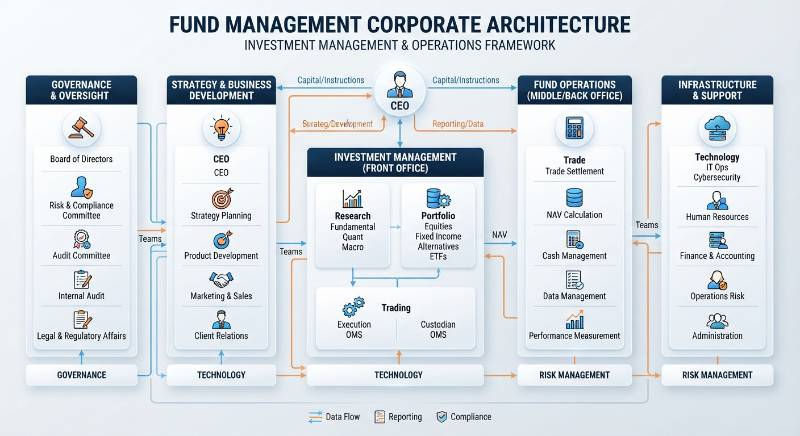
- Fund Administrator Oversight: Coordinating net asset value (NAV) calculations and asset reconciliations with a qualified fund administrator and custodian.
- Brand & Identity Protection: Securing fund intellectual property through international Trademark Registration across key capital-raising markets.
Streamlining Fund Entity Multi-Currency Corporate Bank Account Opening
The most common operational bottleneck for offshore fund structures is securing institutional multi-currency corporate banking. Global financial institutions enforce strict underwriting standards for special purpose vehicles (SPVs), general partners (GPs), and carry vehicles.
Overcoming these onboarding hurdles requires clean corporate documentation and direct relationships with tier-one commercial banks. Engaging a dedicated specialist for Bank Account Opening ensures underwriting files are prepared to institutional standards.
| Banking Tier | Target Entity Types | Underwriting Lead Time | Primary Documentation Required |
|---|---|---|---|
| Tier-1 Global Banks (HK / SG) | Main Fund Master, Hong Kong LPF/OFC, Regulated GPs | 4 to 8 weeks | PPM / LPA, Track Record, UBO Source of Wealth, TCSP Certificate of Incumbency |
| Regional Commercial Banks | Investment SPVs, Co-investment Vehicles, HoldCos | 2 to 4 weeks | Board Resolution, Deal Pipeline Contracts, Proof of Capital Flow Logic |
| Specialized Digital Asset Banks | Web3 VC Funds, Algorithmic Trading Vehicles | 1 to 3 weeks | On-chain Wallet Verification, AML Algorithmic Compliance Framework |
Case Study: Structuring an Asia-Focused PE Vehicle via Hong Kong Midshore Nexus
A private equity sponsor managed a $120M USD cross-border portfolio spanning early-stage enterprise software in Hong Kong, Singapore, and Mainland China. Their legacy offshore holding structure suffered from double withholding tax leakage and faced banking account freezes from an offshore provider that failed annual economic substance reporting.
Olesen Global restructured the operational matrix using our first-hand corporate formation and TCSP infrastructure:
- Vehicle Re-domiciliation: Transitioned the primary asset accumulation entity into a Hong Kong Limited Partnership Fund (LPF), qualifying for the local zero-percent profits tax unified fund exemption.
- Direct Governance Setup: Appointed a licensed TCSP entity to manage general corporate secretarial duties, maintain the Significant Controllers Register, and execute ongoing regulatory compliance.
- Multi-Currency Banking Pipeline: Established primary operational and capital-call treasury accounts with a Tier-1 international bank in Hong Kong within 21 business days.
- Cost & Substance Optimization: Lowered annual compliance costs by 42% compared to the Caribbean structure, while securing access to Double Tax Agreements across target investment jurisdictions.
Frequently Asked Questions on Offshore Fund Vehicles
What is the primary difference between a standalone fund and a segregated portfolio company (SPC)?
A standalone fund operates as a single legal vehicle with combined assets and liabilities. A Segregated Portfolio Company (SPC) creates legally protected sub-funds (portfolios) under a single umbrella company. Assets and liabilities within one portfolio remain ring-fenced from other portfolios, protecting investors across different asset classes or strategies from cross-liability risk.
Why should fund sponsors work with a direct TCSP licensee instead of an intermediary broker?
Direct TCSP licensees (such as Olesen Global, License TC010076) hold physical operations and regulatory authorization from the Hong Kong Companies Registry. Working directly eliminates intermediate markups, ensures direct communication with compliance officers, speeds up corporate filings, and prevents mismanaged KYC disclosures during bank underwriting.
How does Hong Kong’s Unified Fund Exemption (UFE) regime benefit offshore funds?
Under the UFE regime, both domestic and offshore funds are exempt from Hong Kong profits tax on transactions in qualifying assets (including shares, stocks, debentures, and private company equities), provided the transactions are arranged or carried out by an SFC-licensed corporation or meet specific substance criteria.
What are the typical annual maintenance costs for an offshore or midshore fund?
Annual recurring costs vary based on fund size and regulatory status. An offshore fund manager should budget for annual registered office and agent fees, statutory audit fees, government registry renewal charges, and economic substance reporting fees, typically ranging from $10,000 to $25,000 USD annually for a standard structure.
Launch Your Compliant Fund Structure with Olesen Global
Structuring an institutional fund requires direct, first-hand regulatory expertise. Olesen Global operates as a fully licensed Trust or Company Service Provider (TCSP License TC010076) in Hong Kong, delivering corporate structuring, governance, company secretarial, audit coordination, and multi-currency banking support without intermediary markups.