Hong Kong Trademark Registration Timeline: The Complete Statutory Roadmap
Securing brand ownership in a premier global financial hub requires navigating strict statutory milestones. For multinational corporations, cross-border e-commerce sellers, and Web3 startups, understanding the exact lifecycle of trademark prosecution under the Hong Kong Intellectual Property Department (IPD) prevents costly market entry delays.
The 5-Stage Statutory IP Filing Process in Hong Kong
A standard, uncontested trademark registration in Hong Kong takes between 6 and 8 months from the filing date to certificate issuance. Governed by the Trade Marks Ordinance (Cap. 559), the process follows five structured stages administered by the Trade Marks Registry under the Intellectual Property Department.
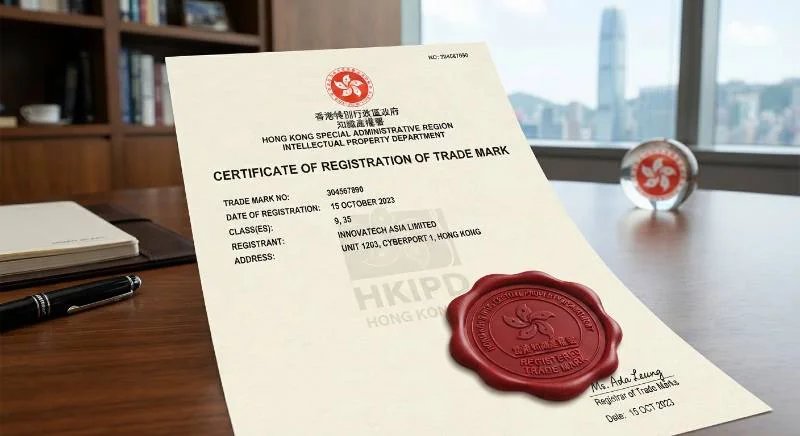
Every application moves through sequential legal gateways designed to balance business trademark protection against broader public and commercial interests.
Stage 1: Pre-Filing Clearance and Nice Classification (Days 1–3)
Before submitting any statutory forms, applicants must conduct a comprehensive availability search using the IPD Online Search System. This step identifies existing identical or deceptively similar marks in identical or related classes.
Goods and services must be classified accurately according to the latest edition of the Nice Classification system. Drafting broad, vague, or non-standard specifications often triggers immediate objections during review.
Stage 2: Official Filing and Formal Examination (Months 1–2)
Upon electronic submission of Form T2, the Trade Marks Registry issues an official filing receipt within 24 to 72 hours. This receipt assigns the formal application number and establishes the statutory filing date.
During formal examination, the Registry verifies administrative completeness, including applicant representation details, clear graphical representation of the mark, and payment of class fees.
Stage 3: Substantive Examination by the Registry (Months 2–4)
A trademark examiner assesses the mark against the statutory criteria set out in Sections 11 and 12 of Cap. 559. The examiner checks for absolute grounds for refusal (e.g., lack of distinctiveness, purely descriptive terms) and relative grounds (e.g., conflicts with prior registered marks).
If issues arise, the IPD issues an official opinion or deficiency notice response deadline, typically granting the applicant 6 months (extendable by 3 months upon showing reasonable cause) to remedy informalities or submit legal arguments.
Stage 4: Gazette Publication and 3-Month Public Opposition Window (Months 4–7)
Once accepted, the application is published in the official Hong Kong Intellectual Property Journal. This triggers a strict, statutory 3-month opposition window.
During this period, any third party may file a formal notice of opposition under Form T6 if they believe the mark infringes upon their prior rights or violates statutory provisions.
Stage 5: Certificate Issuance and 10-Year Protection Maintenance (Month 8+)
If no opposition is filed within the 3-month window, the Registry enters the mark into the official Register of Trade Marks. The applicant receives the official Certificate of Trade Mark Registration.
Registration takes retroactive legal effect from the initial filing date and remains valid for an initial period of 10 years, renewable indefinitely in 10-year intervals.
Dual-Track Timeline Comparison: Best-Case 6-Month vs Contested 18-Month Tracks
Trademark applications in Hong Kong diverge sharply based on initial search accuracy and the presence of third-party disputes. The table below illustrates the milestone differences between frictionless filings and contested applications.
| Statutory Milestone | Smooth Path (No Objections) | Deficiency / Office Action Track | Contested Opposition Track |
|---|---|---|---|
| Filing & Receipt | Days 1–3 | Days 1–3 | Days 1–3 |
| Substantive Examination | Months 2–3 (Cleared) | Months 2–4 (Notice Issued) | Months 2–3 (Cleared) |
| Response & Legal Arguments | N/A | Months 4–10 (3–6 mo reply) | N/A |
| Gazette Publication | Months 4–7 (3 Months) | Months 11–14 (3 Months) | Months 4–7 (Opposed at Mo 7) |
| Opposition Proceedings | None | None | Months 8–18+ (Pleadings & Hearing) |
| Certificate Granted | Month 6–8 | Month 12–15 | Month 18–24+ |
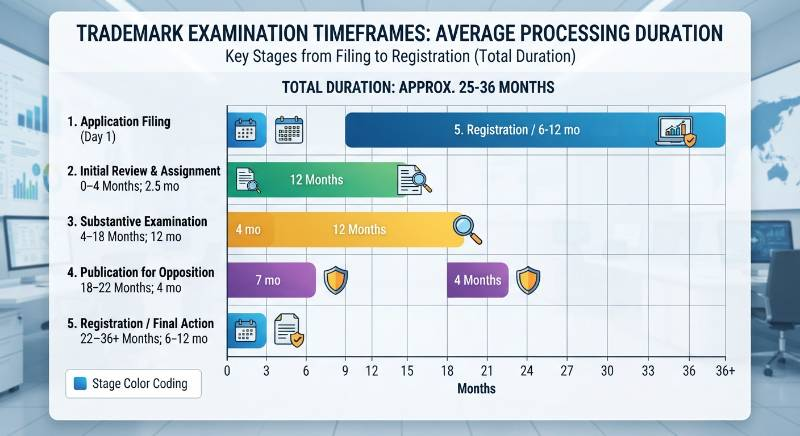
Data from the Trade Marks Registry indicates that approximately 15% to 20% of unvetted filings encounter substantive objections under Section 11 (lack of distinctiveness) or Section 12 (relative grounds). Resolving these objections quickly requires disciplined legal responses within the statutory 6-month window.
Key Bottlenecks and Acceleration Strategies for HK Trademark Approval
To eliminate preventable procedural delays, our practitioners apply The Precision IP Clearance Protocol. This structured methodology addresses the three most common causes of trademark prosecution stalls:
“Most trademark delays in Hong Kong are completely avoidable. When applicants use broad, non-standard specifications or fail to check prior phonetic equivalents, they turn an 8-month administrative process into an 18-month legal dispute.”
— Senior IP Counsel, Olesen Global Compliance Practice
- Standardizing Goods & Services: Use pre-approved IPD classification descriptions. Custom, overly bespoke terminology triggers non-standard classification inquiries, adding 2 to 4 months of administrative review.
- Paris Convention Priority Claims: If you filed a matching trademark application in a Paris Convention member state or WTO member territory within the preceding 6 months, you can claim priority in Hong Kong under Section 41 of Cap. 559. This backdates your effective Hong Kong protection to your home country’s filing date.
- Defensive Disclaimers: If your brand mark includes non-distinctive or descriptive elements alongside a distinctive core logo, proactively disclaiming exclusive rights to those generic terms during filing prevents substantive office action letters.
Trademark Acceleration Checklist
- Conduct Identical and Similarity Searches: Review the IPD register for identical text, phonetic equivalents, and visual logo similarities across relevant classes.
- Standardize Nice Classification Descriptions: Adopt pre-approved statutory terms across targeted core and auxiliary classes.
- Verify Priority Timelines: File within the statutory 6-month priority window if claiming date rights from a foreign application.
- Prepare Evidence of Acquired Distinctiveness: For marks containing geographical or suggestive phrasing, assemble sales receipts, media mentions, and market penetration metrics prior to submission.
Strategic Brand Protection: Aligning HK Trademarks with Global Commercial Milestones
A Hong Kong trademark is more than local legal protection; it serves as a gateway asset for cross-border commercial scaling. Aligning your trademark timeline with operational milestones prevents disruptions in e-commerce, banking, and institutional fundraising.

For example, Amazon Brand Registry accepts formal Hong Kong trademark application numbers to grant early-stage brand registry privileges, long before the final certificate is issued. Obtaining an official IPD filing receipt within 72 hours allows e-commerce enterprises to secure Buy Box protection and create A+ content immediately.
“For Web3 and decentralized finance protocols setting up in the Cyberport ecosystem, securing intellectual property rights under Hong Kong’s common-law framework is a standard prerequisite for venture institutional due diligence and institutional custody setup.”
— Hong Kong Fintech & Regulatory Advisory Board
| Comparison Dimension | Hong Kong IPD | Mainland China CNIPA |
|---|---|---|
| Governing Law | Trade Marks Ordinance (Cap. 559) — Common Law | Trademark Law of the PRC — Civil Law |
| Average Timeline | 6 to 8 Months | 9 to 12 Months |
| Subclass Rules | Class-level protection; no rigid subclass system | Strict, rigid subclass system within classes |
| Opposition Period | 3 Months (Statutory) | 3 Months (Statutory) |
| Legal Territoriality | Valid only within Hong Kong SAR | Valid across Mainland China only |
Businesses operating across the Greater Bay Area must remember that Hong Kong and Mainland China maintain independent trademark registries under the principle of “One Country, Two Systems.” Holding a CNIPA trademark gives no legal protection in Hong Kong, and vice versa.
Direct Filing vs First-Hand Licensed TCSP Representation
While overseas businesses can technically attempt direct filings, Hong Kong law requires an official address for service in Hong Kong to receive Registry notifications, formal deficiency orders, and third-party opposition notices.
Using unlicensed overseas intermediaries often results in missed statutory deadlines and inflated brokerage fees. Working directly with a first-hand, licensed Trust or Company Service Provider (TCSP License No. TC010076) guarantees direct oversight and continuous progress monitoring throughout the statutory lifecycle.
Comprehensive corporate compliance ties intellectual property protection directly to your broader company structure:
- Hong Kong Trademark Registration: Direct statutory clearance, specification drafting, and defense against Registry deficiency notices.
- Hong Kong Company Registration: Seamless incorporation structured to hold global intellectual property portfolios.
- Company Secretary Services: Statutory compliance, annual returns, and official service address management.
- Bank Account Opening: Establishing corporate merchant banking and cross-border settlement channels.
- Accounting & Audit: Ensuring IP asset valuations and licensing royalties comply with local Inland Revenue Department (IRD) requirements.
Frequently Asked Questions About Hong Kong Trademark Timelines
Can the Hong Kong trademark registration process be expedited?
Unlike patent filings in select jurisdictions, the Hong Kong Trade Marks Registry does not offer a paid fast-track or accelerated examination procedure. The statutory 3-month public opposition window in the Hong Kong Intellectual Property Journal cannot be shortened under any circumstances. However, preparing clear Nice Classification descriptions and conducting thorough pre-filing clearance avoids deficiency notices and ensures your application finishes within the fastest possible 6- to 8-month window.
What is the status of the Madrid Protocol in Hong Kong?
Hong Kong is actively finalizing the domestic legal and administrative arrangements to implement the Madrid Protocol. Once fully operational, international applicants will be able to designate Hong Kong in their Madrid international registrations, and Hong Kong businesses will be able to seek protection across member states through a single centralized filing.
What happens if the IPD examiner issues an official objection letter?
If the examiner identifies absolute or relative grounds for refusal, the IPD issues an official opinion outlining the deficiencies. The applicant has an initial 6-month statutory deadline to respond with legal arguments, evidence of acquired distinctiveness, or amended specifications. If necessary, a further 3-month extension may be requested with valid justification.
How long is a registered Hong Kong trademark valid, and when can it be renewed?
A trademark registered in Hong Kong remains valid for 10 years from the official filing date. Renewal applications can be submitted up to 6 months before the expiration date. A 6-month grace period is available after expiration, subject to statutory late renewal penalty fees.
Accelerate and Secure Your Hong Kong Trademark with Olesen Global
Avoid unnecessary office actions, mitigate opposition risks, and establish your brand rights through a direct, licensed Hong Kong corporate service provider. Our dedicated legal specialists track every filing milestone from initial clearance to certificate issuance.