Hong Kong Trademark Classes Explained: The Complete 2026 Guide
Securing your brand in Asia’s premier business hub requires a bulletproof intellectual property strategy. For international founders, Web3 startups, and e-commerce brands, navigating the trademark registration process in the Hong Kong SAR starts with a fundamental decision: selecting the right trademark classes.
Choosing the incorrect class can leave your company vulnerable to copycats or lead to costly registration rejections. As a first-hand TCSP-licensed provider (TC010076) with deep local expertise, Olesen Global Corporate Services assists businesses in structuring compliant, long-term corporate and IP frameworks.
What is the Nice Classification System in Hong Kong?
The Nice Classification system is the international standard used by the Intellectual Property Department (IPD) of Hong Kong to categorize trademark applications. This system organizes products and services into 45 separate classes to establish a clear, structured scope of protection under the Trade Marks Ordinance (Cap. 559).
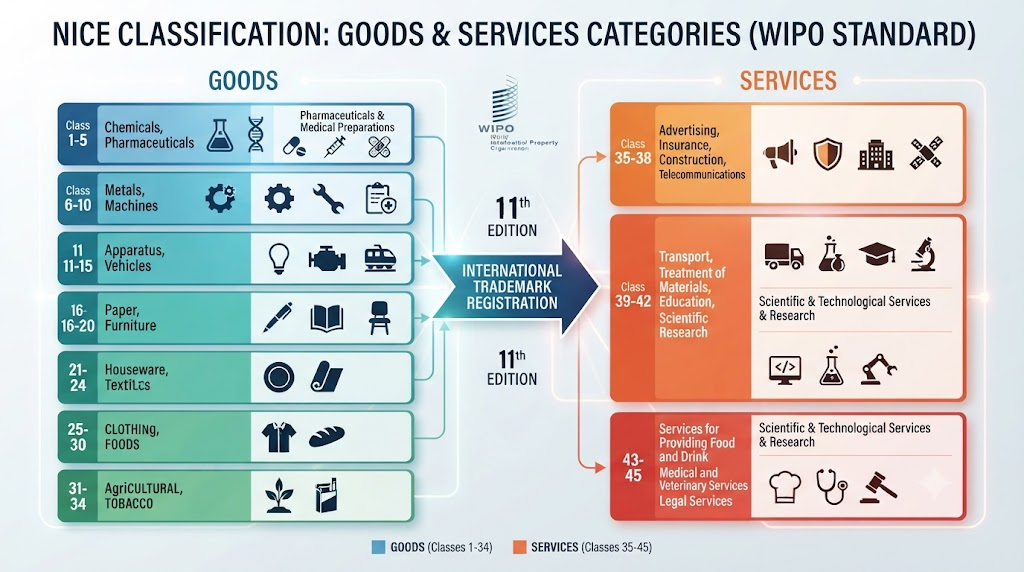
The system divides your commercial activities into two macro categories:
- Goods (Classes 1 to 34): Physical products, ranging from industrial chemicals (Class 1) and cosmetics (Class 3) to electronic software and hardware (Class 9).
- Services (Classes 35 to 45): Business activities, such as advertising and retail management (Class 35), financial operations (Class 36), and software development (Class 42).
As of 2026, the 13th edition of the Nice Classification dictates current filing standards. This edition replaces older frameworks like the Nice Classification 12th edition, introducing more precise definitions for digital products, virtual environments, and decentralized technologies.
“Failing to update your application terms to match the latest Nice Classification edition is the leading administrative cause of trademark delays in Hong Kong. The IPD expects precise terminology that reflects contemporary market structures.”
— Marcus Cheng, Senior IP Counsel, Asia Intellectual Property Association
Based on our 10+ years of corporate compliance data, registering your brand in Hong Kong without a precise Hong Kong Trademark Registration strategy often results in missed opportunities, especially if you plan to license your brand globally.
The Nice Multi-Dimensional Mapping Framework
To prevent over-filing (which inflates your trademark registration HK cost) or under-filing (which leaves your brand exposed), we utilize a proprietary method called The Nice Multi-Dimensional Mapping Framework. This systematic approach ensures your brand assets are perfectly protected across all necessary categories.
Follow these five actionable steps to identify your ideal trademark classes:
- Map Current Revenue Channels: Identify the exact products or services that generate your core income today. List their physical and digital formats.
- Project 3-Year Brand Expansion: Determine where your business will scale by 2026 and beyond. If you sell physical apparel (Class 25) today but plan to launch a mobile app tomorrow, include Class 9 and Class 42 in your roadmap.
- Draft the Trademark Specification of Goods and Services: Translate your business activities into official terminology approved by the Intellectual Property Department HKIPD. Avoid generic descriptions that trigger rejection.
- Audit the Hong Kong Trademark Search Database: Run comprehensive searches in both primary and highly correlated sibling classes to spot potential conflicts early.
- Evaluate Defensive Class Needs: Determine if a defensive trademark Hong Kong strategy is necessary to block bad-faith registrations in unrelated industries.
Modern Digital Assets: Trademark Classes for Web3, AI, and SaaS
The rise of digital assets in Hong Kong’s tech hubs, such as Cyberport and Science Park, has transformed how intellectual property is categorized. Traditional classification models often struggle to capture the nuances of virtual technologies.

If your firm operates in the SaaS, AI, or Web3 sectors, your brand protection strategy requires a multi-class filing approach across these key areas:
- Class 9 (Digital & Virtual Goods): Essential for downloadable software, mobile applications, virtual goods, and smart contracts. If you issue non-fungible tokens (NFTs) or digital collectibles, Class 9 is your primary line of defense.
- Class 42 (SaaS & AI Platforms): Covers non-downloadable, cloud-based software, software-as-a-service (SaaS) hosting, and the development of generative AI models.
- Class 36 (Financial & Crypto Transactions): Crucial if your platform processes digital payments, offers cryptocurrency exchange services, or manages decentralized finance (DeFi) protocols.
For example, a Web3 startup in Cyberport launching a decentralized gaming platform with an in-game marketplace cannot rely solely on Class 9. They require a combined filing in Class 9 (downloadable game files), Class 42 (hosting the game server), and Class 35 (operating the online marketplace for virtual assets).
Industry-Specific Class Strategies for E-Commerce and Retail
Cross-border e-commerce brands utilizing Amazon, Shopify, or local platforms like HKTVmall face unique IP hurdles. In e-commerce, your storefront brand and your product brand often require separate classification strategies.
“Many online merchants mistakenly assume that registering Class 35 for retail services protects their physical products. It does not. If you sell cosmetics under your brand name, you must register in Class 3, or competitors can legally sell identical products using your name.”
— Sarah Jenkins, E-Commerce Brand Specialist
Consider the following standard cross-border e-commerce and retail class mappings:
- Class 35 (E-Commerce Storefront): Protects your retail store name, wholesale services, online marketplace operations, and targeted digital advertising efforts. This is a prerequisite for Amazon Brand Registry.
- Class 16 (Packaging & Paper Materials): Protects branded shipping boxes, product manuals, and physical retail packaging.
- F&B Brands (Food & Beverage): F&B businesses must separate physical goods from hospitality services. Register physical goods under Class 30 (coffee, baked goods), Class 32 (beers, non-alcoholic drinks), or Class 33 (alcoholic beverages), while securing restaurant and catering services under Class 43.
Single-Class vs. Multi-Class Filing: Cost-Benefit Analysis
Hong Kong allows applicants to file either a single-class application or a multi-class application. Understanding the trade-offs in Hong Kong trademark fees, processing times, and legal risks is essential for efficient budget allocation.
| Feature | Single-Class Application | Multi-Class Application |
|---|---|---|
| Initial HKIPD Fee | HKD 2,000 (First class) | HKD 2,000 + HKD 1,000 per additional class |
| Opposition Risk Impact | Isolated. If opposed, only this class is delayed. | Shared. Opposition to one class can stall the entire application unless divided. |
| Administrative Overhead | Higher. Multiple renewal dates and files to track. | Lower. Single registration number and consolidated renewal. |
| Filing Strategy Focus | Best for niche startups with singular product lines. | Best for expanding brands requiring comprehensive IP protection. |
While multi-class filings offer significant cost advantages on additional classes, they carry an inherent trademark opposition risk. If a third party opposes your filing under Class 35, your undisputed protection under Class 9 may face administrative delays unless you pay to divide the application.
HKIPD Application Statistics & Common Classification Mistakes
Official data indicates that trademark applications in Hong Kong have grown steadily, driven by international brands setting up local holding companies. However, a significant portion of these filings experience avoidable delays.

| Metric / Year | 2024 Actual | 2025 Projected | 2026 Target |
|---|---|---|---|
| Total Applications Filed | 38,450 | 41,200 | 44,500 |
| First-Time Approval Rate | 64% | 66% | 68% |
| Delays Due to Classification Errors | 34% | 32% | 30% |
Incorrect classification descriptions remain one of the most common trademark rejection reasons in Hong Kong. To ensure a smooth registration process, avoid these three prevalent classification mistakes:
- Using Vague Terms: Terms like “computer software” in Class 9 are considered too broad by the IPD. You must specify the software’s exact purpose (e.g., “downloadable mobile application for peer-to-peer cryptocurrency transactions”).
- Misclassifying Services as Goods: Online retail platforms often register under Class 9 (because they use an app) instead of Class 35 (retail services) and Class 42 (hosting software).
- Ignoring Local Jurisdictional Rules: Relying on US USPTO or European EUIPO classification terms without adapting them to local Hong Kong IPD guidelines often leads to official objections.
How to Conduct a Free HKIPD Trademark Search Before Filing
Before submitting your application and paying non-refundable official fees, you must run a comprehensive search on the official Hong Kong trademark search database. This step helps identify conflicting or highly similar marks that could block your registration.
Follow this step-by-step process to run your preliminary check:
- Access the Official Portal: Visit the online search system managed by the Hong Kong Intellectual Property Department.
- Run an Active Search: Input your proposed brand name. Search for exact matches as well as phonetically similar variations.
- Filter by Class: Restrict your searches to your primary classes, but also check highly related classes (for example, search both Class 9 and Class 42 if you run a tech platform).
- Analyze Conflicting Marks: Examine the status of similar marks. Look for active registrations, pending applications, or recently expired trademarks that could still pose legal obstacles.
While a DIY search provides a helpful starting point, professional pre-screening is highly recommended. Professional searches can uncover complex phonetic similarities and cross-class conflicts that standard keyword searches might miss.
Frequently Asked Questions About HK Trademark Classification
Can I add classes to an existing Hong Kong trademark registration?
No. Once a trademark application is submitted to the IPD, you cannot add additional classes or expand the specification of goods and services. If your business expands into new markets, you must file a completely new trademark application covering those new classes.
What is the difference between Class 9 and Class 42 for software brands?
Class 9 covers physical or downloadable software products (such as a mobile app downloaded from the App Store). Class 42 covers non-downloadable, cloud-based software provided as a service (SaaS) or general software engineering and design services.
How long is a registered Hong Kong trademark valid?
A registered trademark in Hong Kong is valid for 10 years from the official filing date. You can renew your registration indefinitely for successive 10-year periods by paying the required renewal fees before the expiration date.
Does Hong Kong recognize international trademark priority claims?
Yes. Under the Paris Convention, if you filed a trademark application in another member country within the past six months, you can claim priority in Hong Kong. This allows your Hong Kong application to use the filing date of your original foreign application.
Protect Your Brand in Hong Kong with Licensed Experts
Don’t risk your intellectual property with incorrect class filings. Partner with Olesen Global, a premier, first-hand TCSP-licensed provider (TC010076) with a physical office in Hong Kong. We deliver end-to-end support—from company registration and corporate secretary services to professional trademark filing and bank account opening.