Hong Kong Registered Office Address: The Statutory Baseline
A Hong Kong registered office address serves as the official statutory gateway where regulatory authorities and judicial bodies deliver legally binding notices, tax returns, and judicial writs. Governed by Section 658 of the Companies Ordinance (Cap. 622), this address must be a physical location situated within the Hong Kong Special Administrative Region rather than a generic PO Box.
Cross-border founders often confuse an operational headquarters with a statutory address. While operational addresses manage supply chains and marketing communications, the registered office exists strictly for the receipt of legal service and official government correspondence.
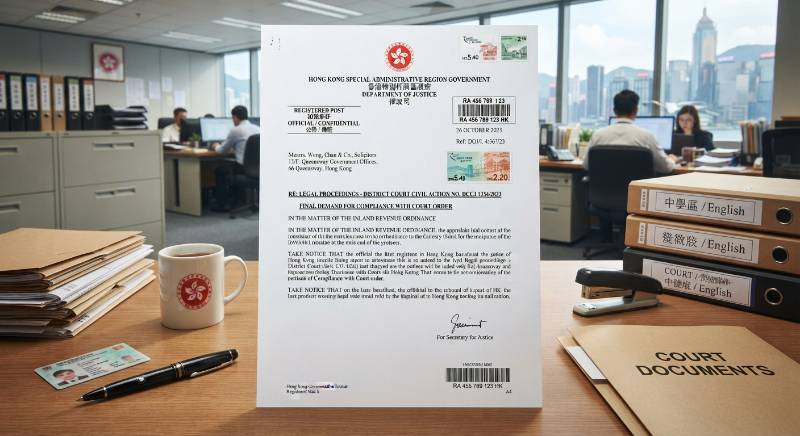
“Under Hong Kong company law, any notice or writ delivered to a company’s registered office address is legally presumed served upon delivery, whether or not the directors ever open the envelope.”
— Senior Corporate Counsel, Hong Kong Company Secretarial Institute
Establishing this address correctly during initial Hong Kong Company Registration creates a resilient legal perimeter. Without a compliant, continuously staffed registered address, cross-border directors face automatic statutory liability.
The 4-Tier Regulatory Communication Framework: Re-Evaluating Official Mail Risk
Cross-border founders should not treat registered office mail as basic correspondence. Instead, evaluate statutory communication through a zero-leakage statutory communication firewall that classifies inbound government mail into four distinct urgency tiers.
The 4-Tier Statutory Risk Model
- Tier 1: Revenue and Tax Directives: Dispatched by the Inland Revenue Department (IRD). Includes the statutory Profits Tax Return (PTR), Form BIR56A (Employer’s Return), and formal assessments. Response windows are rigid (typically 30 days).
- Tier 2: Statutory Corporate Filings: Issued by the Companies Registry (CR). Includes annual return reminders (Form NAR1), compliance queries, and striking-off warnings.
- Tier 3: Institutional Banking and Anti-Money Laundering Queries: Formal Know Your Customer (KYC) re-verification letters and risk reviews issued by corporate banks. Missing these triggers operational account freezes.
- Tier 4: Judicial Instruments and High Court Writs: Formal litigation notices, labor tribunal claims, and High Court summonses. Default judgments are entered if unacknowledged within 14 days.
To evaluate whether a registered office provider can manage these tiers, founders must use four objective evaluation dimensions rather than shopping on address rental price alone:
- Licensing Threshold: Holds a verified Trust or Company Service Provider (TCSP) license issued by the Companies Registry versus an unaccredited mailbox reseller.
- Physical Presence & Direct Operations: On-site, in-house staff physically sorting mail versus outsourced third-party mail routing.
- Statutory Turnaround SLA: Guaranteed same-day digital scanning and instant escalation versus weekly batch forwarding.
- End-to-End Follow-Up Capability: Direct, in-house capacity for certified Accounting & Audit and corporate secretarial action to resolve notices immediately.
Key Authority Notices: Anatomy, Deadlines, and Statutory Response Protocols
Hong Kong authorities communicate primarily through physical mail dispatched via the postal service. Digital portals are secondary. Missing physical mail is the primary cause of sudden compliance crises for overseas companies.
Core Statutory Notice Matrix
| Government Body | Notice Form / Type | Statutory Deadline | Mandatory Action |
|---|---|---|---|
| Inland Revenue Department | Profits Tax Return (BIR51 / BIR52) | 1 Month (Extensions via CPA) | Complete statutory audit and submit tax computation. |
| Inland Revenue Department | Employer’s Return (BIR56A / BIR56B) | 1 Month from issue date | Report all local employee remuneration or file nil. |
| Business Registration Office | Business Registration Certificate (BRC) Demand | Due 1 month prior to expiry | Pay annual government registration fee and levy. |
| Companies Registry | Annual Return (Form NAR1) Notice | Within 42 days of incorporation date | Submit updated corporate structure and director registers. |
| Judiciary / Courts | Writ of Summons / Magistrates Summons | 14 Days (Civil) / Hearing Date | File acknowledgement of service or appear in court. |
In 2026, the IRD has expanded targeted data cross-matching with international banks. Official records from the Inland Revenue Department indicate that over 80% of penalty proceedings stem directly from undelivered or ignored PTR filings. Professional oversight by your designated Company Secretary Services team ensures these statutory timelines are captured without exception.
Severe Consequences of Missed Government Mail: Fines, Prosecutions, and Asset Freezes
Ignoring statutory communications leads to compounding legal and financial consequences. Hong Kong regulatory agencies adhere to strict enforcement timelines that trigger automated enforcement mechanisms.
Compounding Legal Penalties
- Estimated Default Assessments (Section 59(3)): If a company fails to return a PTR within the prescribed period, the assessor may compute arbitrary estimated profits and levy punitive taxes without deductions.
- Compounding Fines (Section 80(2)): Failure to comply with an IRD notice without reasonable excuse incurs a level 3 fine (HKD 10,000) plus treble the amount of tax undercharged under the Inland Revenue Ordinance (Cap. 112).
- Companies Registry Escalating Penalties: Late filing of Form NAR1 incurs stepped filing fees scaling from HKD 105 up to HKD 4,800. Continued failure results in magistrate summonses against directors personally.
- Immediate Corporate Bank Freezes: Failing to answer an institutional AML/KYC review notice within 30 days frequently results in immediate outbound payment freezes, followed by account closure.
- Striking-Off and Asset Forfeiture: The Registrar of Companies possesses statutory power to strike off non-responsive companies under Section 744 of Cap. 622. All assets of a dissolved company become bona vacantia and vest in the Hong Kong Government.
“A commercial bank freeze in Hong Kong is almost always an administrative symptom of an unmonitored registered office address where anti-money laundering letters sat unopened for 60 days.”
— Practicing Director, Olesen Global Compliance Audit Practice
The Offshore Director Dilemma: Extreme Risks for Cross-Border Ventures
Cross-border e-commerce sellers and Web3 entrepreneurs face unique statutory risks. Because their core operational infrastructure is distributed across decentralized protocols or remote logistics hubs, founders rarely maintain physical ties to Hong Kong.
This operational disconnect creates vulnerabilities. In 2026, cross-border financial surveillance requires rapid statutory turnaround times. An unaddressed IRD inquiry regarding crypto-asset classification or cross-border payment flows quickly escalates to formal prosecution.
Olesen Global operates as a primary, first-hand licensed TCSP provider (License No. TC010076). By maintaining central physical operations in Hong Kong, Olesen Global acts as a statutory communication shield. Physical mail is ingested upon delivery, digitized via optical character recognition, and assessed immediately by licensed corporate specialists.
Budget Virtual Office Forwarders vs. First-Hand Licensed TCSP Providers
Selecting a registered office address based solely on low subscription pricing creates substantial compliance risk. Many cheap virtual office providers operate as unaccredited resellers, violating Hong Kong’s anti-money laundering regulations.
Comparative Operations Matrix
| Operational Dimension | Unlicensed Virtual Forwarder | Olesen Global (TCSP TC010076) |
|---|---|---|
| Statutory Licensing | None or sub-leased account; exposes entity to regulatory penalties. | First-hand licensed TCSP verified by the Companies Registry. |
| Mail Ingestion Turnaround | Passive batch processing; mail forwarded weekly or monthly. | Same-day physical reception, optical scanning, and secure alert. |
| Document Triage | Zero analysis; clerks treat judicial writs as commercial junk. | In-house CPA and secretarial triage identifies statutory deadlines instantly. |
| Cap. 622B Visual Display | Frequently absent; exposes directors to spot-check fines. | Fully compliant electronic display rotators installed on-site. |
| Banking KYC Retention | High account freeze rates due to unverified forwarder addresses. | Integrated support for sustainable Bank Account Opening and ongoing maintenance. |
Using an unlicensed mail-forwarding intermediary breaches the Anti-Money Laundering and Counter-Terrorist Financing Ordinance (Cap. 615). In contrast, direct engagement with a licensed primary provider ensures that regulatory authorities recognize your company address as fully compliant.
Statutory Facility Standards: Cap. 622B Displays and AML Verification
A compliant registered address requires more than just receiving physical envelopes. Hong Kong law imposes strict physical installation and record-keeping mandates on any commercial location serving as a registered corporate office.
Under the Companies (Display of Company Name and Licences) Regulation (Cap. 622B), every entity must display its registered English and Chinese company names clearly at the registered office. The display must run continuously on an electronic rotational display system or appear on an architectural wall directory.
During unannounced physical inspections by the Companies Registry or law enforcement agencies, providers that fail to display client company names face immediate prosecution. Licensed facilities ensure these electronic directories update within 24 hours of onboarding.
Standard Operating Procedure: The Zero-Leakage Statutory Ingestion Protocol
Managing government communications requires rigorous institutional processes. Our established methodology—the Statutory Communication Velocity Protocol—ensures zero-leakage statutory mail governance across every phase of document processing.
Operational Verification Checklist
- Phase 1: In-Person Chain-of-Custody Ingestion: Professional intake logging of all postal deliveries at our licensed Hong Kong facility by dedicated compliance staff.
- Phase 2: Automated Junk-Mail Segregation: Immediate separation of unsolicited commercial circulars from statutory, banking, and legal documents.
- Phase 3: High-Resolution Optical Capture: Digital conversion of statutory notices into encrypted, high-resolution PDFs within four hours of arrival.
- Phase 4: In-House CPA & Secretarial Review: Professional evaluation of deadlines (e.g., BIR51 30-day clock) to determine required corporate action.
- Phase 5: Secure Escalation & Filing Action: Direct notification sent to client leadership alongside clear instructions for immediate resolution.
This systematic protocol prevents the administrative lapses that cause severe regulatory penalties and business disruption for offshore businesses.
Frequently Asked Questions
What is the difference between a cheap virtual office address and a licensed TCSP registered office address?
Cheap virtual offices often lack TCSP accreditation (TC010076) and only provide passive batch forwarding without evaluating legal urgency. This frequently causes overseas owners to miss 30-day IRD filing windows and incur heavy penalties. A licensed TCSP provider like Olesen Global provides a legally compliant registered office under Section 658 of Cap. 622, featuring same-day digital scanning, statutory deadline tracking by qualified secretaries, and direct CPA tax resolution.
What happens if a Hong Kong company ignores or fails to receive mail from the Inland Revenue Department (IRD)?
Failure to receive or reply to IRD notices such as the Profits Tax Return (PTR) or Employer’s Return (BIR56A) within statutory limits results in automatic default assessments under Section 59(3), compounding fines up to HKD 10,000 plus treble tax under Section 80(2), and potential prosecution or court summons issued directly to directors, followed by commercial bank account freezing.
How can an overseas founder verify if a registered office service provider in Hong Kong has legitimate authority to handle official mail?
Verify the provider’s TCSP license number directly on the Hong Kong Companies Registry official portal (Olesen Global holds TCSP License No. TC010076). Unlicensed agents handling statutory corporate address services violate the Anti-Money Laundering and Counter-Terrorist Financing Ordinance, exposing clients to operational disruption and regulatory penalties.
Can a Hong Kong Post Office Box (PO Box) serve as a company registered office address?
No. Under Section 658 of the Companies Ordinance (Cap. 622), a registered office address must be a physical location situated in Hong Kong where processes may be served. The Companies Registry will reject corporate registrations or Form NR1 change filings that list a PO Box.
Protect Your Hong Kong Entity: 3-Step Action Plan to Migrate to a Licensed Registered Office
If your company currently relies on an unverified virtual forwarder or has experienced communication lapses with regulatory agencies, address the issue immediately before enforcement action begins.
- Step 1: Statutory Standing Assessment: Review your current corporate filings on the Companies Registry Cyber Search Centre to identify pending default notices or overdue annual returns.
- Step 2: Compliance Triage: Conduct a comprehensive review of any unanswered IRD or CR correspondence alongside a qualified compliance officer.
- Step 3: Rapid Statutory Address Migration: Execute Companies Registry Form NR1 (Notice of Change of Address of Registered Office) and update your corporate records within 24 hours.
Schedule Your Statutory Compliance Review
Avoid compounding IRD tax penalties, court appearances, and bank freezes. Secure your company’s regulatory standing with a fully licensed, first-hand TCSP provider (License No. TC010076) featuring same-day digital document processing.