The 5-Dimensional Decision Framework for Global Entrepreneurs
Choosing between a Hong Kong Private Limited Company and a Sole Proprietorship depends on your risk exposure, tax positioning, cross-border banking needs, statutory compliance capacity, and residency status. While a sole proprietorship offers a fast, low-cost entry point for local freelancers, a private limited company provides structural asset protection, international banking credibility, and 100% remote foreign ownership.
International founders cannot evaluate this decision solely on initial formation fees. The long-term commercial viability of your business hinges on structural alignment with global banking compliance and regulatory scrutiny.
To establish a systematic evaluation, we apply the 5-Vector Entity Selection Protocol. This analytical framework models five structural dimensions before committing capital:
- Vector 1: Legal Liability & Asset Ring-Fencing: Assessing whether personal assets remain insulated from contractual claims, commercial debt, and operational litigation.
- Vector 2: Effective Tax Architecture: Weighing corporate two-tiered profits tax rates against unincorporated personal assessment thresholds and international treaty access.
- Vector 3: Statutory Audit Mandates: Factoring in mandatory certified public accountant (CPA) audits versus informal internal bookkeeping obligations.
- Vector 4: Cross-Border Banking Eligibility: Evaluating Know-Your-Customer (KYC) pass rates across Tier-1 multi-currency commercial banks.
- Vector 5: Jurisdictional Sovereignty & Residency: Determining foreign ownership parameters, local guarantor requirements, and remote governance feasibility.
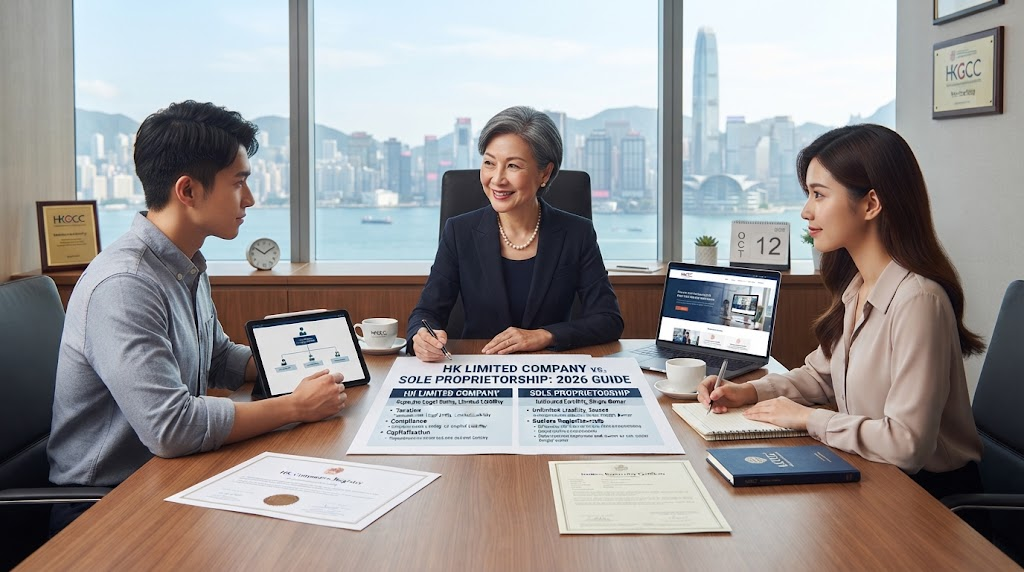
Key Differences at a Glance: Limited Company vs Sole Proprietorship
The structural, legal, and operational distinctions between these two entity types are governed by separate regulatory authorities in Hong Kong: the Hong Kong Companies Registry and the Inland Revenue Department (IRD).
| Evaluation Dimension | Hong Kong Private Limited Company | Hong Kong Sole Proprietorship |
|---|---|---|
| Legal Status | Distinct legal entity (Corporate Personhood) | No separate legal identity from owner |
| Liability Exposure | Limited to unpaid share capital | Unlimited personal liability for all debts |
| Profits Tax Rates | 8.25% (first HKD 2M) / 16.5% (balance) | 7.5% (first HKD 2M) / 15.0% (balance) |
| Statutory Audit Requirement | Mandatory annual audit by practicing HK CPA | No statutory audit; basic accounting records |
| Non-Resident Ownership | 100% foreign-owned allowed; remote setup | Requires local resident agent / HKID holder |
| Corporate Banking Eligibility | High acceptance at Tier-1 & digital banks | Extremely low for non-residents; high KYC hurdles |
| Company Secretary Requirement | Mandatory licensed TCSP provider or resident | Not applicable |
Legal Liability & Separate Entity Status: Protecting Personal Wealth
The foundational distinction under the Hong Kong Companies Ordinance (Cap. 622) is corporate personhood. A private limited company exists as an autonomous legal person capable of owning property, executing contracts, suing, and being sued.
When an entrepreneur incorporates a limited company, their personal exposure is strictly bounded by their subscribed share capital. If the corporation encounters insolvency or contractual disputes, the shareholders’ private assets—including real estate, personal bank balances, and global holdings—remain shielded from commercial creditors.
“Operating an international trading enterprise or a digital platform via an unincorporated structure eliminates the corporate veil entirely. In cross-border contractual disputes, a sole proprietor stands personally liable to the full extent of their global net worth.”
— Senior Corporate Governance Counsel, Hong Kong Corporate Services Institute
In contrast, a sole proprietorship does not possess a separate legal identity. The business and the individual owner are legally indistinguishable under common law.
Every commercial commitment, vendor liability, lease agreement, and tort claim incurred by the business attaches directly to the individual. For global founders managing cross-border supply chains or handling client funds, operating without limited liability introduces unnecessary personal financial risk.
Founders building institutional value typically secure their corporate framework through Hong Kong Company Registration to establish an airtight legal barrier between commercial risk and family wealth.
Taxation Dynamics: Two-Tier Profits Tax vs Unincorporated Rates
Hong Kong operates under a territorial tax regime, taxing only profits arising in or derived from the territory. However, the mechanism applied depends heavily on whether your business is incorporated.
Under the corporate Two-Tiered Profits Tax Rates Regime administered by the Inland Revenue Department (IRD), corporations benefit from an 8.25% tax rate on the first HKD 2,000,000 of assessable profits. Profits exceeding this threshold are taxed at the standard corporate rate of 16.5%.
Unincorporated businesses, including sole proprietorships, face tax rates of 7.5% on their initial HKD 2,000,000 and 15% on the balance. While these nominal rates appear 0.75% to 1.5% lower on paper, unincorporated entities forfeit critical fiscal and structural advantages.
| Net Assessable Profit | Limited Company Tax (8.25% / 16.5%) | Sole Proprietorship Tax (7.5% / 15.0%) | Effective Difference |
|---|---|---|---|
| HKD 1,000,000 | HKD 82,500 (8.25%) | HKD 75,000 (7.50%) | + HKD 7,500 |
| HKD 2,000,000 | HKD 165,000 (8.25%) | HKD 150,000 (7.50%) | + HKD 15,000 |
| HKD 5,000,000 | HKD 660,000 (13.20% effective) | HKD 600,000 (12.00% effective) | + HKD 60,000 |
The slight tax savings of a sole proprietorship are quickly offset by operational drawbacks. Private limited companies can carry forward unabsorbed tax losses indefinitely to offset future profits, deduct legitimate corporate director remuneration, and access Hong Kong’s network of over 45 Comprehensive Double Taxation Agreements (DTAs).
Furthermore, sole proprietors cannot access double tax relief protocols in overseas jurisdictions, frequently leading to double taxation on cross-border revenue streams.
Structuring your corporate assets also allows you to protect intellectual property via Trademark Registration, creating clean intangible asset classes held directly by the corporation.
Compliance & Maintenance: Annual CPA Audit vs Informal Bookkeeping
Statutory maintenance represents the primary operational divergence between these business structures. Hong Kong maintains a rigorous corporate governance framework to preserve its status as a premier international financial hub.
Every Hong Kong private limited company must fulfill mandatory statutory maintenance obligations under Cap. 622:
- Annual Statutory Audit: Financial statements must be audited annually by an independent, practicing Hong Kong Certified Public Accountant (CPA).
- Annual Return (Form NAR1): Submission of updated corporate details to the Companies Registry within 42 days of the company’s incorporation anniversary.
- Licensed Company Secretary: Appointment of a qualified professional or a firm holding a valid Trust or Company Service Provider license (TCSP License TC010076).
- Significant Controllers Register (SCR): Maintaining an updated SCR and appointing a Designated Representative (SCR) to liaise with law enforcement authorities.
- Business Registration Certificate (BRC): Annual or triennial renewal with the IRD’s Business Registration Office.
A sole proprietorship operates with simpler compliance requirements. It requires only an initial BRC, ongoing business renewals, and basic internal profit-and-loss bookkeeping to file individual Profits Tax returns (Form BIR60). No CPA audit or Companies Registry filings are required.
However, this apparent simplicity comes at the expense of external credibility. Audited financial statements provide an objective verification of commercial solvency required by institutional lenders, enterprise buyers, and venture capital investors.
To avoid non-compliance penalties, companies rely on professional Company Secretary Services and dedicated Accounting & Audit Services to ensure timely, error-free statutory filings.
Banking Accessibility & KYC Realities for Non-Resident Owners
Banking infrastructure is often the decisive factor for international founders. Hong Kong commercial banks operate under strict anti-money laundering (AML) and counter-terrorist financing (CTF) frameworks established by the Hong Kong Monetary Authority (HKMA).
Statistics from institutional onboarding pipelines reveal an 88% higher onboarding rejection rate for cross-border sole proprietorships at Tier-1 commercial banks compared to properly structured limited companies.
“Tier-1 commercial banks in Hong Kong rarely approve multi-currency corporate accounts for non-resident sole proprietorships. Without an incorporated legal identity, certified audited balance sheets, and an accountable TCSP secretary, cross-border KYC screening usually leads to rejection.”
— Senior Compliance Director, Global Financial Institutions Group
Tier-1 banking institutions—including HSBC, Standard Chartered, and Bank of China (Hong Kong)—require transparent corporate documentation to satisfy institutional KYC standards. A private limited company provides this structure through its Articles of Association, verified register of directors and members, and oversight by a licensed TCSP representative.
Sole proprietorships operated by non-residents present higher compliance risks for bank onboarding teams. Because personal and business funds are commingled in unincorporated models, underwriters struggle to distinguish personal transactions from commercial revenue.
Consequently, foreign entrepreneurs who require dedicated multi-currency settlement capabilities should secure specialized guidance for Hong Kong Bank Account Opening using an incorporated corporate entity.
The Non-Resident Cross-Border Scenario: Why 100% Foreign Ownership Matters
For cross-border e-commerce operators, international trading houses, and remote SaaS founders, Hong Kong provides an ideal legal foundation—provided the correct corporate structure is selected.
Under Hong Kong law, a Private Limited Company permits 100% foreign ownership. There are no statutory requirements regarding the nationality or residency of shareholders or directors. A foreign citizen can incorporate, own, and govern a Hong Kong limited company remotely without ever entering the territory.
In stark contrast, establishing a sole proprietorship as a non-Hong Kong resident presents significant legal obstacles:
- The Resident Agent Mandate: If the owner does not hold a valid Hong Kong Permanent Identity Card (HKID) or an appropriate employment/investment visa, the IRD requires the appointment of a local Hong Kong resident to act as the official business agent.
- Joint and Several Exposure: The resident agent must accept legal liability and handle official government correspondence, making it difficult to find qualified individuals willing to assume this role without substantial fees.
- Transferability Constraints: An unincorporated enterprise cannot be sold through simple equity transfers. Any change in ownership requires re-registering the enterprise and obtaining new operational permits.
A limited company avoids these issues entirely. Equity is cleanly divided into shares that can be transferred, diluted, or assigned to international investors through standard corporate resolutions.
Debunking the ‘Conversion Myth’: Why Upgrading Later Is Costly
A common misconception among early-stage founders is that they can register as a sole proprietorship to test their business concept and seamlessly convert to a limited company later. Hong Kong commercial law does not support direct entity conversions.
Upgrading an unincorporated entity into a private limited company requires a complete, multi-step structural overhaul:
- Step 1: Dissolution of the Sole Proprietorship: Formally deregistering the unincorporated entity with the IRD Business Registration Office and settling all personal tax liabilities.
- Step 2: Fresh Incorporation: Executing a de novo incorporation via the Companies Registry to create a new corporate legal person with a new registration number.
- Step 3: Contractual Novation & Asset Assignment: Re-executing all commercial vendor agreements, client contracts, software licenses, and property leases in the name of the new corporate entity.
- Step 4: Bank Account Closure and Re-Application: Closing the existing sole proprietorship merchant and bank accounts, then initiating a brand-new corporate bank application from scratch.
- Step 5: IP and Trademark Re-Assignment: Legally transferring intellectual property, brand assets, and operational domain names to the new limited company.
This restructuring process creates operational downtime, requires renegotiating supplier terms, and carries substantial administrative and legal costs. Choosing the correct limited structure from day one eliminates these future migration expenses.
Why Work with a Direct TCSP-Licensed Provider (TC010076)?
Hong Kong requires corporate service providers to hold a formal Trust or Company Service Provider (TCSP) license under the Anti-Money Laundering and Counter-Terrorist Financing Ordinance. Operating through unregulated third-party brokers exposes business owners to statutory non-compliance and service disruptions.
Olesen Global (傲承环球) is an officially licensed TCSP provider holding TCSP License TC010076, operating directly from our physical headquarters in Hong Kong. We manage the entire corporate lifecycle without intermediary markups:
- Direct Integration with Regulatory Systems: Real-time processing through the Hong Kong Companies Registry e-Registry and the Inland Revenue Department portal.
- In-House Practicing CPAs & Corporate Secretaries: Technical compliance management, statutory governance, and certified audit reporting managed directly by our team.
- Institutional Banking Facilitation: Direct account opening pathways across primary Tier-1 banks, regional institutions, and virtual commercial banking platforms.
- One-on-One Progress Tracking: Transparent onboarding, milestone updates, and active compliance monitoring for global founders.
Structural Readiness Checklist
Before launching your Hong Kong enterprise, review this operational checklist to ensure statutory readiness:
- Assess Liability Risk: Evaluate potential contractual, operational, and financial exposures.
- Confirm Residency Feasibility: Verify whether 100% remote foreign ownership is required.
- Determine Banking Needs: Ensure your entity structure satisfies Tier-1 multi-currency commercial account criteria.
- Appoint a Licensed TCSP Secretary: Secure an authorized corporate service provider (License: TC010076).
- Establish Compliance Protocols: Plan for annual CPA audits, NAR1 filings, and SCR register maintenance.
Frequently Asked Questions
Which structure is more cost-effective over the long term?
While a sole proprietorship requires lower initial setup costs and avoids annual CPA audit fees, a Private Limited Company offers greater long-term financial efficiency for expanding businesses. It provides personal asset protection, access to the 8.25% two-tiered corporate tax rate, infinite tax loss carry-forwards, and seamless global bank account approvals.
Can a non-Hong Kong resident register a sole proprietorship?
Non-Hong Kong residents face significant operational hurdles when registering a sole proprietorship. The Inland Revenue Department requires non-residents to appoint a local Hong Kong resident to act as their agent and assume shared regulatory liability. In contrast, a Hong Kong Private Limited Company allows 100% foreign ownership and remote directorship when supported by a licensed TCSP company secretary.
How do commercial banks evaluate sole proprietorships versus limited companies?
Tier-1 international and domestic Hong Kong banks (such as HSBC, Standard Chartered, and Bank of China) prioritize Private Limited Companies due to their clear corporate governance, regulated ownership structures, and CPA-audited financials. Sole proprietorships face high rejection rates for multi-currency commercial accounts due to stringent anti-money laundering and KYC requirements.
Is an annual CPA audit legally mandatory for a Hong Kong limited company?
Yes. Under Section 429 of the Hong Kong Companies Ordinance (Cap. 622), all private limited companies must prepare annual financial statements audited by an independent Hong Kong Certified Public Accountant (Practicing). Sole proprietorships are exempt from statutory audits but must maintain basic ledger records for IRD assessment.
Can I convert my sole proprietorship into a limited company later?
Hong Kong law does not offer a direct statutory conversion mechanism. Transitioning requires dissolving the sole proprietorship, incorporating a new private limited company, re-executing all commercial and vendor contracts, closing and opening bank accounts, and transferring all intellectual property and business assets.
Take Action: 3-Step Entity Suitability & Fast-Track Incorporation
Launch Your Compliant Hong Kong Corporate Structure
Establish an asset-protected, tax-efficient, and bank-ready corporate presence in Hong Kong. Work directly with our licensed compliance specialists, in-house CPAs, and chartered company secretaries.
- Step 1: Entity Suitability Assessment: One-on-one review of your cross-border business model, liability exposure, and banking requirements.
- Step 2: Digital KYC & Verification: Secure, paperless submission verified directly by licensed TCSP officers (License: TC010076).
- Step 3: Fast-Track Setup & Banking Support: Complete statutory corporate kit delivery, Significant Controllers Register setup, and prioritized corporate bank account opening support.