Hong Kong Company Founder and Executive Relocation Guide: Statutory Compliance, Visa Structuring, and Corporate Substance Architecture
An authoritative regulatory manual for multinational founders, controlling shareholders, and c-suite executives establishing commercial operations, deploying physical infrastructure, and securing residency under Hong Kong immigration and corporate ordinances.
Relocating foreign corporate founders and senior management to Hong Kong requires strict alignment between the Companies Ordinance (Cap. 622) and the Immigration Ordinance (Cap. 115). Holding shares or serving as a registered non-resident director confers zero statutory rights to reside or execute hands-on operations within the territory. The Hong Kong Immigration Department (ImmD) requires sponsoring corporate entities to exhibit demonstrable economic substance, verifiable paid-up capital, dedicated physical commercial office premises, local MPF-registered personnel, and compliant commercial banking infrastructure before issuing executive entry permits.
Cap. 622, Cap. 115, Cap. 112
6 to 12 Weeks (Substantive)
HK Resident / TCSP Licensee
Independent Commercial Lease
Statutory Governance and Regulatory Scope for Relocating Executives
International corporate structuring frequently encounters an operational impasse when executives confuse legal entity ownership with lawful territorial deployment. Under the legal architecture established by the Companies Ordinance (Cap. 622), an overseas individual may incorporate a Hong Kong private company limited by shares, subscribe to its initial equity, and assume statutory directorship without holding local immigration status. However, directorship constitutes an administrative and governance capacity; it does not confer authorization to enter Hong Kong to execute operational mandates, manage physical facilities, or draw local employment compensation.
The Immigration Department (ImmD), acting under the statutory powers of the Immigration Ordinance (Cap. 115), rigorously distinguishes passive equity holding from active jurisdictional employment. Engaging in day-to-day operations, negotiating client contracts on-site, or managing local staff while holding mere visitor transit status violates Section 41 of Cap. 115, carrying penal liabilities including substantial fines and deportation. Sponsoring corporate entities must therefore be structurally prepared to underwrite immigration applications through demonstrable business volume and genuine territorial integration. Utilizing professional Hong Kong company registration ensures that the initial baseline governance—comprising corporate articles, formal capitalization, and regulatory licensing—satisfies institutional thresholds before any immigration petitions are submitted.
The immigration authorities review sponsor legitimacy through a rigorous lens: the enterprise must possess genuine commercial substance rather than merely existing as an offshore conduit. Adjudicators evaluate whether an inbound founder or senior manager will generate measurable economic contributions to the Special Administrative Region (HKSAR). This standard requires establishing physical corporate roots, generating transactional flow, creating employment opportunities for local Hong Kong permanent residents, and integrating cleanly into the domestic tax and banking infrastructure.
Corporate Entity Architecture and Legal Readiness Under Cap. 622
Before any visa dossier is submitted to the Immigration Department, the sponsoring entity must satisfy explicit statutory governance criteria codified within the Companies Ordinance (Cap. 622). A critical structural mandate involves the separation of corporate governance functions. Pursuant to Section 475(2) of Cap. 622, a private company having only one director cannot appoint that sole director as the statutory Company Secretary. Furthermore, Section 475(3) strictly prohibits a private company having only one director from having as its company secretary a body corporate of which that sole director is also the sole director. Founders operating as single-member business owners must therefore secure an independent statutory corporate secretary who is an ordinarily resident individual in Hong Kong or a licensed corporate body.
Engaging professional, institutionally licensed statutory company secretary services under Trust or Company Service Provider (TCSP) License TS010076 guarantees that corporate filings, register updates, and statutory resolutions adhere to regulatory standards. In addition to secretarial management, Cap. 622 mandates the maintenance of an accurate Significant Controllers Register (SCR) at the company’s registered office or designated location pursuant to Part 12, Division 2A of the Ordinance. Sponsoring entities must formally appoint a Designated Representative (DR) to provide SCR access to authorized law enforcement officers upon statutory demand. Eligible representatives must be a resident director, a resident employee, or a TCSP licensee.
A frequent error made by relocating executives involves relying on nominal corporate secretarial addresses as the company’s operational base when submitting employment visa dossiers. Sponsoring entities must differentiate between their formal statutory address and their actual commercial workspace. Immigration vetting officers routinely cross-examine corporate registers and physical premises; entities failing to align with clear commercial office physical substance criteria face immediate scrutiny or outright sponsor rejection. Furthermore, enterprises undergoing restructuring or transferring foreign entities into Hong Kong can now utilize the official corporate re-domiciliation framework, which preserves original corporate history, identity, and active contractual obligations without liquidating assets or disrupting ongoing cross-border commercial transactions.
Strategic Visa Route Selection: GEP Investment, GEP Employment, and TTPS
Choosing the correct immigration pathway depends on the applicant’s equity stake, academic profile, financial resources, and corporate operational status. The HKSAR government provides distinct entry channels: the General Employment Policy (GEP) for Investment (Entrepreneurs), standard GEP Employment sponsorship, and the Top Talent Pass Scheme (TTPS). Each pathway imposes divergent documentation standards, capital verification protocols, and renewal burdens.
Founders holding controlling equity interests who are building an enterprise from early-stage inception generally fall under the GEP Investment regime. The applicant must prove that their business will produce substantial economic value for the territory. Navigating these mandates requires mastering comprehensive GEP investment visa requirements, which demand a comprehensive two-year business projection detailing capital allocation, turnover targets, and local employment creation. Conversely, multinational corporations transferring seasoned regional directors into established Hong Kong entities rely on standard GEP Employment, where the focus shifts toward justifying why the position cannot be readily filled by the domestic labor pool.
High-earning executives or graduates from eligible world-class universities frequently utilize the Top Talent Pass Scheme (TTPS), particularly under Category A (annual taxable income reaching or exceeding HKD 2.5 million in the preceding 12 months). Founders evaluating this streamlined vehicle should analyze our comparative breakdown of TTPS versus GEP pathways to select the correct approach. While TTPS provides immediate initial entry without an upfront corporate sponsor, renewal requires demonstrating operational commercial viability, local employment, and ongoing business operations comparable to GEP standards.
| Evaluation Dimension | GEP – Investment (Entrepreneur) | GEP – Standard Employment Sponsorship | Top Talent Pass Scheme (TTPS – Cat A & B) |
|---|---|---|---|
| Statutory Eligibility & Baseline Mandate | Controlling shareholder or major equity partner establishing or participating in a business; must demonstrate substantial economic contribution under Cap. 115. | Executive-level employee holding non-controlling or minority shares; possesses graduate degrees or demonstrable specialized professional expertise. | Category A: Verified annual personal income exceeding HKD 2,500,000; Category B: Bachelor’s degree from recognized global top 100 universities plus 3 years work experience. |
| Corporate Sponsor Prerequisite | Sponsoring entity must be the applicant’s newly incorporated or acquired Hong Kong operating company, fully registered under Cap. 622. | Sponsoring entity must be an actively trading Hong Kong company with established bank history, audited financials, and existing staff headcount. | Zero corporate sponsor required for initial application; unconditional entry permit issued for employment exploration or entity formation. |
| Physical Substance & Capital Commitment | Independent commercial tenancy agreement required; minimum HKD 500,000 to 1,000,000 paid-up liquidity deployed in local commercial accounts. | Demonstration of established corporate commercial office, operational business licenses, and sufficient corporate capital to sustain executive salary. | No physical office required at application; fully leased commercial office mandatory at month 24 renewal stage to validate local operations. |
| Processing Timeline & Initial Permission | Processing window ranges from 8 to 16 weeks; initial grant typically yields 24 to 36 months under standard pattern (3-3-2 years). | Processing window ranges from 6 to 10 weeks; initial grant yields 24 to 36 months conditioned strictly upon sponsoring employer contract. | Processing window ranges from 2 to 4 weeks; initial grant yields 24 months unconditional stay (Category A grants 36 months starting late 2024 revisions). |
| Local Employment & MPF Expectations | Detailed hiring plan required: commitment to hire 2 to 3 Hong Kong permanent residents within 12 to 24 months, complete with MPF contributions. | Must establish that domestic labor market lacks equivalent technical expertise through local recruitment listings or internal transfer rules. | Must have established local employment or operating business enterprise with active MPF enrollment for self and staff by the extension milestone. |
| Extension Mechanics & PR Eligibility | Evaluated on audited financials, revenue performance, physical office lease continuity; leads to Permanent Residency (PR) after 7 continuous years. | Tied to continuous employment contract; changing employers requires formal ImmD approval; eligible for PR after 7 continuous years. | Renewal requires proof of gainful employment or commercial viability of founded business; counts toward 7-year continuous residency PR milestone. |
Operationalization Roadmap: Capital Injection, Physical Premises, and Banking Execution
Following corporate incorporation under Cap. 622, the enterprise must establish operational infrastructure to substantiate its immigration petition. The primary operational bottleneck facing inbound businesses is securing commercial banking facilities. Hong Kong authorized financial institutions operate under strict Anti-Money Laundering and Counter-Terrorist Financing (Cap. 615) mandates and Hong Kong Monetary Authority (HKMA) supervisory guidelines. Institutional underwriters conduct rigorous Know-Your-Customer (KYC) reviews, Source-of-Wealth (SoW) tracing, and commercial viability audits before approving corporate accounts.
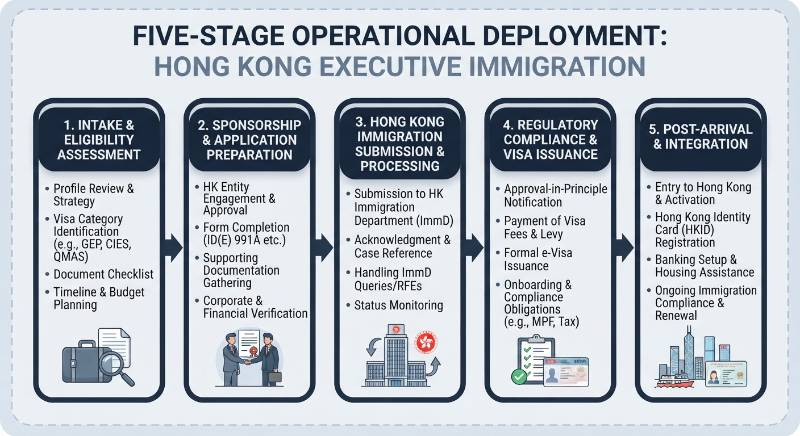
Obtaining commercial bank account opening support mitigates onboarding friction. Sponsoring entities must supply structured documentation, including verified business models, cross-border counterparty draft contracts, corporate resolution filings, and transparent source-of-capital verification. Attempting to sponsor an executive without an active Hong Kong commercial bank account holding capital reserves (ideally HKD 500,000 to HKD 1,000,000 or more) frequently results in operational delays from ImmD adjudicators, who view undercapitalized sponsors as entities lacking operational viability.
Concurrently, the company must execute an authentic commercial tenancy agreement. ImmD policy strictly rejects applications relying solely on virtual office addresses, statutory secretarial boxes, or shared mailing addresses. While an early-stage enterprise may utilize dedicated private rooms within reputable serviced co-working centers, the lease agreement must clearly demonstrate exclusive commercial possession, verified lease terms, photographic evidence of corporate signage, and dedicated phone installations. Sponsoring entities must also protect intangible assets through formal filings: deploying global trademark and intellectual property protection via the Intellectual Property Department (IPD) provides documented proof of regional brand commitment and proprietary technological assets during immigration assessments.
Employment Substantiation, MPF Setup, and Dual-Tax Compliance Integration
Securing initial visa approval represents the beginning of ongoing statutory compliance rather than its completion. Once the founder or executive enters Hong Kong and activates their employment visa, the corporate entity assumes statutory responsibilities as an employer under the Employment Ordinance (Cap. 57) and the Mandatory Provident Fund Schemes Ordinance (Cap. 485). The employer must enroll the executive into an approved MPF scheme within the first 60 days of employment. Enforcing statutory MPF and local employment compliance is vital: monthly contributions (mandating 5% employer and 5% employee contributions, capped at HKD 1,500 monthly each for relevant incomes exceeding HKD 30,000) generate an unalterable paper trail required by the ImmD at every subsequent visa renewal.
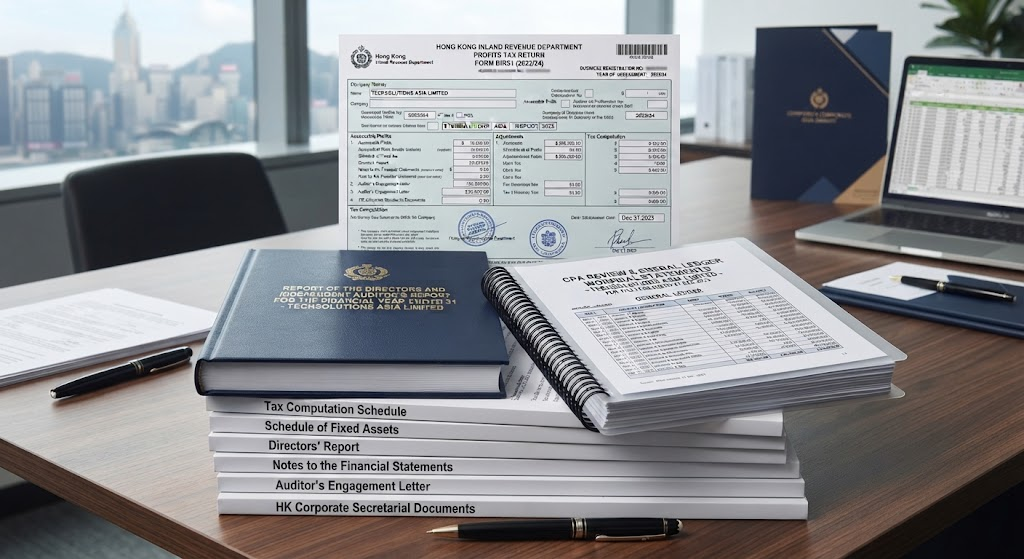
Corporate financial management requires careful harmonization between executive compensation and corporate taxation. The Inland Revenue Department (IRD), governing under the Inland Revenue Ordinance (Cap. 112), applies a territorial source system of taxation. However, founders frequently create tax compliance exposure by mischaracterizing corporate disbursements as non-taxable distributions or mixing corporate cash reserves with personal operational expenses. Executive remuneration must be formally processed via standard monthly payroll slips, supported by corporate resolutions, and properly reported on employer return filings (Form BIR56A and IR56B). Utilizing integrated tax compliance and CPA audit services safeguards the entity against aggressive recharacterization audits under Section 61 and 61A general anti-avoidance provisions.
Salaries Tax Mechanics and Executive Remuneration Structuring
Relocating founders and C-suite executives face an entirely distinct tax framework governing their personal income under the Inland Revenue Ordinance (Cap. 112). Hong Kong operates a territorial Salaries Tax regime characterized by exceptionally competitive headline rates, capped at a maximum standard rate of 15% on net chargeable income, or progressive brackets spanning 2% to 17% (whichever results in a lower liability). However, the legal characterization of founder compensation—specifically distinguishing between office holders (directors) and ordinary employees—governs statutory exposure.
Director Fees vs. Employment Remuneration
A critical statutory distinction exists between remuneration derived from an office of directorship and earnings derived from a contract of employment:
- Statutory Director Fees: Under established Hong Kong case law and IRD practice, a corporate directorship is an office legally sited at the corporate seat. If an executive serves as a director of a Hong Kong incorporated company, the entirety of their directorship fees is deemed Hong Kong-sourced income subject to Salaries Tax, regardless of whether the board meetings were attended remotely or physical duties were discharged outside the territory. Time-apportionment claims are unavailable for statutory directorship fees.
- Employment Remuneration: Compensation paid to an executive in their capacity as an employee (e.g., Chief Executive Officer, Managing Director, or Chief Technology Officer) under an operational employment contract is evaluated based on the locality of the employment contract. If an employment relationship is characterized as non-Hong Kong sourced (negotiated, concluded, and enforceable overseas, with an overseas employer), the executive may qualify for time-apportionment relief under Section 8(1A)(a) of Cap. 112 based on the number of days physical services were rendered in Hong Kong during the year of assessment.
Mandatory Provident Fund (MPF) Exemption Framework
Under the Mandatory Provident Fund Schemes Ordinance (Cap. 485), employers and employees are each mandated to contribute 5% of monthly relevant income (subject to statutory statutory caps of HKD 1,500 monthly per party). However, foreign executives and founders entering Hong Kong under approved employment visas enjoy statutory MPF exemption under two distinct legal pathways:
- 13-Month Exemption Window: Expatriate employees holding valid employment visas are exempt from mandatory MPF enrollment for their initial 13 continuous months of employment in Hong Kong.
- Overseas Retirement Scheme Exemption: If the expatriate executive remains an active participant in an overseas retirement or pension scheme established outside Hong Kong throughout their tenure, they may secure a continuous statutory exemption beyond the initial 13-month window upon formal notification to the MPF trustee.
Immigration Pathways for Founders and Relocating Leadership
Establishing legal presence in Hong Kong requires strategic selection of the statutory immigration channel administered by the Hong Kong Immigration Department (ImmD). The primary pathways tailored for founders, investors, and C-level transferees operate under rigorous procedural and capital standards.
| Visa Category | Target Demographic | Key Statutory & Evidentiary Thresholds | Initial Stay & Extension Pattern |
|---|---|---|---|
| Investment as Entrepreneur | Founding equity holders establishing or participating in an operating business. | Two-year business plan, capital commitment, office lease, local job creation, audited financials or certified projection, economic benefit assessment. | 36 months initial grant (3+3+2 extension pattern under standard schedule). |
| General Employment Policy (GEP) | Senior executives, intra-company transferees, and professional specialists. | Confirmed employment offer, market-rate remuneration package, demonstration of specialized skills not readily available in the local workforce. | 36 months initial grant (3+3+2 schedule; or 3+5 for top-tier earners exceeding HKD 2M). |
| Top Talent Pass Scheme (TTPS) | High-earning founders (Category A) or graduates of top global universities (Cat B/C). | Cat A: Taxable annual employment or business income of HKD 2.5 million or more. Cat B/C: Accredited degree from eligible top 100 global institutions. No upfront job offer required. | 24 months initial entry (Cat A: 36 months); renewal strictly contingent on operating business or local employment. |
| Start-up Incubation Stream | Founders admitted into government-backed incubation programs (e.g., Cyberport, HKSTP). | Admittance letter into designated accelerator or incubator; expedited ImmD review with standard capital proofs substantially mitigated. | Aligned with standard Entrepreneur schedule (3+3+2 extension pattern). |
| Technology Talent Admission Scheme (TechTAS) | R&D executives and specialized technical directors in designated innovation areas. | Sponsoring firm must hold valid TechTAS quota from Innovation and Technology Commission; fast-track ImmD clearance within 2 to 4 weeks. | 24 to 36 months initial grant; standard employment extension milestones. |
| Capital Investment Entrant Scheme (New CIES) | High-net-worth founders and family office principals investing capital assets. | Net assets of HKD 30 million or more deployed into permissible financial assets and non-residential real estate under CIES rules. | 24 months initial stay; renewable in 3-year increments provided qualifying portfolio is maintained. |
Executing the Relocation Roadmap: Four Phases
Relocating key executives requires synchronized execution between statutory entity filings, immigration formalities, physical office occupancy, and institutional banking clearance. Missteps in this sequencing trigger costly operational delays, particularly during anti-money laundering (AML) and customer due diligence (CDD) assessments conducted by international commercial banks.
Phase 1: Corporate Incorporation and Statutory Setup
Execute corporate registration through a licensed TCSP provider via our Hong Kong Company Registration Service. Concurrently appoint a licensed corporate secretary under our statutory Company Secretary Governance Solutions to establish the corporate registers, obtain the Business Registration Certificate, and prepare statutory documentation for immigration filings.
Phase 2: Banking Clearances and Capital Capitalization
Open operating corporate bank accounts through tier-one institutional banks (HSBC, Standard Chartered, Bank of China HK) using our professional Commercial Bank Account Opening Support. Inject paid-up capital into the company account to evidence substantial commercial substance prior to formal submission of the Entrepreneur or GEP visa dossier to the Immigration Department.
Phase 3: Visa Approval, Identity Card Issuance, and Tenancy Formalities
Upon receipt of the ImmD entry visa, the executive enters Hong Kong and completes identity card registration at the Registration of Persons Office under Cap. 177 regulations. Commercial premises leases and executive residential tenancies are finalized and stamped at the Inland Revenue Department Stamp Office to establish indisputable local physical ties.
Phase 4: Statutory Accounting, Annual Audit, and Intellectual Property Safeguards
Implement Hong Kong Financial Reporting Standards (HKFRS) accounting procedures from day one. Prepare for statutory year-end audit filings with our Certified CPA Audit and Profits Tax Compliance Services, while shielding enterprise brands and technology across the Greater Bay Area via our Global Trademark Protection Services.
Annual Maintenance and Continued Compliance Matrix
Relocating founders remain personally liable under the Companies Ordinance (Cap. 622) and Inland Revenue Ordinance (Cap. 112) for corporate statutory lapses. Maintaining both the legal integrity of the enterprise and the validity of immigration permissions demands continuous adherence to the statutory compliance schedule below.
| Statutory Obligation | Governing Authority & Ordinance | Filing Deadline | Director Liability & Non-Compliance Penalty |
|---|---|---|---|
| Annual Return (Form NAR1) | Companies Registry (Cap. 622) | Strictly within 42 days following incorporation anniversary. | Escalating registration late fees up to HKD 3,480; criminal summons and fines up to HKD 50,000 plus daily defaults for company and directors. |
| Business Registration Renewal | Inland Revenue Department (Cap. 310) | Annually or triennially within 30 days of expiry. | Fixed statutory penalty of HKD 300 per late certificate, potential prosecution with fines up to HKD 5,000 and 1 year imprisonment. |
| Certified CPA Statutory Audit | Companies Registry & IRD (Cap. 622 / Cap. 112) | Completed before statutory AGM; filed alongside Profits Tax Return BIR51. | Unaudited returns rejected by IRD; estimated default assessments issued; Section 80 prosecution of company officers. |
| Employer’s Return (BIR56A / BIR56B) | Inland Revenue Department (Cap. 112) | Within 1 month from date of issuance (typically April). | Direct court summons, statutory fines up to HKD 10,000, and jeopardized executive visa extension reviews. |
| Significant Controllers Register (SCR) | Companies Registry (Cap. 622) | Updated within 7 days of verified changes in beneficial ownership. | Criminal offense under Section 653ZC; fine of HKD 25,000 plus daily default fines of HKD 700 on the company and every responsible officer. |
Senior Company Secretary & Auditor FAQ Vault
Can a foreign founder act as their own statutory Company Secretary in Hong Kong?
No. Under Section 474 and Section 475 of the Companies Ordinance (Cap. 622), where a private company has only one director, that sole director is expressly prohibited from acting as the company secretary. Furthermore, an individual company secretary must ordinarily reside in Hong Kong. If a corporate company secretary is appointed, it must hold a valid Trust or Company Service Provider (TCSP) License issued by the Companies Registry under the Anti-Money Laundering and Counter-Terrorist Financing Ordinance (Cap. 615). Olesen Global holds TCSP License TS010076, fulfilling all statutory requirements.
How does relocating personal residence to Hong Kong impact an offshore profits tax claim?
Relocating senior executive management and founding personnel to Hong Kong significantly increases the evidential hurdle for offshore tax claims. Under Section 14 of the Inland Revenue Ordinance, profits are sourced where central commercial operations that produce the profit take place. If contracts are negotiated, signed, or executed by founders physically located in Hong Kong, the IRD will deem the underlying income Hong Kong-sourced and taxable under the two-tiered regime (8.25% on the first HKD 2 million; 16.5% thereafter). Furthermore, under the refined Foreign Sourced Income Exemption (FSIE) regime, retaining pure offshore treatment without meeting economic substance standards in the territory is strictly scrutinized.
What documents must a newly incorporated company submit to secure an Entrepreneur Visa for its founder?
The Hong Kong Immigration Department requires comprehensive corporate substance documentation, including: (1) a certified two-year business plan detailing economic contribution, turnover forecasts, and capital outlay; (2) certified corporate documents (Certificate of Incorporation, Business Registration, Form NNC1/NAR1); (3) commercial bank statements demonstrating sufficient capitalized working capital; (4) a signed commercial office tenancy agreement (pure virtual offices and shared hot-desks are disqualified); (5) a detailed local hiring plan with employment contracts and MPF records for local staff; and (6) verified proof of founder academic and industry credentials.
Can a dormant or non-trading Hong Kong company sponsor an executive employment visa?
No. The Immigration Department assesses the genuine operational viability of the sponsoring entity under the General Employment Policy. A company with statutory dormant status under Section 5 of Cap. 622, or an active company showing zero turnover, un-audited dormant accounts, and no operational office, cannot establish the genuine need for executive sponsorship. The sponsor must demonstrate operational track records, commercial transactions, active business premises, and sufficient corporate capital before any visa sponsorship dossier is entertained.
Does Hong Kong tax global dividend income or capital gains realized by relocated founders?
Hong Kong imposes no tax on capital gains, whether realized from the sale of shares, real estate, or other capital assets. Similarly, dividends received by individuals from domestic Hong Kong companies or foreign entities are entirely exempt from Hong Kong Salaries Tax and Profits Tax. However, founders who retain residual tax residency or citizenship in jurisdictions with worldwide taxation regimes (such as the United States) must carefully structure dividend extractions alongside bilateral Double Taxation Agreements (DTAs) to mitigate cross-border withholding and personal income exposures.
Can a relocated founder maintain an offshore bank account while operating a Hong Kong entity?
While a Hong Kong private limited company may hold commercial bank accounts internationally, maintaining multi-currency onshore settlement accounts within Hong Kong’s Tier-1 banking ecosystem (such as HSBC, Standard Chartered, or Bank of China) is essential for demonstrable economic substance, seamless MPF contributions, payroll execution, and Inland Revenue Department (IRD) audit reconciliations. Olesen Global orchestrates targeted compliance dossiers to facilitate direct Commercial Bank Account Opening alongside executive physical relocation.
What mandatory corporate updates must be filed when an executive’s residential address changes to Hong Kong?
Under Section 645 and Section 652 of the Companies Ordinance (Cap. 622), any change in the residential address or particulars of a company director or company secretary must be reported to the Companies Registry on Form ND2B within 15 days of the change. Furthermore, internal records—including the Register of Directors, Register of Secretaries, and the Significant Controllers Register (SCR)—must be amended immediately by the appointed Statutory Company Secretary to prevent statutory penalties and retain legal standing under TCSP regulatory supervision.
Cross-Border Relocation & Corporate Governance Lifecycle
Successful founder and c-suite relocation requires synchronized corporate, tax, immigration, and regulatory milestones. Deviations in sequencing frequently cause enterprise banking delays, visa rejections, or inadvertent corporate default under the Companies Ordinance (Cap. 622).
PHASE 1: T-90 DAYS
Corporate Structuring & IP Protection
- Execute Hong Kong Company Incorporation or subsidiary setup under Cap. 622.
- Appoint a licensed TCSP company secretary and establish statutory registered office.
- Secure regional intellectual property rights via Global Trademark Registration.
- Structure employment agreements, executive remittal tiers, and commercial lease intents.
PHASE 2: T-45 DAYS
Immigration Filing & Banking Architecture
- Submit comprehensive Investment Visa (GEP) or Top Talent Pass (TTPS) petitions.
- Furnish two-year business business growth plans, capital proofs, and local recruitment quotas.
- Prepare source of wealth documentation for corporate bank AML vetting.
- Execute commercial banking due diligence interviews in Hong Kong.
PHASE 3: T+0 TO T+30 DAYS
In-Country Establishment & Identity
- Enter the HKSAR under approved entry e-visa and obtain biometric landing slips.
- Complete registration for the Hong Kong Identity Card (HKID) within 30 days of arrival.
- Enroll relocated executive and initial staff into an approved Mandatory Provident Fund (MPF) scheme.
- Finalize physical commercial lease and utility proofs to establish physical operating substance.
PHASE 4: T+60 TO ONGOING
Statutory Maintenance & Fiscal Defense
- File Form ND2B with the Companies Registry reflecting permanent residential changes.
- Update Significant Controllers Register (SCR) and Designated Representative logs.
- Execute statutory annual financial statements with independent Certified CPA Audit Compliance.
- File Employer’s Return (BIR56A/B) and individual Salaries Tax returns with the IRD.
Strategic Value: Integrated TCSP Secretarial, Accounting, and Immigration Control
Attempting to navigate Hong Kong executive relocation via disconnected agents—using an independent visa agency, a transactional shelf company reseller, and an unverified accounting vendor—systematically introduces compliance friction. Cross-border business migrations demand that corporate filings under Cap. 622, financial statements reviewed under the Hong Kong Financial Reporting Standards (HKFRS), and business proof tendered to the Immigration Department remain precisely aligned.
Operating under Hong Kong TCSP License TS010076, Olesen Global acts as an institutional anchor for multinational founders, family offices, and executives. From initial entity constitution and direct commercial bank facilitation to statutory audit defense and visa maintenance, our licensed practitioners safeguard corporate legal standing, operational speed, and tax efficiency throughout the enterprise expansion journey.
Consult with Olesen Global’s Licensed Corporate Specialists
Backed by Hong Kong TCSP License TS010076, practicing company secretaries, and certified CPA auditors ready to architect your entity formation, banking, and executive relocation.