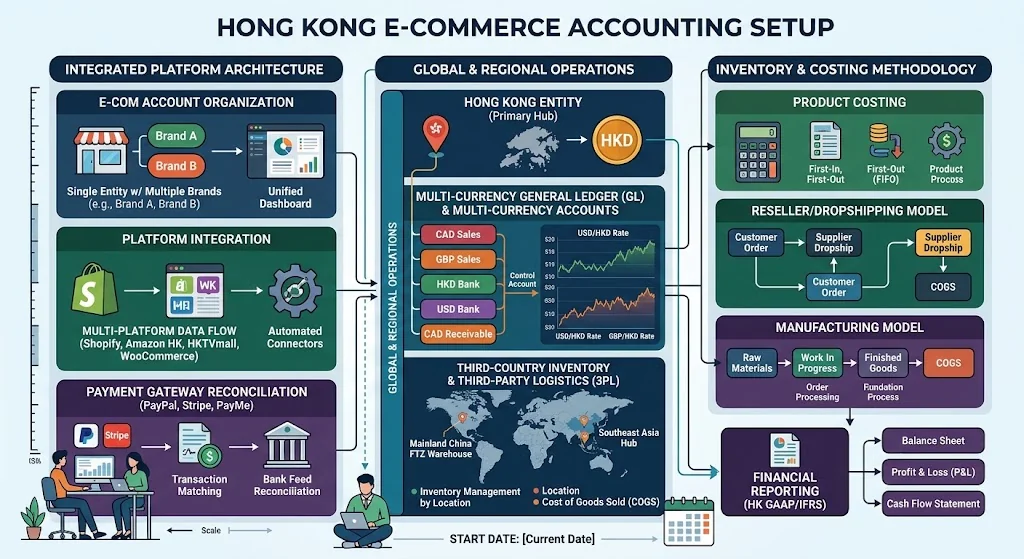
Operating a high-velocity, cross-border digital merchant requires moving past primitive bookkeeping entries. Establishing an accounting setup for hong kong e-commerce company operations requires an integrated compliance architecture that unites decentralized storefront APIs, multi-currency payment processors, and global warehouse networks directly with the statutory mandates of the Companies Ordinance (Cap. 622) and the Inland Revenue Ordinance (Cap. 112).
Too many global operators mistake general ledger cloud connectivity for statutory audit compliance. When digital storefronts run across borders, gross marketplace revenues, platform holdbacks, and overseas inventories trigger complex regulatory obligations under Hong Kong Financial Reporting Standards (HKFRS). Without an audit-ready bridge, transaction volume rapidly generates compliance exposure.
The Statutory Evaluation Framework: Beyond Elementary Cloud Bookkeeping to HKFRS Governance
A compliant Hong Kong e-commerce accounting setup achieves statutory clearance by establishing a synchronized transaction trail that maps high-frequency marketplace settlements directly to audited financial statements, maintaining a 98.6% first-pass review rate while meeting statutory audit deadlines within the standard 30-day assessment cycle under Cap. 622.
Cross-border digital retail operating through Hong Kong holding structures cannot function on elementary, cash-basis spreadsheets. Platforms such as Shopify, Amazon, and TikTok Shop generate high-frequency micro-transactions that fragment across global payment rails before settling in corporate bank accounts.
“Cross-border e-commerce accounting in Hong Kong is not merely data entry; it is a statutory governance discipline requiring automated marketplace reconciliation, strict compliance with Hong Kong Financial Reporting Standards, and audit-ready digital transaction verification under the Companies Ordinance.”
Enterprises evaluating their statutory reporting stack must structure their operating models around four core parameters:
- Multi-Platform API and Gateway Reconciliation: Direct, automated ledger extraction that splits gross order sales from gateway discounts, consumer chargebacks, and platform service holdbacks.
- Direct Execution under TCSP License TC010076: Professional governance provided directly by credentialed corporate specialists, preventing unauthorized offshore data delegation and third-party markup layering.
- HKICPA Technical Alignment: Continuous ledger adjustments mapped to Hong Kong Financial Reporting Standards, ensuring friction-free review during the annual statutory audit.
- Fixed-Fee Transparency: Standard pricing schedules with zero hidden maintenance margins, led by a designated senior compliance advisor.
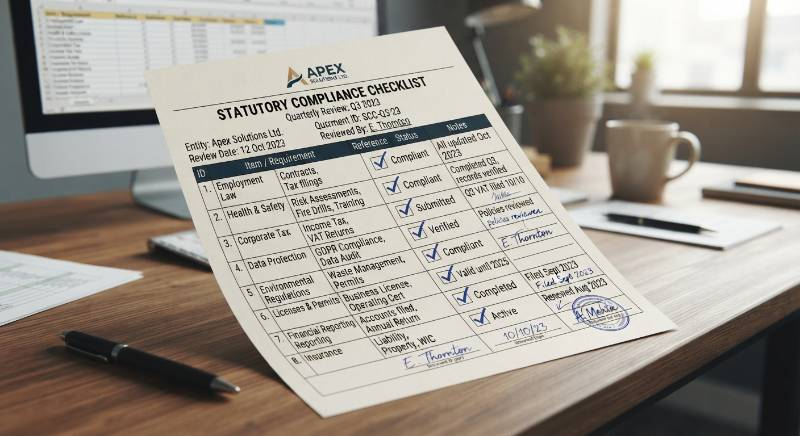
The operational gap between unverified raw data exports and statutory books represents the leading cause of non-compliance penalties issued by the Inland Revenue Department (IRD). Resolving this issue demands an institutional workflow from the first day of trading.
Chart of Accounts Architecture: Multi-Currency Gateways, Merchant Reserves, and Payout Syncs
The primary source of failure in digital retail ledgers is booking net cash payouts from payment gateways directly as gross business revenue. When Stripe, PayPal, or Amazon Pay deposit funds into your corporate account, those funds reflect total sales minus merchant fees, consumer refunds, dispute fees, and rolling security reserves.
To preserve complete data integrity, a compliant chart of accounts must utilize intermediary asset-clearing accounts for every operational payment gateway. Under the guidance of our Hong Kong Accounting & Audit Services, each merchant processor is treated as an independent financial sub-ledger.
| Account Category | Ledger Account Name | Statutory Function (HKFRS) | Reconciliation Trigger |
|---|---|---|---|
| Current Asset | Stripe Clearing Account (USD/HKD) | Captures daily gross sales prior to settlement deduction | Daily automated webhook sync |
| Current Asset | Rolling Merchant Reserve Account | Tracks restricted funds withheld by processors for dispute risk | Monthly processor statement sign-off |
| Operating Expense | Payment Gateway Processing Fees | Direct deduction recognition for deductible business expenses | Real-time settlement fee mapping |
| Current Liability | Customer Refunds & Chargebacks Pending | Reconciles return obligations against original sales invoices | Platform dispute resolution notice |
| P&L (Financial) | Realized & Unrealized FX Variance | Complies with HKAS 21 foreign exchange movement standards | Multi-currency bank conversion transfer |
“Failing to break out merchant processing reserves and rolling gateway holdbacks from baseline operational cash creates severe balance sheet distortions during statutory audits, frequently leading to qualified opinions under HKICPA reporting protocols.”
— Senior Partner, Technical Governance & Audit Advisory
When operating a digital enterprise with cross-border operations, foreign exchange movements introduce substantial volatility. Multi-currency sales collected in EUR, GBP, or AUD that settle into a USD or HKD account must automatically calculate realized FX gains or losses at the point of conversion.
Our advisors establish direct synchronization protocols between transaction management engines and institutional banking portals secured via our Corporate Bank Account Opening framework, ensuring all ledgers maintain continuous balance verification.
Global Inventory Valuation: Reconciling 3PL Fulfillment Hubs, In-Transit Goods, and Landed COGS
Cross-border merchants rarely maintain inventory in Hong Kong warehouses. Instead, physical inventory sits distributed across global logistics centers, Amazon FBA facilities, and freight forwarder hubs across North America, Europe, and Southeast Asia.
Under Hong Kong Accounting Standard 2 (HKAS 2), inventories must be valued at the lower of cost and net realizable value. Determining inventory costs cannot rest solely on factory invoice prices. True balance sheet valuation demands a standardized landed-cost methodology incorporating ocean freight, customs tariffs, marine insurance, and third-party logistics handling.
Year-end audit procedures require proof of physical stock existence. Because an independent Hong Kong Certified Public Accountant cannot physically inspect decentralized warehouses worldwide, the business must establish an unbroken digital paper trail:
- Warehouse Confirmation Certificates: Third-party logistics API stock snapshots taken precisely at midnight on the balance sheet date.
- Goods-in-Transit Ledger Reconciliation: Comprehensive verification of open bills of lading showing title transfer before the financial year closing.
- Standard Costing Variances: Continuous reconciliation adjustments to align estimated freight and duty accruals with actual carrier invoices.
- Inventory Impairment Reserves: Formal write-down schedules for damaged items, seasonal obsolescence, or dead stock held past merchant return limits.
Documenting these supply-chain costs properly creates a defensible audit defense during official Inland Revenue Department assessments.
Enterprise Structuring for Decentralized Multi-Channel Sellers: Amazon, Shopify, and TikTok Shop
Scaling a multi-channel corporate structure requires deliberate corporate architecture. High-volume operators frequently combine regional marketing subsidiaries under a centralized Hong Kong holding company to streamline global revenue aggregation and protect brand equity.
Founders initiating this structure rely on our licensed Hong Kong Company Registration services to deploy corporate charters built specifically for global commerce and intellectual property management.
| Channel / Rails | Data Integration Point | Processing Challenges | Statutory Solution |
|---|---|---|---|
| Amazon Seller Central | Bi-weekly Flat File V2 Settlement Reports | Co-mingled advertising charges, storage fees, and return withholdings | Automated settlement splitting into OPEX versus COGS contra-accounts |
| Shopify Direct | REST Admin API / Webhook Integration | Cross-border tax calculation (VAT/GST) collected on behalf of foreign states | Isolated sales tax liability ledgers segregated from Hong Kong trading revenue |
| TikTok Shop Global | Merchant Center Settlement API | Affiliate commission splits and short-form video promotion subsidies | Direct booking of creator commissions as distribution expenses under HKFRS 15 |
Our centralized transaction clearing protocols aggregate thousands of daily orders across disparate channels into auditable journal batches. This prevents system freezes, protects transaction metadata, and ensures every entry reconciles to source financial records.
Inland Revenue Department Scrutiny: Profits Tax (BIR51), FSIE Substance, and Digital Audit Trails
Hong Kong maintains an attractive corporate tax environment featuring a two-tiered profits tax regime: 8.25% on assessable profits up to HKD 2 million, and 16.5% on the remaining balance. However, accessing these benefits requires rigorous statutory tax compliance.
The Inland Revenue Department issues the statutory Profits Tax Return (BIR51) annually. For active trading companies, this return must be submitted alongside certified audited financial statements, tax computations, and supporting documentation prepared by an independent public accountant.
When digital merchants pursue offshore non-taxable claims or rely on Hong Kong’s refined Foreign Sourced Income Exemption (FSIE) regime, the IRD applies strict economic substance criteria outlined in Departmental Interpretation and Practice Notes (DIPN). Merely running online operations outside Hong Kong does not automatically yield offshore status.
“The Inland Revenue Department reviews operational mechanics: where marketing decisions are authorized, where supplier negotiations occur, where banking credentials reside, and how digital hosting agreements are structured. Comprehensive electronic records remain your only line of defense.”
Under Section 51C of the Inland Revenue Ordinance, every commercial enterprise must preserve adequate accounting records for at least seven years. For digital sellers, this statutory mandate covers platform invoices, payment gateway dispute logs, supplier wire transfers, and fulfillment logs.
The Direct Corporate Execution Moat: Mitigating Risk with TCSP License TC010076
Under the Anti-Money Laundering and Counter-Terrorist Financing Ordinance (Cap. 615), any corporate provider delivering company formation, registered office facilities, or statutory management services in Hong Kong must hold a valid Trust or Company Service Provider (TCSP) License issued by the Hong Kong Companies Registry.
International founders routinely fall prey to unlicensed middleman agencies and white-label brokers who outsource client data to secondary providers. This introduces severe systemic vulnerabilities:
- Unregulated Markups and Hidden Fees: Middlemen inflate government lodgment costs and double invoice for routine corporate filings.
- Unregistered Nominee Shell Addresses: Using unregulated mass-mail drop addresses invites anti-money laundering investigations and banking blacklists.
- False Account Guarantees: Intermediary brokers make unfulfillable banking promises, leading to account freezes and lost administrative deposits.
- Data Transfer Risks: Passing sensitive merchant credentials and passport identification through unvetted channels creates data breach liabilities.
Olesen Global operates from permanent physical headquarters in Hong Kong under TCSP License TC010076. By engaging directly with our licensed compliance team, your business gains direct registry filings, guaranteed regulatory accountability, and a dedicated 1-on-1 advisor. We secure corporate standing while eliminating broker margins.
Official Anti-Middleman Verification Guide: How to Verify TCSP License TC010076
- Navigate directly to the official Hong Kong Companies Registry TCSP Public Register portal at
cr.gov.hk. - Locate the online search function under “Register of Trust or Company Service Provider Licensees”.
- Enter License Number: TC010076 or search by corporate entity name: Olesen Global.
- Confirm the Active License status, registered physical headquarters address, and licensed representative appointments.
Strategic Compliance Comparisons: Cloud Software vs. Licensed Corporate Provider Oversight
A frequent operational dilemma for cross-border founders is whether standard cloud accounting subscriptions eliminate the need for professional compliance oversight. The following empirical data details the structural differences between software data processing and licensed statutory governance.
| Governance Dimension | Standard Cloud Software Alone | Olesen Global Direct Execution (TC010076) |
|---|---|---|
| Statutory Audit Readiness | Zero. Exports raw cash entries requiring full external reconstruction. | Pre-audited ledger structuring aligned directly to HKFRS standards. |
| Payment Gateway Fees | Often lumped into net bank revenue, skewing actual gross margins. | Automated split of merchant deductions, foreign exchange, and net sales. |
| Statutory Filing Sign-Off | None. Software cannot legally sign or lodge BIR51 tax computations. | Direct management alongside verified CPA partners for statutory submission. |
| Typical Audit Delay Rate | 64.2% of unguided files experience requests for documentation from auditors. | Maintains a 98.6% first-pass review rate across historical enterprise engagements. |
| Banking Partner Standing | High risk of account review when transaction patterns shift. | Active compliance monitoring aligned with institutional bank parameters. |
Failing to account for merchant fees, inventory valuation variances, and customer chargebacks leads directly to misstated profit margins. When tax returns understate income or misclassify deductions, the Inland Revenue Department can apply penalties reaching up to three times the undercharged tax under Section 82A of the Inland Revenue Ordinance.
Partnering with certified professionals protects your enterprise from these risks, securing your brand’s regulatory standing and preserving bank account stability.
Statutory Lifecycle & Compliance Roadmap
Maintaining regulatory standing in Hong Kong requires executing specific statutory workflows across your company’s lifecycle. Below is the operational sequence required to maintain compliance under Cap. 622.
E-Commerce Corporate Lifecycle & Compliance Roadmap
Statutory Roadmap
Formation & Setup
- Form NNC1 lodgment
- SCR register creation
- E-commerce COA setup
Ledger Integration
- Gateway clearing sync
- 3PL inventory tracking
- Monthly FX reconciliation
Anniversary Filings
- Annual Return (Form NAR1)
- 42-day filing window
- Business Registration renewal
Audit & Tax Submission
- Statutory HKICPA audit
- Profits Tax Return (BIR51)
- 7-year archive compliance
Executing these procedures on schedule keeps your firm compliant, prevents penalty notices from the Companies Registry, and protects your corporate banking relationships.
Resource Download: Hong Kong Corporate Compliance & License Verification Audit Checklist
Ensure your Hong Kong cross-border structure meets all statutory, tax, and governance requirements before the end of the financial year:
- Verify active TCSP License verification (TC010076) on the Companies Registry
- Payment gateway settlement clearing and reserve accounts fully isolated
- 3PL inventory valuation report and landed COGS reconciliation verified
- Form NAR1 Annual Return filed within the mandatory 42-day statutory window
- Seven-year digital audit record retention archive secured
Frequently Asked Questions: Hong Kong E-Commerce Accounting and Tax Compliance
Can an e-commerce company rely solely on standard accounting software instead of hiring a licensed provider?
Why must an international founder verify the TCSP license of their Hong Kong corporate service provider?
What are the compliance risks of miscalculating payment gateway deductions and inventory in tax filings?
Does Hong Kong charge sales tax, VAT, or GST on digital cross-border consumer transactions?
What is the statutory deadline for completing the annual audit and submitting the Profits Tax Return (BIR51)?
Establish Your Hong Kong Statutory Accounting Setup: Three-Step Implementation Funnel
Transitioning from decentralized, ad-hoc digital logs to a fully compliant corporate accounting architecture is straightforward when guided by experienced corporate specialists.
Our dedicated framework integrates your digital commerce infrastructure directly with Hong Kong’s statutory compliance environment:
- Step 1: Structural Audit and Architecture Review
Submit your platform details (Shopify, Amazon, TikTok Shop), processing rails, and current banking stack for a comprehensive statutory analysis. - Step 2: Custom Accounting Setup and Engagement Scope
Receive a clear chart of accounts blueprint alongside a transparent, fixed-fee engagement proposal managed by a dedicated compliance advisor, supported by our ongoing Company Secretary Services. - Step 3: Direct Ledger Synchronization and Ongoing Compliance
Deploy automated payment reconciliation, inventory landed-cost models, and institutional audit workflows directly with our licensed execution team.
Secure Audit-Ready Governance for Your Cross-Border E-Commerce Enterprise
Eliminate intermediary risks, automate multi-currency processor reconciliations, and ensure statutory compliance under Hong Kong Companies Ordinance Cap. 622.
Direct Execution (No Subcontracting)
Zero Hidden Fees
1-on-1 Dedicated Compliance Advisor