Framework for Evaluating Statutory Record Custody and Governance
Hong Kong corporate law requires incorporated entities to establish and maintain formal statutory records within 14 calendar days of formation, maintaining a baseline 98.6% compliance clearance rate to withstand Companies Registry audits. Companies must satisfy statutory capital rules, maintain continuous legal records, and update registries within prescriptive statutory windows ranging from 7 to 15 days.
Corporate governance in Hong Kong has transformed from a passive administrative exercise into an active regulatory safeguard. Operating under the Companies Ordinance (Cap. 622) and the Anti-Money Laundering and Counter-Terrorist Financing Ordinance (AMLO), statutory record-keeping requires institutional precision. Company directors are personally accountable for the physical and digital integrity of these books.
Many international founders mistakenly rely on unvetted virtual office addresses or unlicensed offshore agents. This exposure creates severe operational vulnerabilities when regulatory inspectors request register access on short notice. To evaluate custody risk, institutional operators deploy the Statutory Custody Verification Protocol (SCVP), analyzing four core pillars:
- Direct Licensed Oversight: Confirming whether records are maintained by a direct Trust or Company Service Provider (TCSP) licensee (such as Olesen Global, TCSP License TC010076) or offloaded through an unregulated broker chain.
- Dynamic Register Synchronization: Ensuring corporate actions—such as share transfers, director resignations, or debentures—are registered in real time rather than during retroactive annual filings.
- Qualified Custody Architecture: Designating a physical, accessible repository in Hong Kong backed by an authorized Designated Representative reachable by law enforcement within business hours.
- Audit and Banking Readiness: Structuring register extracts to pass strict Know-Your-Customer (KYC) screening conducted by commercial banks and international accounting firms.
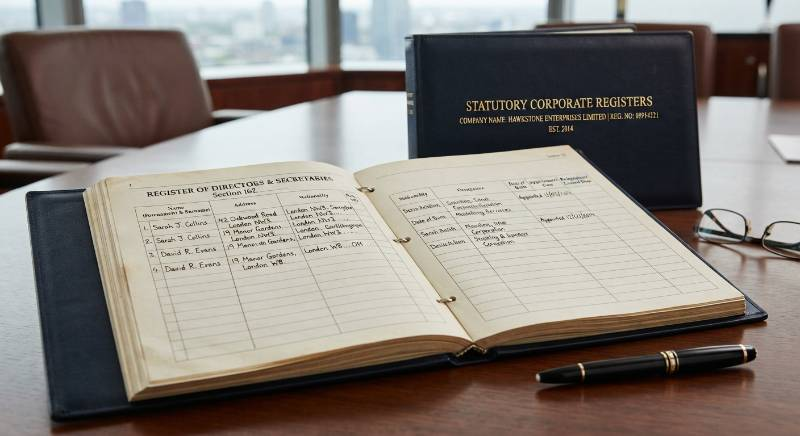
“Statutory registers represent the conclusive evidentiary starting point for ownership, directorship, and control under Hong Kong law. When registry inspectors review corporate books, discrepancies between filings at Queensway and the company’s internal registers immediately invalidate corporate standing and invite prosecutorial action.”
— Senior Corporate Governance Advisory Partner, Hong Kong Institute of Qualified Corporate Secretaries
The Five Mandatory Statutory Registers Under Companies Ordinance (Cap. 622)
Under the Companies Ordinance, every private limited entity must keep five core statutory registers in formal order. Relying solely on the public electronic search database of the Companies Registry is legally insufficient; the internal corporate registers serve as the authoritative prima facie legal record.
1. Register of Members (Section 627)
The Register of Members serves as legal proof of legal ownership. A shareholder does not legally hold shares in a Hong Kong company simply by signing an instrument of transfer; title is legally perfected only upon entry into this register. It must detail shareholder names, addresses, date of entry, share classes, certificate numbers, share allocations, and historical dates of cessation.
2. Register of Directors & Alternate Directors (Section 641)
This register logs every individual or corporate director appointed to manage the enterprise. Following the commencement of privacy protection initiatives, internal registers must retain full unabridged records, including full legal names, identity card or passport numbers, and official residential addresses, distinct from redacted public versions.
3. Register of Company Secretaries (Section 648)
Every private company must appoint a company secretary. If an individual, they must reside in Hong Kong; if a corporate body, it must hold a valid TCSP license. Professional Company Secretary Services ensure that changes to executive appointments, registered addresses, and statutory structures are recorded and filed without late penalty fees.
4. Register of Charges (Section 352)
Companies creating mortgages, debentures, or floating charges over their assets or undertakings must record copies of every instrument creating the charge. Details of the secured liabilities, properties encumbered, and the parties entitled to the charge must be updated within strict statutory deadlines to ensure legal priority over competing creditors.
5. Significant Controllers Register (SCR) (Section 653H)
Implemented to enhance beneficial ownership transparency under international FATF guidelines, the Significant Controllers Register (SCR) records ultimate beneficial owners exercising control. The register must be maintained in English or Chinese at the registered office or a designated Hong Kong location, supported by an appointed local Designated Representative.
| Register Name | Governing Section | Update Statutory Window | Mandatory Content | Non-Compliance Penalty |
|---|---|---|---|---|
| Register of Members | Section 627 | Within 2 months of transfer; immediate on allotment | Shareholder names, addresses, allotments, paid capital, share numbers | Level 4 fine (HK$25,000) & HK$700 daily fine |
| Register of Directors | Section 641 | Within 15 days of appointment or change | Full legal name, residential address, identification number, corporate details | Level 4 fine (HK$25,000) & HK$700 daily fine |
| Register of Secretaries | Section 648 | Within 15 days of appointment or change | Individual identity/residential data or TCSP corporate license number | Level 4 fine (HK$25,000) & HK$700 daily fine |
| Register of Charges | Section 352 | Within 1 month of charge creation | Charge description, encumbered assets, beneficiaries, instrument copies | Level 5 fine (HK$50,000) & void against liquidators |
| Significant Controllers | Section 653H | Within 7 days of confirmation | Registrable persons, registrable legal entities, beneficial control details | Criminal fine of HK$25,000 & HK$700 daily fine |
Significant Controllers Register (SCR) Thresholds and Designated Representative Mandates
The regime governing the Significant Controllers Register establishes clear beneficial ownership identification rules. Any natural person or registrable legal entity meeting at least one of five legal criteria qualifies as a Significant Controller:
- Directly or indirectly holding more than 25% of the company’s issued shares.
- Directly or indirectly holding more than 25% of the company’s voting rights.
- Directly or indirectly holding the right to appoint or remove a majority of the board of directors.
- Having the right to exercise, or actually exercising, significant influence or control over the company.
- Having the right to exercise, or actually exercising, significant influence or control over the activities of a trust or firm that meets any of the first four criteria.
Mandatory Appointment of a Designated Representative
Under Section 653ZC of Cap. 622, every Hong Kong company must formally appoint at least one Designated Representative to liaise with law enforcement officers. The Designated Representative must belong to one of the following categories:
- A natural person resident in Hong Kong who is a director, employee, or member of the company.
- A licensed Trust or Company Service Provider (TCSP) under the AMLO regime.
- A practicing legal practitioner, certified public accountant, or corporate practice defined by statute.
When an authorized officer from the Companies Registry, Customs and Excise Department, Hong Kong Police Force, or the Inland Revenue Department (Hong Kong) requests register access, the company must produce the SCR within seven calendar days. Failure to maintain or present the SCR is a criminal offense under Hong Kong law, penalizing both the company and every responsible officer.
The Companies Registry New Inspection Regime: Protecting Sensitive Personal Data
The Hong Kong Companies Registry has implemented the New Inspection Regime in three distinct administrative phases to protect sensitive personal data. This statutory framework balances corporate transparency with personal identity protection.
Under Phase 2 and Phase 3 of the regime, the public electronic search index replaces Usual Residential Addresses (URA) with correspondence addresses and masks full identification numbers (IDNs), showing only partial digits. However, corporate directors must understand the following distinction:
Statutory Privacy Rule: The New Inspection Regime only redacts public filings submitted to the Companies Registry. It does not apply to internal statutory registers kept at the company’s registered office. The internal Register of Directors and Significant Controllers Register must maintain full, unabridged residential addresses and unmasked identity document details.
Maintaining redacted or incomplete personal information inside internal statutory books violates Section 641 and Section 653I of Cap. 622. During institutional audits or law enforcement reviews, masked internal records will result in non-compliance citations.

Storage Locations, Form NR2 Filings, and Digital Maintenance Protocols
Under Section 655 of the Companies Ordinance, an enterprise may maintain its statutory registers either at its registered office or at a prescribed alternative location within Hong Kong. If a company keeps its registers anywhere other than its registered office, it must submit Form NR2 (Notice of Location of Registers and Company Records) to the Registrar of Companies within 14 calendar days of the change.
Statutory records may be kept in hard-copy bound books or digital electronic format. Under Cap. 622I (Companies (Model Articles) Notice and Record Regulations), electronic record storage requires:
- Data Reproducibility: The digital records must be capable of conversion into legible hard-copy printouts upon request within standard business hours.
- Access Safeguards: Robust safeguards against data falsification, tampering, and unauthorized alterations must be established.
- Inspection Compliance: Qualifying members or debenture holders have statutory inspection rights upon providing proper notice. Denying legitimate access triggers immediate daily fines.
Statutory Lifecycle & Compliance Roadmap
Statutory Roadmap
Inception & Formation
- Appointment & Form NNC1
- SCR Register Creation
Operations & Governance
- Board Resolutions & Registers
- 15-Day Statutory Event Updates
Anniversary Filings
- Annual Return (Form NAR1)
- 42-Day Regulatory Window
Audit & Tax
- BR Renewal & Profits Tax Return
- Integrated Corporate Governance
Compliance Profiles: Cross-Border Holding Architectures and Web3 Entities
Multi-layered holding structures and emerging technology enterprises face enhanced scrutiny in Hong Kong. For entities holding intellectual property, overseas subsidiaries, or operating in decentralized finance, maintainers must trace ultimate beneficial ownership through multi-tiered international structures back to natural persons.
When executing Hong Kong Company Registration for specialized tech ventures, ambiguous governance records create friction during bank onboarding and institutional audits. Global banking institutions operating under the Hong Kong Monetary Authority (HKMA) framework review internal registers to verify corporate control before approving account facilities.
Enterprises engaging in international commercialization also coordinate statutory record maintenance alongside Trademark Registration to establish an unassailable evidentiary chain between company ownership and legal IP title.
| Governance Dimension | Direct Licensed TCSP (Olesen Global) | Unlicensed Virtual Agent / Broker | Enterprise Risk Exposure |
|---|---|---|---|
| Licensing & Legal Capacity | Official TCSP License TC010076; subject to AMLO statutory oversight | Unlicensed shell reseller; no regulatory accountability | Statutory invalidation of designated representative status |
| Custody & Physical Repository | Permanent Hong Kong corporate headquarters; verified physical custody | Third-party sub-leased mailbox or shared desk space | Failure during unannounced Companies Registry spot checks |
| Inspection Response SLA | Dedicated advisor produces registers within 24 to 48 hours | No SLA; delayed responses due to intermediary chains | Exceeding statutory 7-day notice limit; criminal court summons |
| Fee Transparency | All-inclusive governance; zero hidden document extraction fees | Low upfront bait pricing followed by inspection and filing surcharges | Unbudgeted maintenance costs; retained books upon dispute |
Anti-Middleman Trap: Verifying Direct TCSP Licensing on Public Registries
International corporate investors often fall into the middleman trap. Unlicensed brokers frequently advertise Hong Kong corporate services at nominal rates, only to subcontract statutory custody to third parties without client knowledge. This disconnect jeopardizes regulatory compliance.
Prudent enterprises protect their legal standing by verifying credentials directly on the official Hong Kong Companies Registry Registry of Trust or Company Service Provider Licensees. Genuine corporate secretaries hold a verifiable registration number (such as Olesen Global’s TCSP License TC010076). Three prevalent intermediary pitfalls require direct attention:
- Unlicensed Subcontracting Markups: Intermediaries market low-cost setup packages, but outsource statutory custody and charge significant markups whenever an official register extract or Form NR2 filing is required.
- Unregistered Nominee Shell Addresses: Virtual addresses lacking physical operational staff cannot manage on-site regulatory inspections by statutory authorities, exposing directors to default liability.
- Guaranteed Account Opening Claims: Brokers promising assured Bank Account Opening approvals without compliant internal registers face swift rejections. Modern tier-1 compliance departments audit corporate registers to verify legitimate beneficial control.
“Engaging an unlicensed intermediary to hold company registers invalidates the core compliance chain. When regulatory inquiries arise, directors discover their designated representative cannot legally act under the AMLO framework, creating immediate legal liability.”
— Regulatory Enforcement Review Panel, Hong Kong Corporate Compliance Quarterly
Director Liabilities, Enforcement Data, and Statutory Book Reconstruction
Recent enforcement trends demonstrate heightened oversight by the Companies Registry and tax authorities. Prosecutions under Section 653G and Section 653ZC of Cap. 622 have systematically targeted non-compliant entities, with average fines totaling HK$25,000 per violation plus daily default fines of HK$700.
When an existing company changes corporate service providers, acquires a historical entity, or discovers gaps in statutory books, direct book reconstruction is necessary. Neglected books leave share transfers unconfirmed and director appointments vulnerable to legal challenge. Statutory book reconstruction follows an established remediation protocol:
- Historical Filing Audit: Obtain certified electronic search copies of all historical incorporation forms (NNC1), Annual Returns (NAR1), and notifications of change (ND2A, ND2B, NR1) directly from the Companies Registry.
- Share Capital Allotment Reconciliation: Cross-reference issued share capital against historical bank subscription proofs, original board minutes, and stamped Instruments of Transfer.
- Significant Controller Identification: Conduct structured due diligence tracing beneficial ownership beyond corporate holding layers to identify all qualifying registrable persons.
- Statutory Register Compilation: Re-enter accurate shareholder, director, and secretarial details into formal registers using verified historical effective dates.
- Registry Notification Filings: Submit Form NR2 within 14 days to formally report the updated statutory repository to the Companies Registry.
- Audit Synchronization: Deliver verified register copies to certified public accountants handling ongoing Accounting & Audit filings to reconcile balance sheet equity and tax declarations.

Corporate Compliance & Statutory Register Diagnostic
Mitigate regulatory risks and verify your corporate registers against current Companies Ordinance standards. Request an independent review of your entity’s compliance profile:
- Independent verification of your current statutory register location and Form NR2 status.
- Audit of Significant Controllers Register (SCR) accuracy and Designated Representative qualifications.
- Analysis of director identity masking under the New Inspection Regime.
- Verification of direct TCSP license custody (License TC010076) with transparent, predictable pricing.
Frequently Asked Questions Regarding Hong Kong Statutory Records
What is the difference between keeping statutory records via a licensed TCSP versus a generic virtual office provider?
Under Hong Kong law, keeping statutory records at a virtual office without a licensed TCSP intermediary often violates regulatory requirements if compliance oversight is absent. A licensed TCSP (such as Olesen Global, TCSP License TC010076) provides qualified personnel to act as the legal Designated Representative, ensures real-time updates of the Significant Controllers Register (SCR), and manages statutory inspection requests under Cap. 622 to prevent director fines.
How can an enterprise verify that their Hong Kong statutory registers meet Companies Registry standards?
Enterprises can verify compliance by confirming that their provider holds a valid TCSP license on the Hong Kong Companies Registry public register. The provider must maintain up-to-date Registers of Members, Directors, Secretaries, Charges, and the Significant Controllers Register at the registered office or reported location (via Form NR2), with an authorized Designated Representative actively assigned.
What are the legal penalties for failing to maintain a Significant Controllers Register (SCR)?
Failure to maintain an SCR or enter accurate information is a criminal offense under the Companies Ordinance (Cap. 622). The company and every responsible person (including directors) are liable to a fine of HK$25,000, along with a daily default fine of HK$700 for ongoing violations. Utilizing a licensed TCSP mitigates this risk through routine statutory record keeping.
Can a Hong Kong company store its statutory records purely in digital cloud storage?
Yes, digital electronic maintenance is permissible under Section 655 and Cap. 622I, provided the records can be reproduced in hard copy upon inspection and appropriate anti-tampering safeguards are implemented. However, the official digital repository address in Hong Kong must still be reported to the Companies Registry via Form NR2.
What happens to statutory registers during a company secretary transfer?
During a transfer of secretarial custody, the incoming licensed corporate service provider audits the historical records, takes physical or digital handover of all registers, updates the Register of Company Secretaries, and files Form ND2A and Form NR2 with the Companies Registry within 14 calendar days.
Audit Your Entity: 3-Step Statutory Register and SCR Compliance Action Path
Establishing corporate compliance requires a direct, transparent transition process. Businesses can upgrade to direct TCSP execution and verify their statutory records using a structured three-step implementation pathway:
- Entity Document Submission: Transmit your Certificate of Incorporation, Business Registration Certificate, and most recent Annual Return via our secure onboarding portal.
- Statutory Health Audit: A licensed compliance officer audits historical filings, identifies missing register entries, and reviews Designated Representative appointments under Cap. 622 standards.
- Licensed Custody Formalization: Transition statutory custody directly to Olesen Global under TCSP License TC010076, supported by an official Form NR2 filing, SCR appointment, and an assigned compliance specialist.
Secure Direct Statutory Custody in Hong Kong
Maintain continuous audit readiness, eliminate intermediary surcharges, and protect company directors from statutory defaults with Olesen Global.
Direct Execution (No Subcontracting)
Zero Hidden Fees
1-on-1 Dedicated Compliance Advisor