Hong Kong Company Mainland China Market Entry Strategies: Cross-Border Trade, FIE, RO, JV, and Distribution Route Selection
Mainland China market entry via a Hong Kong private limited company incorporated under the Companies Ordinance (Cap. 622) provides international enterprises with a legally segregated, tax-efficient gateway. Utilizing a Hong Kong entity as an intermediate holding vehicle enables foreign investors to access preferential 5% dividend withholding tax rates under the Mainland China-Hong Kong Double Tax Arrangement (DTA), isolate mainland operating risks, optimize multi-currency treasury operations, and streamline capital injection and exit strategies under State Administration for Market Regulation (SAMR) and State Administration of Foreign Exchange (SAFE) frameworks.
Strategic Architecture of Hong Kong Vehicles in Mainland China Expansion
Structuring direct foreign investment into Mainland China requires cross-border legal segregation, regulatory adaptability, and capital efficiency. Multinational corporations and regional growth enterprises routinely avoid direct parent-to-subsidiary cross-border equity linkages. Instead, establishing an intermediate Special Purpose Vehicle (SPV) or operating hub within the Hong Kong Special Administrative Region (HKSAR) provides institutional insulation against mainland operational, administrative, and jurisdictional liabilities.
Under the common law legal framework preserved by the Basic Law, a Hong Kong private limited company incorporated through Hong Kong company incorporation services operates with distinct legal personality and limited shareholder liability. When structuring downstream mainland investments—such as establishing a Mainland China WFOE via a Hong Kong holding company—the Hong Kong entity acts as an essential corporate buffer. Downstream commercial disputes, labor arbitrations, or operational liabilities before mainland administrative organs remain ring-fenced at the intermediate tier, preventing exposure to ultimate global holding assets.
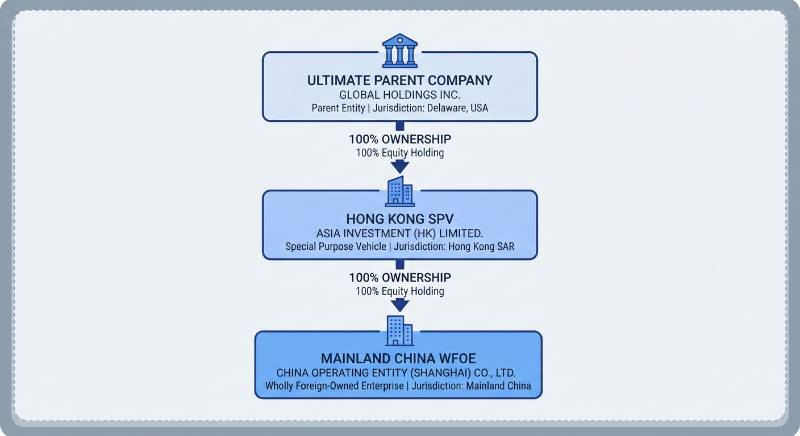
Beyond structural isolation, Hong Kong offers unparalleled preferential market access under the Closer Economic Partnership Arrangement (CEPA). Qualifying Hong Kong service suppliers (HKSS) and manufacturers enjoy zero-tariff access for eligible physical goods and liberalized entry requirements across priority sectors throughout the mainland, including financial services, logistics, technology, and legal consulting. Coupled with the absence of foreign exchange controls in Hong Kong, international groups can deploy capital into the mainland in stages while maintaining full operational agility at their regional headquarters.
Dual-Jurisdiction Legal Framework: PRC Company Law and Cap. 622 Alignment
Cross-border corporate operations demand strict, simultaneous compliance with two fundamentally distinct statutory frameworks: the Hong Kong Companies Ordinance (Cap. 622) governing the holding company, and the revised PRC Company Law governing the mainland enterprise. Failure to harmonize governance between these regimes invites severe regulatory friction, statutory penalties, and potential operational paralysis.
The revised PRC Company Law, which came into full regulatory force on July 1, 2024, introduced sweeping structural reforms. Chief among these is Article 47, which imposes a mandatory five-year statutory timeline for paying up registered capital for all limited liability companies formed within Mainland China. Under prior rules, foreign investors could schedule capital injections across decades. Under current mandates, every mainland corporate vehicle must fully contribute its subscribed capital within five years of establishment. Existing Foreign-Invested Enterprises (FIEs) established prior to the revised law must execute a structured transitional adjustment to gradually align their capital injection schedules within prescribed grace windows established by the State Administration for Market Regulation (SAMR).
Simultaneously, the parent entity in Hong Kong must maintain meticulous corporate standing under the Companies Ordinance (Cap. 622). Every Hong Kong private limited company must designate a qualified statutory company secretary and maintain a real physical registered office within Hong Kong. Under Section 653A of Cap. 622, companies must continuously maintain a Significant Controllers Register (SCR) identifying all individuals and legal entities with ultimate operational control or holding over 25% of company shares or voting rights. SCR records must be kept accessible at the registered office for inspection by law enforcement authorities.
Engaging a certified, first-party licensed Hong Kong corporate service provider operating under Hong Kong Trust and Company Service Provider (TCSP) License TS010076 guarantees that all mandatory annual governance duties—including timely filing of the Annual Return (Form NAR1), Business Registration Certificate renewals, and statutory records upkeep—are executed seamlessly. This statutory discipline ensures that the Hong Kong holding vehicle preserves legal standing before mainland regulatory reviews, notarizations, and annual compliance inspections.
Vehicle Selection Matrix: WFOE, Representative Office, Joint Venture, or Direct Distribution
Foreign corporate leadership evaluating mainland entry must align commercial goals, regulatory barriers, and investment timelines against the available statutory entry vehicles. The four primary commercial routes are the Wholly Foreign-Owned Enterprise (WFOE / FIE), the Representative Office (RO), the Equity or Cooperative Joint Venture (JV), and the Non-Resident Cross-Border Distribution Structure.
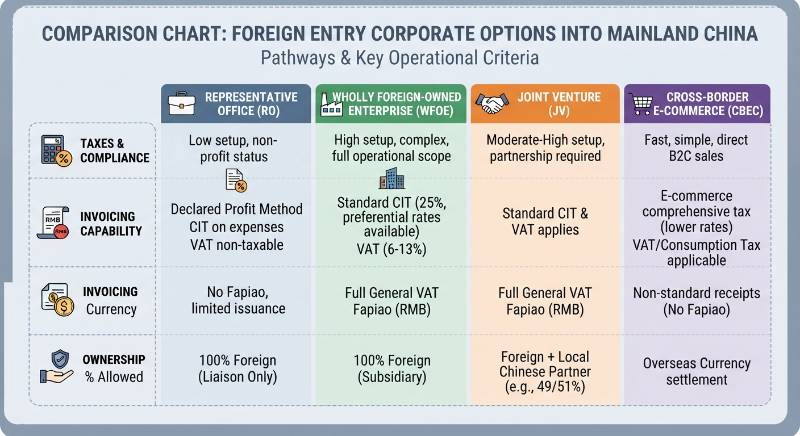
| Feature / Dimension | Wholly Foreign-Owned Enterprise (WFOE) | Representative Office (RO) | Equity Joint Venture (JV) | Direct Cross-Border Distribution |
|---|---|---|---|---|
| Legal Status | Independent Mainland Legal Entity (LLC) | Non-Legal-Entity Liaison Office | Independent Legal Entity (Co-Owned) | Purely Contractual Relationship (Offshore) |
| Commercial Scope | Full commercial operational capacity (Trading, Services, Production) | Non-profit liaison, market research, and PR only | Full commercial capacity within restricted/licensed sectors | Direct export, cross-border fulfillment, no local entity |
| Fapiao / VAT Invoicing | Direct issuance of General & Special VAT Fapiao | Strictly prohibited from revenue invoicing | Direct issuance of General & Special VAT Fapiao | Offshore invoicing only (No Mainland VAT Fapiao) |
| Registered Capital | Mandatory 5-year paid-up requirement | None (Funded through operational remittances) | Mandatory 5-year paid-up rule, shared equity | None in Mainland China |
| Taxation Profile | 25% EIT on net audited mainland profits | Deemed profit tax on gross operating expenses (~8-10%) | 25% EIT on net audited mainland profits | Customs duties, import VAT, offshore company taxation |
| Local Direct Hiring | Direct local employment contracts & social insurance | Must dispatch staff via government-approved agency (FESCO) | Direct local employment contracts & social insurance | No mainland direct employment capacity |
The Wholly Foreign-Owned Enterprise (WFOE) remains the standard vehicle for enterprises seeking complete managerial autonomy, IP protection, and full commercial operating rights, including issuing official tax invoices (Fapiao) directly to corporate purchasers. In contrast, foreign investors frequently misunderstand the operational profile of the Representative Office. For a comparative structural analysis of these models, consult our detailed advisory on Representative Office commercial limitations and tax liabilities.
When entering heavily regulated industries on the Special Administrative Measures for Foreign Investment Access (Negative List)—such as telecommunications, medical services, or sensitive manufacturing—an Equity Joint Venture (JV) may remain legally mandatory. In such scenarios, holding the JV equity through an offshore Hong Kong vehicle ensures superior dispute resolution clauses under the Hong Kong International Arbitration Centre (HKIAC) rather than domestic litigation. Alternatively, companies testing market appetite before committing capital can execute Mainland China distribution and agency agreement structuring, supplying qualified mainland distributors directly through their Hong Kong commercial export entity.
Cross-Border Execution Roadmap: CAAO Legalization and Multi-Currency Banking
Executing downstream mainland market entry requires navigating a rigorous cross-border administrative and banking verification pipeline. The process transitions from corporate incorporation in Hong Kong through formal mainland registration before the municipal branch of the State Administration for Market Regulation (SAMR).
| Step / Phase | Statutory Action Item | Responsible Authority / Professional | Standard Processing Time |
|---|---|---|---|
| Phase 1: Formation | Incorporate Hong Kong Holding Company, secure NNC1 and BR | Hong Kong Companies Registry & TCSP Licensee | 1–2 Business Days |
| Phase 2: Offshore Banking | Open multi-currency corporate treasury accounts (HKD, USD, CNH) | Tier-1 Commercial Banks (HSBC, Standard Chartered, BOC) | 2–4 Weeks |
| Phase 3: CAAO Attestation | Execute Notarial Legalization & Mainland Delivery Registration | China-Appointed Attesting Officer (CAAO) | 4–7 Business Days |
| Phase 4: Municipal SAMR | Submit WFOE/JV formation docket, approve Articles of Association | State Administration for Market Regulation (Municipal Branch) | 5–10 Business Days |
| Phase 5: Capital & Tax Reg. | SAFE foreign exchange filing, basic CNY and capital bank accounts | SAFE, State Taxation Administration, Settlement Bank | 2–3 Weeks |
A critical statutory distinction exists between multilateral authentication and mainland Chinese legal attestation. Following Mainland China’s accession to the Hague Apostille Convention, documents flowing between many contracting states require only an apostille. However, the HKSAR and Mainland China operate under a specialized bilateral attestation mechanism. A standard Hague Apostille or standard Hong Kong notary public seal is invalid before mainland administrative bodies.
Corporate constitutive instruments—including the Certificate of Incorporation, Business Registration Certificate, Articles of Association, Form NNC1, and Board Resolutions authorizing mainland investment—must undergo formal attestation by a China-Appointed Attesting Officer (CAAO). The CAAO legalizes the corporate registry records, confirms the active legal standing and beneficial ownership of the Hong Kong parent, and submits the sealed documentation through China Legal Service (H.K.) Ltd. for forwarding and sealing. The resulting attested instrument is accepted by municipal SAMR branches across Mainland China.
Concurrently, establishing institutional banking rails represents an essential operational milestone. Multinational firms must secure corporate bank accounts capable of holding, clearing, and remitting convertible currencies and offshore Renminbi (CNH). Engaging professional commercial bank account opening support ensures strict compliance with Hong Kong Monetary Authority (HKMA) anti-money laundering mandates, Customer Due Diligence (CDD), and Know Your Business (KYB) verifications, mitigating application rejections and enabling capital deployment into mainland projects.
Cross-Border Tax Engineering: 5% Withholding Tax Qualification and FSIE Nexus
The primary fiscal advantage of utilizing a Hong Kong intermediate holding company for mainland operations is reducing dividend withholding tax (WHT). Under standard PRC Corporate Income Tax (CIT) Law, outbound dividends remitted from a mainland corporate subsidiary to a non-resident foreign shareholder incur a 10% statutory withholding tax rate. Under Article 10 of the Mainland China-Hong Kong Double Tax Arrangement (DTA), this tax liability is halved to 5%, provided the Hong Kong entity qualifies under strict substantive criteria.
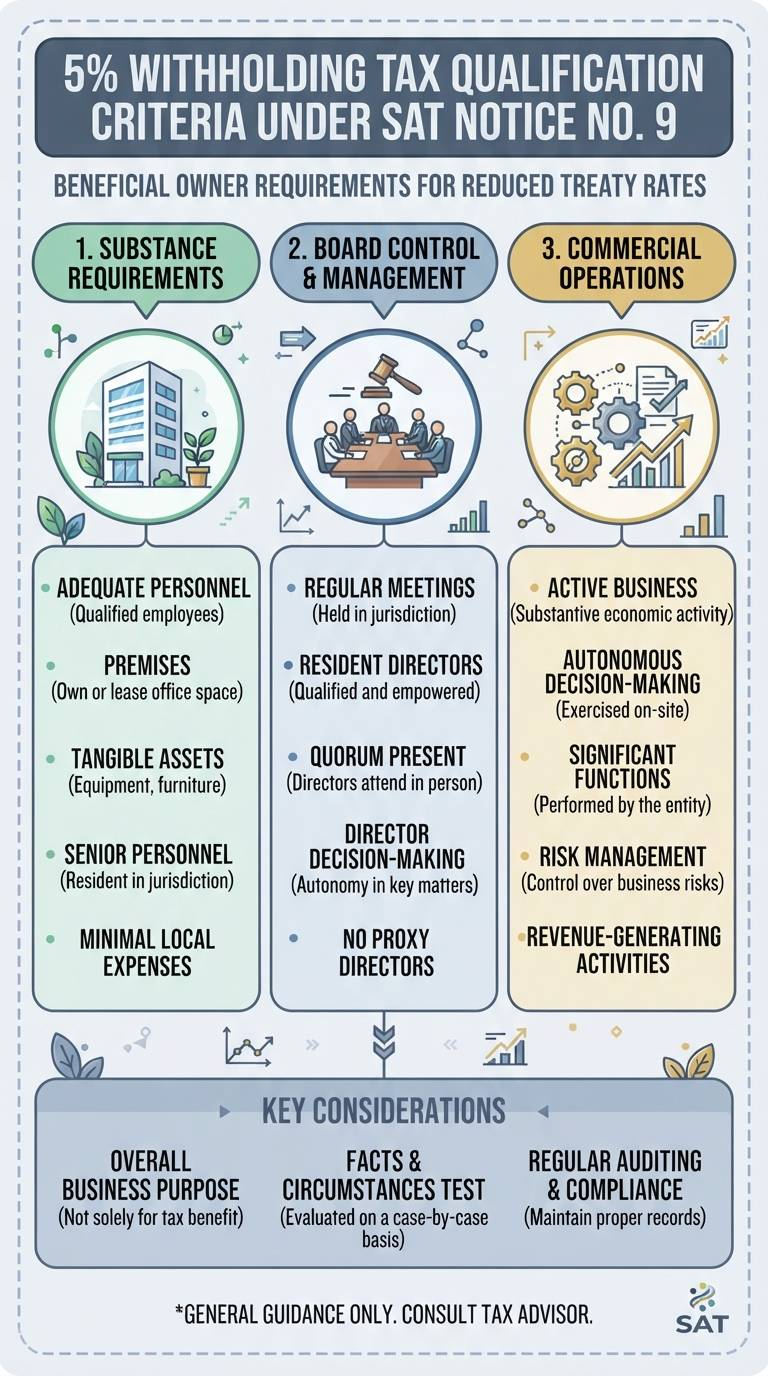
Securing the preferential 5% dividend withholding tax (WHT) rate under the Mainland China–Hong Kong Double Taxation Arrangement (DTA)—reduced from the standard 10% statutory rate stipulated in the PRC Enterprise Income Tax (EIT) Law—demands complete alignment with State Taxation Administration (STA) Public Notice [2018] No. 9 (“Notice No. 9”). Mainland tax authorities evaluate applications based on genuine commercial substance rather than nominal corporate ownership, strictly scrutinizing whether the Hong Kong entity operates as a legitimate economic entity or a mere “conduit company” established to capture treaty concessions.
Beneficial Ownership Criteria Under STA Notice No. 9
To qualify as a “Beneficial Owner” eligible for treaty-reduced withholding tax on cross-border dividends, interest, and royalties, the Hong Kong holding corporation must pass comprehensive qualitative tests demonstrating substantive engagement in commercial activities:
- Commercial Substance and Active Operations: The Hong Kong enterprise must possess physical operating premises, qualified resident operational management, and local personnel proportional to its asset portfolio and transaction volume. Entities configured purely as passive holding shells with zero staff face automatic disqualification under local tax bureau reviews.
- Discretionary Asset and Income Control: Directors of the Hong Kong company must exercise absolute, unconstrained managerial discretion over inbound dividends. If loan agreements, corporate bylaws, or side covenants compel the Hong Kong entity to distribute more than 60% of received dividends to an offshore ultimate parent company within 12 months, the STA classifies the entity as a non-beneficial conduit.
- Negative Factor Exclusions: Notice No. 9 outlines specific operational red flags that trigger treaty denial, including insufficient active business income relative to investment returns, tax-exempt or negligible effective taxation on the received income in Hong Kong, and minimal risk assumption regarding market volatility, credit defaults, or operational contingencies.
Inland Revenue Department (IRD) Certificate of Resident Status (CoR)
Mainland tax authorities reject DTA treaty relief filings unless supported by a valid Certificate of Resident Status issued by the Hong Kong Inland Revenue Department (IRD). The IRD exercises rigorous administrative scrutiny before granting a CoR, cross-examining whether central management and control genuinely reside within the territory of Hong Kong.
Evidentiary Checklist for IRD Form IR1313A / IR1313B:
Securing a CoR requires verifiable proof that major executive decisions are formulated and executed in Hong Kong. Applicants must provide signed minutes of board meetings convened physically within Hong Kong, corporate banking records managed by Hong Kong-based signatories, local commercial lease documentation, and local employment contracts. Leveraging professional statutory company secretary services ensures administrative records, meeting protocols, and registered offices adhere precisely to these IRD evidentiary benchmarks.
Cross-Border Capital Repatriation & SAFE Regulatory Controls
Deploying equity and extracting capital between a Hong Kong parent entity and a Mainland subsidiary (Wholly Foreign-Owned Enterprise, or WFOE) operates under stringent oversight from the State Administration of Foreign Exchange (SAFE). Establishing structured cross-border conduits requires rigorous planning across equity investments, cross-border shareholder lending, and lawful profit dividend distributions.
| Channel | Regulatory Framework | Statutory Quota / Approval Barrier | Withholding Tax Impact |
|---|---|---|---|
| Equity Dividend Distribution | PRC Company Law; SAFE Circular 37/13; STA Notice No. 9 | Requires 10% statutory reserve allocation up to 50% of registered capital; prior-year loss recoupment | 5% under DTA (upon CoR & BO clearance); otherwise 10% |
| Cross-Border Shareholder Loan | PBOC Circular [2017] No. 9 (Macro-Prudential Framework) | Capped at Net Assets × Cross-Border Financing Leverage Ratio × Macro-Prudential Factor | 7% interest WHT under DTA; 6% PRC VAT plus local surcharges |
| Intercompany Service / IP Licensing | STA Public Notice [2017] No. 6; Transfer Pricing Rules | Bank tax clearance filing required for outbound remittances exceeding USD 50,000; Arm’s-Length validation | 7% royalty WHT under DTA; 6% VAT on services/royalties |
Cross-Border Intercompany Service Agreements
Transferring management fees, technical consulting charges, or shared service overhead from a Mainland operating subsidiary to the Hong Kong regional headquarters provides operational liquidity while offsetting Mainland corporate income tax liabilities. However, the STA inspects intra-group service arrangements under six mandatory tests outlined in Public Notice [2017] No. 6: the Benefit Test, Need Test, Duplication Test, Value-Creation Test, Remuneration Test, and Authenticity Test.
To withstand tax audits, service fees must represent genuine commercial value rendered to the Mainland entity. Holding-company stewardship activities, duplicated overhead, and passive supervisory expenses cannot be charged to Mainland subsidiaries. Comprehensive service level agreements (SLAs), time logs, project deliverables, and arm’s-length pricing documentation must be maintained in synchrony with regular certified CPA accounting and audit records.
Safeguarding Intellectual Property via Hong Kong Holding Vehicles
Hong Kong operates under a robust common law legal tradition with statutory protections aligned with international intellectual property treaties, including the Madrid Protocol and the Paris Convention. Holding critical intangible assets—including software copyrights, brand trademarks, and proprietary patents—in a Hong Kong entity protects core intellectual property while enabling structured licensing into the Mainland market.
- Dual-Jurisdiction Filing Strategy: Registration with the Hong Kong Intellectual Property Department (IPD) does not automatically confer legal exclusivity in Mainland China. Businesses must execute synchronized registrations with the China National Intellectual Property Administration (CNIPA). Securing unified global coverage through professional trademark registration protocols prevents bad-faith squatting across both territories.
- Licensing and Royalty Repatriation: Royalties remitted from Mainland operating entities to a Hong Kong IP holding vehicle benefit from the DTA’s reduced 7% withholding rate (compared to the standard 10% statutory rate), provided the Hong Kong entity owns legitimate economic rights and controls technological updates.
- Arbitration and Dispute Resolution: Intercompany IP licensing contracts should designate the Hong Kong International Arbitration Centre (HKIAC) as the preferred dispute resolution forum. The mutual enforcement arrangement between Hong Kong and the Mainland allows interim measures and final arbitral awards granted in Hong Kong to be enforced directly through Mainland courts.
Hong Kong Foreign Sourced Income Exemption (FSIE) Regime
Following updates to the Hong Kong Inland Revenue Ordinance (Cap. 112) to align with EU Code of Conduct Group standards, multinational enterprise (MNE) groups holding Mainland subsidiaries through Hong Kong must comply with the expanded Foreign Sourced Income Exemption (FSIE) regime. Foreign-sourced dividends, interest, intellectual property income, and equity disposal gains are no longer automatically non-taxable under general territoriality principles.
FSIE Exemption Pathways for Mainland Entry Structures:
- Economic Substance Test (Dividends & Equity Disposal Gains): Pure equity-holding entities must satisfy relaxed economic substance requirements by adhering to all statutory filing requirements under the Companies Ordinance (Cap. 622) and maintaining adequate human resources and physical premises in Hong Kong to hold and manage the shareholdings. Non-pure equity holding entities must conduct substantive economic activities locally.
- Participation Exemption (Non-IP Income): Foreign dividends and disposal gains may remain exempt from Hong Kong Profits Tax without satisfying full economic substance if the Hong Kong parent company holds at least a 5% equity interest in the Mainland subsidiary continuously for at least 12 months immediately prior to the accrual of the income. This exemption is subject to statutory anti-abuse provisions, including the Subject-to-Tax rule (requiring the underlying profits to be taxed abroad at a minimum headline rate of 15%).
- Nexus Requirement (IP Income): Tax exemptions on foreign-sourced intellectual property income follow the OECD nexus approach. Only qualifying expenditures incurred directly by the Hong Kong entity (or outsourced to local independent third parties) qualify to exempt foreign royalty income from Hong Kong Profits Tax.
Senior Company Secretary & Auditor FAQ Vault
Can a newly incorporated Hong Kong company immediately establish a Wholly Foreign-Owned Enterprise (WFOE) in Mainland China?
Yes. There is no statutory minimum age requirement for a Hong Kong company to invest in Mainland China. However, the Mainland State Administration for Market Regulation (SAMR) requires statutory incorporation documents, the Business Registration Certificate, the Articles of Association, and the board resolution authorizing the investment to be notarized by a China-Appointed Attesting Officer (CAAO) in Hong Kong and stamped by the China Legal Service (H.K.) Ltd. Once this notarial attestation pack is complete, incorporation filings can proceed directly with local SAMR branches.
What are the statutory consequences if the Inland Revenue Department denies our Certificate of Resident Status (CoR)?
If the IRD refuses to issue a CoR due to a lack of genuine commercial substance or an absence of local management and control, the Hong Kong entity cannot substantiate treaty residency before the Mainland tax authorities. Consequently, the Mainland tax bureau will assess dividend distributions from the PRC subsidiary at the full 10% statutory Enterprise Income Tax withholding rate rather than the concessional 5% DTA rate. Denials do not invalidate the company’s legal status in Hong Kong, but they eliminate cross-border tax efficiencies until operational substance is established.
How does the Significant Controllers Register (SCR) apply to Hong Kong holding companies with foreign beneficial owners?
Under the Companies Ordinance (Cap. 622), every Hong Kong company must maintain a Significant Controllers Register at its registered office or an authorized location. Any natural person or legal entity holding more than 25% of the shares or voting rights, or exercising significant control over corporate decisions, must be formally identified and recorded. A designated representative—who must be a resident of Hong Kong or a licensed TCSP like Olesen Global—must be appointed to liaise with law enforcement and regulatory bodies upon formal inspection notices.
What documentation is required to remit commercial funds from a Mainland WFOE back to a Hong Kong parent account?
Cross-border fund repatriation requires commercial banks in Mainland China to review specific documentation under SAFE mandates. For dividend distributions, the enterprise must present audited financial statements proving accumulated retained profits, tax clearance confirmation (STA Record-Filing for Outbound Payments over USD 50,000), board distribution resolutions, and capital verification documents. For intercompany service fee settlements, the remitting bank verifies the intercompany agreement, corresponding commercial invoices, proof of service execution (e.g., project deliverable dossiers), and tax assessment receipts.
Can a Hong Kong holding company open an offshore multi-currency bank account without local directors visiting Hong Kong?
Opening a multi-currency account with tier-one commercial banks in Hong Kong generally requires at least one executive director or authorized signatory to attend a mandatory identity verification meeting in person. However, through pre-vetted corporate structures and certified digital KYC protocols managed via dedicated commercial bank account opening support, selected international banks and licensed digital commercial institutions accept remote identity verification, provided thorough company source-of-wealth and operational records are submitted.
What ongoing dual-jurisdiction accounting mandates apply when operating a Hong Kong-Mainland structure?
The Mainland subsidiary must comply with the PRC Accounting Standards for Business Enterprises (ASBE), maintain monthly bookkeeping in RMB, perform annual statutory audits via a certified PRC accounting firm, and execute annual tax reconciliations by May 31. Concurrently, the Hong Kong holding parent must prepare annual financial statements under Hong Kong Financial Reporting Standards (HKFRS), undergo an independent annual audit by a certified Hong Kong CPA firm, file an annual Profits Tax Return (BIR51) with the IRD, and submit an Annual Return (Form NAR1) to the Companies Registry within 42 days of the incorporation anniversary.
Consult with Olesen Global’s Licensed Corporate Specialists
Backed by Hong Kong TCSP License TS010076, practicing company secretaries, and certified CPA auditors.