Hong Kong Commercial Banking Landscape: The Shift from Administrative Filing to AML/CTF Underwriting
Opening a commercial bank account in Hong Kong has transformed from a procedural administrative registration into an adversarial compliance underwriting audit. Historically, submitting a standard Certificate of Incorporation, Business Registration Certificate, and basic corporate records was sufficient to secure institutional banking facilities. Today, Hong Kong’s status as an international financial center operating under the direct regulatory oversight of the Hong Kong Monetary Authority (HKMA) requires authorized institutions (AIs) to enforce strict Anti-Money Laundering and Counter-Financing of Terrorism (AML/CFT) frameworks.
The regulatory foundation governing this shift includes the Anti-Money Laundering and Counter-Terrorist Financing Ordinance (Cap. 615), the statutory duties imposed on Trust or Company Service Providers (TCSP License No. TS010076), and the HKMA Guideline on Anti-Money Laundering and Counter-Financing of Terrorism (For Authorized Institutions). Under these rules, banks must abandon checkbox compliance in favor of a Risk-Based Approach (RBA). This means underwriting teams analyze the underlying legal, structural, and cross-border commercial dynamics of every applicant before allocating transactional account capabilities.

This scrutiny stems from institutional de-risking mandates driven by international bodies like the Financial Action Task Force (FATF). To protect global clearing channels, commercial banks in Hong Kong—ranging from tier-1 clearers like HSBC and Standard Chartered to regional players like Bank of China (Hong Kong), OCBC, and DBS—have deployed automated transaction surveillance and multi-tier compliance committees. These units scrutinize applicants across three distinct risk vectors:
- Structural Transparency: The direct and indirect corporate architecture, tracing through domestic or foreign holding companies, trusts, or partnerships to identify ultimate individual owners.
- Jurisdictional Nexus: The geographic origin and destination of anticipated capital, checking for exposure to sanctioned zones, high-risk non-FATF jurisdictions, or tax havens lacking substantive double-tax treaties.
- Commercial Plausibility: The economic logic of the corporate entity within Hong Kong, assessing whether transactions reflect legitimate commercial activity or indicate pass-through shell operations.
Entering this institutional banking environment without a pre-screened compliance dossier frequently leads to protracted delays, unreturned compliance inquiries, or outright application rejections that are permanently logged in banking compliance databases. Corporate leaders must structure their corporate records and operational profiles to satisfy HKMA-supervised underwriters before formally submitting an application through specialized commercial bank account opening services.
Ultimate Beneficial Ownership (UBO) Transparency & SCR Statutory Verification
A primary friction point in commercial banking applications involves identifying and verifying Ultimate Beneficial Owners (UBOs). Under the Hong Kong Companies Ordinance (Cap. 622) and Cap. 615, commercial banks are legally mandated to look through intermediate holding layers until they identify the natural persons who ultimately own or control the business.
The standard regulatory threshold defines a UBO as any individual who directly or indirectly holds more than 25% of the company’s issued shares, exercises more than 25% of the voting rights, or otherwise exerts ultimate control over management. However, bank compliance officers frequently exercise their statutory discretion under the HKMA Guideline to lower this threshold to 10% when dealing with elevated risk classifications, complex multi-jurisdictional holding structures, or politically exposed persons (PEPs).
| Ownership Tier / Structure | Statutory Identification Threshold | Mandatory Documentary Evidence | Compliance Scrutiny Focus |
|---|---|---|---|
| Direct Individual Holding | Natural person holding ≥25% shares/votes | Certified passport/HKID, proof of residential address (<3 months), personal CV. | Identity verification, sanction screening, political exposure. |
| Intermediate Corporate Layer | Corporate shareholder holding ≥25% of HK target | Certified Certificate of Incumbency, M&A, Register of Members, audited accounts. | Jurisdiction of incorporation, operating history, pass-through structure validation. |
| Discretionary / Family Trust | Settlor, protector, trustee, and identified beneficiaries | Certified Trust Deed, letters of wishes, verification of trustee TCSP licensing. | Irrevocability of trust terms, identification of effective economic controllers. |
| Cross-Border Joint Venture | Multiple corporate entities with fractional stakes | Joint venture agreement, board voting rights register, shareholder resolutions. | Ultimate board control, veto powers, negative control mechanisms. |
In parallel, the Significant Controllers Register (SCR) regime enforced under Cap. 622 requires every Hong Kong incorporated company to maintain an updated register of its significant controllers at its registered office or an eligible place in Hong Kong, managed by a Designated Representative (typically a licensed corporate service provider under TCSP oversight). Bank underwriting units now systematically cross-reference the customer-declared ownership hierarchy against the statutory SCR records, the official Annual Return (Form NAR1), and any filed Notification of Change of Company Secretary and Director (Form ND2A).
Any discrepancy between the operational bank KYC declarations and the statutory SCR register will halt the underwriting process immediately. Nominee arrangements designed to obscure ownership are prohibited under Hong Kong AML laws. If corporate shareholders are incorporated in traditional offshore jurisdictions like the British Virgin Islands, Cayman Islands, or Seychelles, underwriters will demand a certified Certificate of Incumbency (dated within six months) alongside certified statutory share registers to trace ownership down to natural persons. Preparing these structures with licensed professionals providing licensed company secretary solutions ensures that corporate registries and compliance filings align before institutional review.
Director Professional Nexus and Executive Background Auditing
Commercial bank underwriters assess the professional capability and background of the appointed board of directors. Under the Companies Ordinance (Cap. 622), a private company must have at least one director who is a natural person. From a banking compliance perspective, however, the executive team must demonstrate a clear operational nexus with the business activities specified in the company’s business plan.
Banks manage systemic counterparty risk by identifying synthetic shell structures. A recurring red flag involves the appointment of nominal executive directors who lack industry knowledge, operational authority, or commercial track records in the enterprise’s field. Underwriters routinely evaluate directors using several criteria:
- Industry Pedigree: The director’s professional experience, supported by a detailed executive curriculum vitae (CV), LinkedIn profile, prior employment letters, or professional certifications, must align with the company’s trading profile. For instance, an applicant establishing an electronic components export enterprise whose sole director has a background exclusively in fine art will face compliance skepticism.
- Directorial Overload: Underwriters review corporate registries to check how many active directorships an individual holds. Directors holding dozens of active positions across unrelated industries are often categorized as third-party nominees, which triggers enhanced due diligence or refusal.
- Management Authority: The individual presenting for the KYC interview (whether in person or via digital channels) must be capable of explaining the company’s daily operational mechanics, transaction flows, settlement structures, and major vendor relationships without referring to scripted notes or third-party advisors.
When incorporating an enterprise via Hong Kong company incorporation pathways, ensure the appointed natural directors have verified, demonstrable experience directly relevant to the company’s primary Business Registration Certificate (BRC) activities.
Commercial Economic Substance: End-to-End Trading Evidence Audit Trails
To secure account approval, trading companies must present concrete evidence of substantive business operations. Bank compliance departments review these documents to trace the complete commercial cycle, ensuring that payments through the requested account reflect genuine transactions rather than circular, non-commercial movements.
Underwriters expect applicants to provide an integrated evidentiary chain documenting at least two or three historical or active transactions. Single, isolated invoices are insufficient. Each transaction sample must follow a four-point documentation cycle:
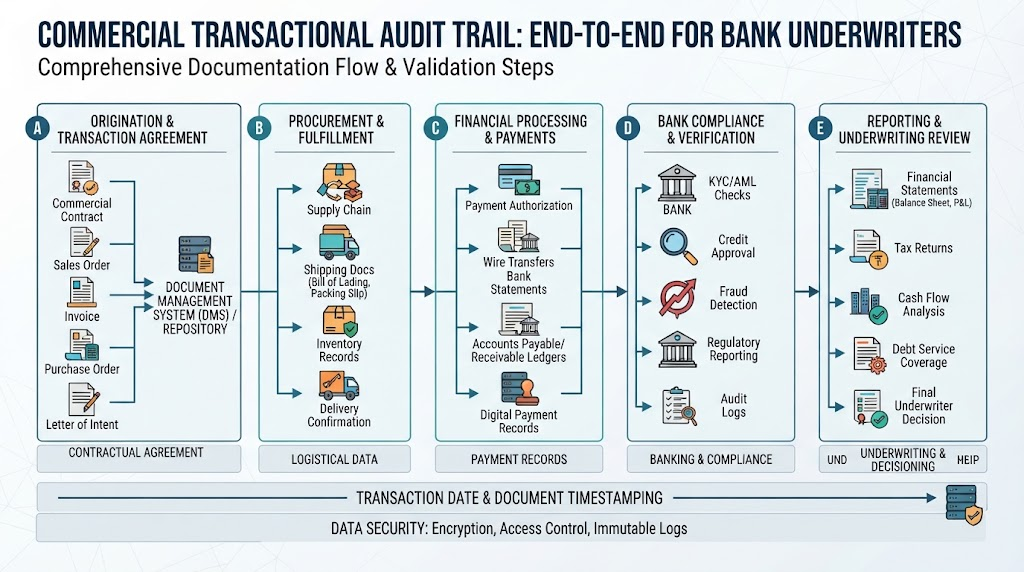
| Lifecycle Stage | Required Documentary Instrument | Critical Underwriting Verification Points |
|---|---|---|
| 1. Contractual Foundation | Bilateral Sales & Purchase Contracts, Framework Service Agreements, Master Distribution Deeds | Full corporate legal names, valid business registration details, signatures of authorized officers, explicit payment terms, clear governing law clauses (e.g., Hong Kong Law or English Law). |
| 2. Commercial Invoicing | Pro-forma & Commercial Invoices, Service Milestone Billings | Itemized unit descriptions matching contractual scopes, progressive invoice numbers, company tax identifiers, precise settlement bank routing coordinates. |
| 3. Logistics & Fulfillment | Ocean Bills of Lading (B/L), Air Waybills (AWB), Customs Declarations, Proof of Delivery (POD) | Carrier stamps, container/tracking numbers, matching consignor/consignee identities, port of loading/discharge aligning with cross-border business models. For digital services: signed acceptance certificates or IP server logs. |
| 4. Financial Settlement | Bank Statements, Swift MT103 Confirmations, Letters of Credit (LC) | Clear settlement paths matching commercial invoices, payer names corresponding directly to the buyer on contracts (zero tolerance for third-party unknown payers). |
For service firms, consulting practices, and software enterprises where physical logistics do not apply, the compliance chain shifts to operational documentation: signed Service Level Agreements (SLAs), verified statement-of-work (SOW) documents, detailed milestone completion sign-offs, and clear communication records confirming delivery. Ensure that all transactional counterparties are clearly identified. Entities using counterparties located in jurisdictions sanctioned by the United Nations, OFAC, or the European Union will trigger automated screening blocks.
Special Protocol: Proving Business Substance for Newly Incorporated Entities Without Historical Revenue
Newly incorporated entities face a structural challenge: they need a commercial bank account to execute transactions and generate revenue, but corporate underwriting teams require verified trading histories to approve accounts. Bank underwriters manage this paradox through a specialized startup onboarding protocol that assesses economic viability using proxy documentation.
Newly incorporated companies can establish commercial substance using four primary strategies:
1. Parent and Affiliate Enterprise Track Records
If the Hong Kong company serves as an offshore procurement hub, regional holding vehicle, or international marketing arm of an established mainland Chinese or foreign enterprise, the applicant can present the parent company’s operational records. This includes certified corporate registration documents, audited financial statements from the prior two fiscal years, enterprise bank statements demonstrating steady cash flow, and high-value customer contracts. This evidence demonstrates that the new entity is an extension of an established enterprise rather than a speculative venture.
2. Pipeline Contracts and Letters of Intent (LOIs)
Underwriters will review prospective business pipelines if documented through formalized instruments. Executed Bilateral Memorandums of Understanding (MOUs), signed distribution agreements contingent upon banking setup, or verified Letters of Intent detailing projected trade volumes, pricing structures, and expected settlement schedules can demonstrate immediate commercial viability.
3. Founder Industry Track Record
In tech, specialized consulting, or early-stage ventures lacking corporate parents, underwriters evaluate the natural beneficial owners. Principals can submit historical employment agreements, ownership records of previous successful ventures, proof of specialized patents, or equity investment term sheets from venture capital or institutional private equity funds.
4. Capitalized Local Office and Physical Operations
Demonstrating genuine local operations helps offset the absence of trading history. This can include a commercial tenancy agreement for dedicated office space in Hong Kong, employment contracts with Hong Kong Mandatory Provident Fund (MPF) enrollment records, commercial utility statements, or corporate insurance policies. Combining these local records with ongoing statutory CPA audit and tax compliance frameworks provides bank risk teams with a verifiable operational profile.
Source of Wealth (SOW) vs. Source of Funds (SOF): Forensic Separation and Documentation
One of the most frequent reasons corporate onboarding packages are delayed or rejected by compliance teams is the confusion between Source of Wealth (SOW) and Source of Funds (SOF). While related, these concepts evaluate distinct financial aspects of the company and its owners.
Source of Wealth (SOW) refers to the economic and commercial activities that generated the Ultimate Beneficial Owner’s cumulative net worth over their career. It explains how the individual accumulated their capital. Source of Funds (SOF), conversely, focuses on the specific capital allocated for the company’s initial deposit, working reserves, and incoming operational transactions. It verifies the exact origin, payment pathway, and legitimacy of specific funds entering the account.
| Compliance Category | Core Underwriting Inquiry | Primary Acceptable Evidence | Unacceptable / Defective Evidence |
|---|---|---|---|
| Source of Wealth (SOW) (Macro-Level Origin) | How did the individual UBO build their cumulative overall financial net worth over time? | Historical company audited financials, verified dividend distribution certificates, corporate share sale deeds, personal tax assessments, commercial property deeds, inheritance probate records. | Generic self-declarations without third-party audit, unsupported bank balance snapshots, uncorroborated resumes. |
| Source of Funds (SOF) (Micro-Level Capital) | Where did the exact funds for the initial balance and upcoming transactional operations originate? | Personal or corporate bank statements showing capital accumulation, bank debit advices, clear wire transfer remittance slips from named accounts held with equivalent FATF-regulated banks. | Third-party unvetted payments, cash deposits via counter or ATM, transfers from unregulated crypto platforms, ambiguous peer-to-peer loans. |
When presenting SOW and SOF dossiers, ensure clear, verifiable continuity between them. If an initial capital injection of HKD 1,000,000 is attributed to dividend distributions from an overseas affiliate, the applicant must provide the corporate resolution authorizing that dividend, the distributing company’s audited profit statements, the corresponding tax filings, and the bank statement showing the funds moving from the corporate account directly into the personal account of the beneficial owner before being remitted to Hong Kong.
Hong Kong Commercial Banking Institutional Matrix: Tier-1, Tier-2, and Licensed Virtual Banks
Selecting the right commercial banking partner is a strategic operational decision. Institutions operating in Hong Kong feature differing risk appetites, compliance focus areas, physical presence requirements, and operational capabilities.
Hong Kong’s banking sector comprises three primary tiers: global Tier-1 clearers, Tier-2 regional commercial banks, and HKMA-regulated virtual business banks. Matching your corporate profile, shareholding complexity, cross-border transactional footprint, and initial deposit capacity with the right institution prevents wasted applications and unnecessary operational delays.
| Institutional Banking Tier | Representative Institutions | Underwriting Turnaround | Min. Operating Balance | Trade Finance & FX Capabilities | Ideal Corporate Profile |
|---|---|---|---|---|---|
| Tier-1 Global Clearers | HSBC, Standard Chartered, Bank of China (Hong Kong) | 6 to 10 Weeks | HKD 50,000 – 500,000 (Tiered fee waivers apply) | Extensive: Global Letters of Credit, Trade Financing, 14+ Multi-Currency accounts, complex hedging instruments. | Established cross-border groups, high-volume trading entities, multinational operational headquarters, public/listed enterprises. |
| Tier-2 Regional Commercial Banks | OCBC, DBS, CITIC, China Construction Bank (Asia) | 4 to 8 Weeks | HKD 20,000 – 100,000 | Moderate to High: Documentary credits, structured trade solutions, robust Greater Bay Area integration. | SMEs with established Asian supply chains, regional trading firms, enterprises requiring bilingual client management. |
| Licensed Virtual Business Banks | ZA Bank, Airstar Bank, PAObank | 1 to 3 Weeks | Zero to Nominal (No traditional penalty fees) | Specialized: Fast cross-border SWIFT/CHATS transfers, standard FX conversions, basic lending facilities. Zero LC facilities. | Technology startups, cross-border e-commerce, digital consultancies, distributed teams requiring 100% digital onboarding. |
Tier-1 institutions offer global treasury, multi-currency cash pooling, and international trade finance facilities, but they maintain the most conservative compliance filters and complex KYC protocols. Virtual banks provide rapid, fully digital onboarding for standard corporate structures, but they generally lack complex trade finance mechanisms, counter services, and documentary credit services. Understanding these trade-offs allows corporate leadership to develop a balanced, multi-account banking setup.
Remote Verification Architecture: Video KYC Protocols vs. In-Person Attestation
The historical rule requiring every company director and beneficial owner to travel to a Hong Kong bank branch for in-person document signing has evolved. Under HKMA initiatives encouraging digital banking adoption, authorized institutions have established standardized remote customer onboarding frameworks.
Applicants can generally choose between two onboarding paths, based on corporate residency, structural complexity, and banking policy:
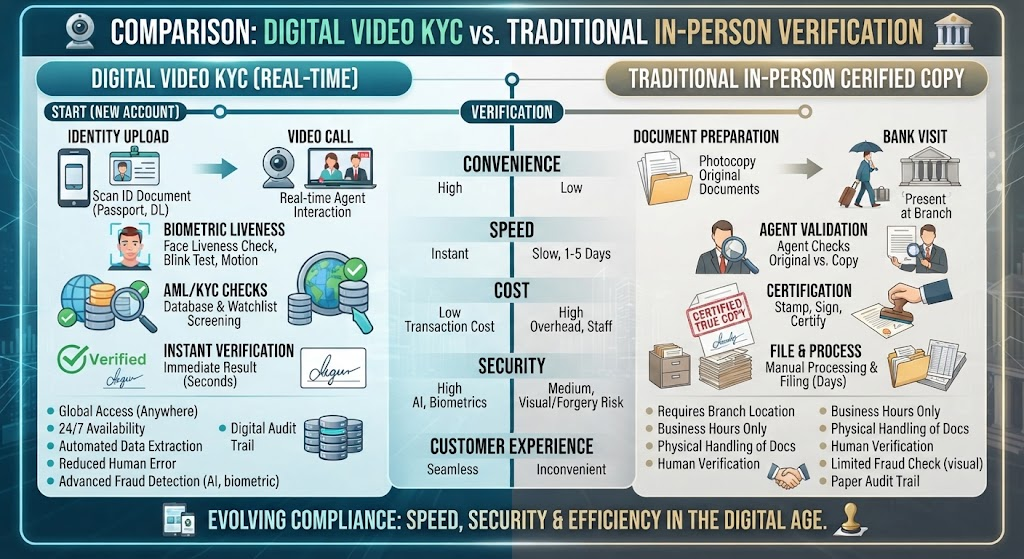
1. Digital Identity Verification (e-IDV) & Video KYC Protocols
Modern commercial banks deploy secure remote identity systems. Directors and significant controllers complete their identity verification through proprietary, encrypted smartphone portals using biometric facial recognition and automated identity document checks. This is followed by a recorded Video KYC interview with an onshore compliance officer. Key operational parameters include:
- Real-time biometric liveness detection and optical character recognition (OCR) verification of original machine-readable passports.
- Recorded video interviews conducted over secure, bank-encrypted systems to review declared business plans and confirm transaction estimates.
- Digital execution of bank mandate forms using e-signature infrastructure compliant with the Hong Kong Electronic Transactions Ordinance (Cap. 553).
2. Certified True Copy (CTC) Attestation & Branch Signing
For complex holding structures or Tier-1 institutional banks requiring physical wet-ink signatures, remote verification relies on Certified True Copy (CTC) protocols. If directors cannot travel to Hong Kong, statutory documents, corporate constitutional records, and government identity cards can be verified by recognized professionals. Under standard HKMA compliance rules, accepted certifying professionals include:
- Practicing Certified Public Accountants (CPA) registered with the Hong Kong Institute of Certified Public Accountants (HKICPA).
- Practicing Solicitors admitted to the High Court of Hong Kong or recognized overseas legal jurisdictions.
- Chartered Corporate Secretaries holding active membership in the Hong Kong Chartered Governance Institute (HKCGI).
- Authorized officers of a licensed Trust or Company Service Provider (TCSP) under statutory regulatory oversight.
Alternatively, several Tier-1 institutions allow directors to complete physical identity verification and wet-ink signature attestation via their overseas network branches (e.g., in Singapore, London, or Shanghai), eliminating the need for dedicated travel to Hong Kong.
Root Cause Analysis: Why Corporate Bank Applications Fail and Remediation Blueprints
Corporate bank rejections in Hong Kong rarely result from arbitrary decisions. They stem from specific compliance deficiencies, unidentified risk triggers, or documentary failures flagged during AML/CFT underwriting. Identifying these failure points is critical to remediating corporate profiles and successfully appealing or resubmitting applications.
| Primary Failure Point | Underwriting Compliance Trigger | Systemic Red Flag Detected | Structured Remediation Blueprint |
|---|---|---|---|
| Mismatched Trading Nexus | Operating geography contradicts declared corporate scope. | Hong Kong entity trading exclusively between sanctioned regions or zero-tax micro-states with zero commercial link to Asia. | Reconstruct business model to demonstrate clear Asian or Greater Bay Area logistical, managerial, or financial nexus. |
| Opaque Ownership Cascades | Incomplete tracing of corporate beneficial owners. | Unregistered discretionary trusts, non-cooperative offshore corporate vehicles, or unverified bearer shares. | Provide certified Certificates of Incumbency and statutory registers down to the natural UBO level, verified by a licensed TCSP. |
| Defective Audit Trails | Incomplete, unsigned, or informal transaction files. | Self-drafted word-processor invoices lacking freight bills, payment receipts, or countersignatures. | Assemble complete end-to-end commercial files with certified bills of lading, customs declarations, and Swift MT103 receipts. |
| Directorial Inexperience | Appointed executive unable to explain operations. | Director fails basic questions regarding margins, supplier profiles, or settlement currencies during video KYC. | Conduct pre-interview operational briefings or appoint qualified natural executive directors with verified sector backgrounds. |
| Unsubstantiated Fund Origins | Unverified capital allocations. | Initial capital injection from unverified third parties, high-risk offshore zones, or unvetted private individuals. | Re-route funding to trace directly from the verified UBO’s personal accounts, accompanied by audited dividend and tax notices. |
If an application is formally rejected, avoid submitting duplicate applications across other institutions without addressing the root cause. Banks share regulatory intelligence regarding suspicious applications through compliance networks. The correct response requires a systematic review of the rejected dossier, preparing an updated compliance file addressing the identified weaknesses, and submitting through alternate banking channels with assistance from Olesen Global senior banking advisors.
Lifecycle Account Health: Post-Opening Maintenance, Annual Re-KYC, and Tax Substance Synchronization
Securing corporate account approval is the first step in a broader compliance cycle. Commercial banks operate continuous transaction monitoring and trigger automated reviews or account suspensions if ongoing activity deviates from the parameters established during the initial KYC onboarding.
Maintaining institutional banking facilities requires adhering to four ongoing compliance obligations:
1. Statutory Filing Updates and Annual Re-KYC Audits
Every Hong Kong company must complete its statutory Annual Return (Form NAR1) with the Companies Registry within 42 days of the anniversary of its incorporation, alongside renewing its Business Registration Certificate under the Business Registration Ordinance (Cap. 310). Commercial banks automatically match internal client records against the electronic database of the Companies Registry. Failure to provide renewed BRC and stamped NAR1 filings triggers automated restrictions on outgoing wire transfers.
2. Dynamic Periodic KYC Reviews (pKYC)
Authorized institutions review corporate accounts every one to three years, depending on the assigned risk profile. During a periodic review, compliance teams request updated balance sheets, recent customer contracts, updated shareholder registers, and verified residential address proofs for all acting directors. Ignoring periodic review notices will lead to account restrictions and eventual termination.
3. CRS & FATCA Tax Residency Synchronization
Under the Common Reporting Standard (CRS) and the Foreign Account Tax Compliance Act (FATCA), Hong Kong financial institutions are legally required to identify the tax residencies of account holders and controlling persons, reporting financial balances annually to the Inland Revenue Department (IRD) for automatic exchange with international tax authorities. Changes in tax residency, corporate restructuring, or amendments to the company’s Foreign Source Income Exemption (FSIE) status must be updated on bank self-certification forms promptly.
4. Transaction Velocity and Operational Consistency
Accounts should not be used as rapid transit conduits where funds are swept out to offshore destinations immediately upon receipt. Accounts that maintain near-zero balances while processing large pass-through transfers trigger automated AML alerts for money transmission, which often leads to internal reviews, account freezes, and termination notices. Maintain reasonable operational working capital in the account, ensure all transactions are supported by clear invoices, and align activities with your annual CPA audits.
Corporate Bank Pre-Screening Readiness Self-Assessment Checklist
Before submitting corporate documentation to any authorized commercial banking institution in Hong Kong, enterprise leadership and financial controllers should review their compliance standing against this statutory and operational pre-screening checklist:
- Statutory Corporate Integrity: The company maintains an active status on the Hong Kong Companies Registry, with a valid Business Registration Certificate (Cap. 310), stamped Incorporation Form (NNC1) or Annual Return (NAR1), and updated Articles of Association.
- Physical Address & TCSP Representation: The company utilizes a compliant, verifiable registered office address provided by a licensed TCSP entity (Cap. 615), complete with required digital enterprise signage, rather than a generic post box.
- Statutory Register Maintenance: The Significant Controllers Register (SCR) is completely filled out, matches the current shareholding structure, and identifies a licensed Designated Representative.
- Directorial Identity & Profile Alignment: All acting directors have clear identity documentation (passports/HKIDs), proof of residential address issued within the past 90 days, and professional resumes detailing relevant industry experience.
- Comprehensive UBO Transparency: All natural persons holding a direct or indirect interest of 25% or more are identified, with certified ownership charts tracing through any intermediate corporate layers.
- Commercial Evidence Dossier: The file includes at least two complete transactional chains (contracts, matching invoices, logistics bills of lading/air waybills, and corresponding payment receipts).
- SOW & SOF Separation: Source of Wealth and Source of Funds are supported by verified documentation, such as personal or corporate audited balance sheets, tax notices, and bank statements showing clear transfer paths.
- Clean Sanctions & High-Risk Counterparty Check: Suppliers, buyers, and geographic trade zones avoid sanctioned or non-cooperative jurisdictions monitored by FATF, the HKMA, OFAC, or the EU.
- Professional Certification (CTC): All foreign or statutory filings requiring certification are verified as true copies by an authorized practicing CPA, Solicitor, or licensed TCSP officer.
Practicing Company Secretary & Banking Compliance Officer FAQ Vault
Why do Hong Kong banks demand personal bank statements and CVs from corporate directors?
Under the HKMA Guideline on Anti-Money Laundering, authorized institutions must apply a risk-based approach to confirm the professional background and operational credibility of corporate management. Directors’ personal resumes demonstrate their technical capability to operate the business, while personal bank statements help verify their financial background and establish that the individual is not acting as an unvetted nominee for undisclosed third parties.
Can a newly incorporated Hong Kong company open an account without signed contracts or historical logistics records?
Yes. Early-stage enterprises and startups can secure corporate accounts by providing proxy evidence of business substance. This includes parent or affiliate company audited accounts and bank records, verified distributor agreements, pipeline Memorandums of Understanding (MOUs), executed commercial leases, and the founders’ verified professional track records in the industry.
How does Hong Kong’s Significant Controllers Register (SCR) impact the banking onboarding process?
Under the Companies Ordinance (Cap. 622), every Hong Kong company must maintain an updated SCR identifying its beneficial owners. Bank compliance teams routinely compare the corporate ownership structure declared on bank applications against the official entries in the company’s statutory SCR. Any discrepancy between bank disclosures and the SCR records will stall the application and trigger an enhanced compliance review.
What is the difference between an in-person bank interview and remote Video KYC verification?
In-person verification requires all authorized account signatories, executive directors, and principal UBOs to visit a Hong Kong commercial branch to present original identity documents and execute wet-ink signature mandates. Remote Video KYC uses HKMA-compliant digital onboarding tools, including biometric facial recognition, automated identity document scanning, and recorded video interviews conducted over encrypted portals, often accompanied by Certified True Copies (CTCs) of statutory documents verified by an authorized professional.
Why do commercial banks reject companies that use generic virtual office addresses?
Commercial banks assess whether a corporate applicant maintains a genuine physical presence or uses an unregulated address. Under the Anti-Money Laundering Ordinance (Cap. 615), corporate secretarial providers must hold an active TCSP license and maintain compliant registered office facilities. Companies using unverified mail drops or addresses linked to prior compliance violations are often flagged for de-risking.
How can corporate account holders avoid unexpected account freezes during annual re-KYC reviews?
To keep accounts active, businesses should file their annual statutory returns (NAR1) on time, renew their Business Registration Certificates promptly, supply requested periodic KYC (pKYC) documentation before bank deadlines, maintain transparent and commercially viable transaction balances, and ensure ongoing operations match the business scope declared during onboarding.
What documents count as valid proof of residential address for non-resident directors?
Banks require utility statements (electricity, water, piped gas), fixed-line telecommunications bills, or personal bank statements issued within the preceding three months. The document must display the individual’s full legal name and full residential street address (P.O. Boxes are not accepted). Non-English documents must include a certified translation completed by a recognized professional or translation authority.
Engaging Olesen Global: First-Hand TCSP KYC Pre-Audit and Banking Submission Escort
Opening and maintaining a corporate bank account in Hong Kong requires navigating a complex environment governed by Cap. 622, Cap. 615, and HKMA regulatory guidelines. Attempting to manage this process without licensed support often leads to operational delays, unreturned inquiries, and institutional account rejections that can disrupt cross-border business plans.
Olesen Global (傲承环球) operates as an established, first-hand corporate service provider holding Hong Kong TCSP License No. TS010076. We manage corporate onboarding directly without intermediaries, using an institutional triage process developed through years of direct engagement with Hong Kong’s major commercial banking desks:
- Preliminary KYC Pre-Screening: Our in-house compliance specialists and practicing company secretaries conduct an audit of your ownership hierarchy, commercial evidence chains, and UBO background files, identifying and resolving compliance red flags before formal submission.
- Institutional Bank Matching: We evaluate your operating model, transaction volumes, target markets, and counterparty footprints to match your company with the most suitable banking tier, ranging from global Tier-1 clearers (HSBC, Standard Chartered) to regional commercial powerhouses (BOC, OCBC, DBS) and HKMA-regulated virtual business banks.
- Dossier Assembly & Statutory Certification: We compile institutional-grade onboarding dossiers, complete with Certified True Copies (CTCs) executed by practicing professionals, statutory SCR alignments, and clear Source of Wealth/Source of Funds audit trails.
- Executive Interview Preparation: We prepare appointed directors with focused briefings for remote Video KYC or in-person underwriting interviews, ensuring management can explain cross-border operational flows, supply chains, and projected balances clearly.
Establish your Hong Kong commercial banking presence on a compliant, professionally audited foundation. Contact the institutional compliance desk at Olesen Global to schedule an exploratory discussion with our senior banking advisors and licensed company secretarial partners.
| Operational Pathway | Service Deliverables | Regulatory Protection | Direct Engagement |
|---|---|---|---|
| Direct Corporate Onboarding & Banking Review | Complete statutory KYC pre-audit, UBO/SCR reconciliation, commercial trading dossier packaging, banking tier routing, and ongoing periodic review support. | Full statutory oversight under TCSP License No. TS010076, adhering to HKMA AML/CFT Guidelines and Hong Kong Companies Ordinance (Cap. 622). | Consult an Olesen Global Banking Specialist |