The 4-Pillar Audit Compliance Evaluation Framework for Global Businesses
Every active enterprise registered in Hong Kong must prepare annual audited financial statements and submit a Profits Tax Return (BIR51) to the Inland Revenue Department (Hong Kong). Annual statutory compliance is not merely an administrative exercise; it is an integrated statutory mechanism required to maintain legal standing, defend international tax classifications, and secure corporate bank accounts.
International founders often evaluate corporate accounting purely on price. However, choosing accounting services solely based on low upfront fees exposes international operations to severe regulatory blindspots and unexpected tax liabilities.
To establish durable governance, companies must apply the Olesen Quad-Pillar Ledger Integrity Protocol to evaluate corporate service providers:
- Direct Practicing CPA Partnership: Statutory audits must be conducted and endorsed by certified public accountants registered with the Hong Kong Institute of Certified Public Accountants (HKICPA), rather than unaccredited third-party brokers.
- Multi-Currency Cross-Border Ledger Processing: Corporate records must systematically balance cross-border disbursements, payment gateways, and foreign currency volatility under Hong Kong Financial Reporting Standards (HKFRS) or the Small and Medium-Sized Entity Financial Reporting Standard (SME-FRS).
- Offshore Exemption Substantive Defensibility: Offshore profit claims demand rigorous evidentiary trails to withstand formal IRD tax queries and comply with updated Foreign Source Income Exemption (FSIE) rules.
- Long-Term Banking Continuity & AML Protection: Audited statements must align directly with commercial banking turnover data to prevent anti-money laundering (AML) red flags and account freezes.

Hong Kong Statutory Audit Requirements: Legal Mandates vs. Zero-Declaration Risks
Under Section 379 of the Hong Kong Companies Ordinance (Cap. 622), company directors are legally bound to prepare annual financial statements that provide a true and fair view of the company’s financial position. Section 405 requires these accounts to be formally audited by an independent practicing auditor.
“A company’s financial health and its ongoing legitimacy hinge on independent CPA attestation. Circumventing statutory audits by filing inactive returns when business operations exist violates Cap. 622 and leads to immediate regulatory enforcement.”
— Senior Corporate Governance Specialist, Olesen Global
Unlicensed agencies frequently advise non-resident founders to file a “Zero Tax Return” or “Dormant Declaration” to cut costs. If a company has transacted even a single dollar through its corporate accounts, registered an operational contract, or managed assets during the basis period, claiming dormant status constitutes tax fraud under Section 82 of the Inland Revenue Ordinance (Cap. 112).
The penalties for unlawful zero-declarations are severe:
- Direct Financial Sanctions: Maximum statutory fines of HK$50,000 plus an additional treble penalty (300% of undercharged tax).
- Criminal Liability: Directors face personal prosecution and imprisonment up to three years.
- Corporate Banking Freezes: Automated data sharing between the IRD and regional financial institutions prompts immediate Know-Your-Customer (KYC) reviews and account closures.
Profits Tax Return (BIR51) Filing, Two-Tiered Rates, and Deadlines
Newly formed corporations typically receive their initial Profits Tax Return (BIR51) approximately 18 months following their Hong Kong Company Registration date. The initial tax return must be completed and submitted to the IRD within 3 months from its issuance date, accompanied by an audited balance sheet, profit and loss account, tax computation, and notes.
Hong Kong operates under the advantageous Two-Tiered Profits Tax Regime:
- Assessable Profits up to HK$2,000,000: Taxed at an accessible rate of 8.25% for corporations (or 7.5% for unincorporated entities).
- Assessable Profits exceeding HK$2,000,000: Taxed at the standard corporate rate of 16.5% (or 15% for unincorporated entities).
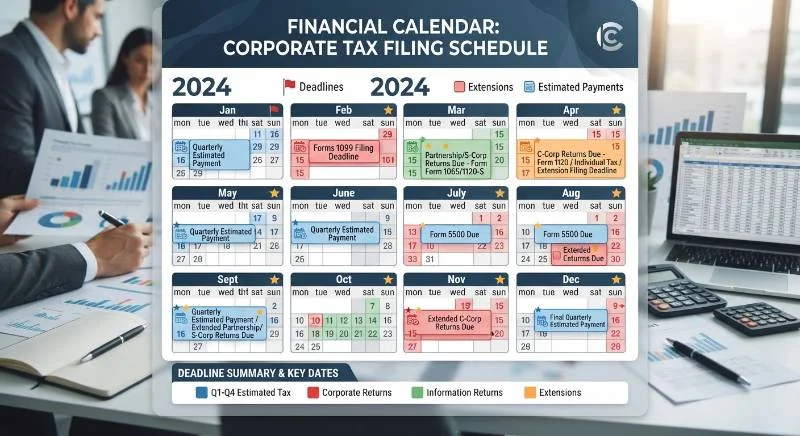
For subsequent filing cycles, statutory submission deadlines are governed by the IRD’s Block Extension Scheme, which categorizes companies by their financial year-end date:
| Category Code | Financial Year-End Date | Standard Submission Deadline | Block Extension Deadline |
|---|---|---|---|
| N Code | April 1 to November 30 | 1 month from issuance | No general extension |
| D Code | December 1 to December 31 | 1 month from issuance | Mid-August (Current Year) |
| M Code | January 1 to March 31 | 1 month from issuance | Mid-November (Current Year) |
Navigating Offshore Profits Tax Exemption & Revised FSIE Regime Compliance
Hong Kong levies tax on a strict territorial source principle. Profits derived outside of Hong Kong are generally not subject to Hong Kong profits tax. However, an offshore status claim requires thorough substantiation through a dedicated tax computation and offshore defense claim submitted alongside the statutory audit.
“Securing an offshore claim is an exacting legal process. Over 94% of initial IRD audit clarifications stem from unsupported claims. Businesses must prove where contracts are negotiated, signed, and physically performed.”
— Senior Tax Counsel, Cross-Border Advisory
To validate an Offshore Profits Tax Exemption, businesses must systematically substantiate three operational areas:
- Contracting and Negotiation: Contracts with clients and suppliers must be negotiated, authorized, and executed outside Hong Kong territory.
- Logistical Flow of Goods: Physical products must not enter or pass through Hong Kong customs unless processed in bonded transit without local value-addition.
- FSIE Regime Compliance: Under Hong Kong’s Foreign Source Income Exemption (FSIE) framework, multinational entities claiming exemptions on specified foreign-sourced passive income (dividends, interest, and intellectual property proceeds) must meet dynamic economic substance and nexus requirements.
Working alongside an accredited Company Secretary Services team ensures statutory registers and board resolutions corroborate offshore operational realities.
Specialized Audit Solutions for Cross-Border E-Commerce, Web3, and Global Trade
Modern cross-border enterprises face intricate accounting environments. High-volume Amazon, Shopify, and cross-border sellers deal with fragmented disbursement statements, multi-currency processing fees, and rolling inventory across decentralized international fulfillment centers.
Olesen Global (TCSP License TC010076) provides purpose-built ledger aggregation that maps high-frequency digital disbursements (e.g., Stripe, Airwallex, PayPal, Amazon Pay) into compliant HKFRS ledgers.
For Web3 and digital asset ventures, our audit team reconstructs on-chain transaction hashes, decentralized exchange liquidity entries, and smart contract fee disbursements into verifiable audit trails. These reports meet both statutory CPA standards and stringent compliance reviews during Bank Account Opening Support and ongoing annual reviews.

Essential Document Checklist for a Frictionless Annual Audit Cycle
To ensure a swift 3 to 6-week turnaround, organizations should prepare their primary accounting documentation before initiating the annual review:
- Banking Records: Official monthly statements for all multi-currency bank and payment gateway accounts.
- Sales Transactions: Sales invoices, settlement reports, service agreements, and customer purchase orders.
- Procurement Records: Supplier invoices, payment vouchers, bills of lading, and freight receipts.
- Operating Expenses: Commercial lease agreements, service provider contracts, employee payroll sheets, and director compensation records.
- Corporate Governance: Articles of Association, updated Business Registration Certificate, Annual Return (NAR1), and significant controller registers.
Key Differences: Licensed In-House TCSP Providers vs. Unregulated Middlemen
Engaging intermediary brokerages introduces risk. Intermediaries often outsource bookkeeping to remote third parties, adding hidden fees, causing missed IRD deadlines, and producing inconsistent audit reports that draw regulatory scrutiny.
| Assessment Dimension | Olesen Global (In-House TCSP TC010076) | Unregulated Broker / Agency |
|---|---|---|
| Statutory Licensing | Verified TCSP License (TC010076) & direct HKICPA practicing partners | Unlicensed intermediary; no direct regulatory oversight |
| Pricing Model | Transparent, direct pricing without middleman markups | Inflated commission structures with recurring hidden fees |
| Offshore Defense Capability | Direct IRD query response handling and structured FSIE substantiation | Generic templates that frequently fail formal IRD review |
| Account Security & AML | Audits structured to comply with tier-one bank KYC/AML requirements | High probability of bank account freezes due to ledger mismatches |

Frequently Asked Questions on Hong Kong Corporate Audits & Tax Submissions
Can an active Hong Kong business apply for Zero Tax Filing instead of a Statutory Audit?
No. Under the Hong Kong Companies Ordinance (Cap. 622) and the Inland Revenue Ordinance, any company with active business transactions is legally required to conduct an annual statutory audit completed by a practicing HK CPA. Zero-tax reporting for active entities is illegal tax evasion, exposing directors to personal liability, severe fines, and sudden bank account cancellation.
How do I verify if a Hong Kong accounting and corporate service firm is legitimate?
You can verify a corporate service provider by checking the official Registry of Trust and Company Service Provider (TCSP) Licensees hosted by the Hong Kong Companies Registry. Olesen Global holds official TCSP license TC010076 and operates from physical offices in Hong Kong, ensuring direct accountability and direct CPA signatory oversight.
What are the primary cost drivers and timelines for a statutory audit?
Statutory audits typically take between 3 and 6 weeks once all primary documents are submitted. Audit fees depend primarily on annual turnover, total transaction volume, the number of corporate bank accounts, ledger complexity, and whether an offshore tax claim or FSIE analysis is required.
What happens if a company submits its Profits Tax Return past the statutory deadline?
Late tax submissions incur immediate estimated assessments and compound penalties under Section 80(2) of the Inland Revenue Ordinance. Initial late filing fines range from HK$1,200 to HK$10,000, along with court summonses and immediate loss of eligibility for the Block Extension Scheme in subsequent filing cycles.
Initiate Your Hong Kong Tax Compliance & Bank Health Diagnostic
Avoid compliance delays, protect your commercial bank accounts, and optimize your international tax position with direct, licensed Hong Kong accounting professionals.
- Upload Records: Submit your multi-currency bank statements, transaction logs, and previous tax filings through our secure portal.
- CPA Assessment: Receive a preliminary 1-on-1 compliance evaluation detailing ledger requirements, FSIE eligibility, and audit scope.
- Direct Filing: Finalize your statutory audit report and Profits Tax Return under direct HKICPA CPA review.