Hong Kong private limited companies are governed by strict dual-track compliance under the Companies Ordinance (Cap. 622) and the Inland Revenue Ordinance (Cap. 112). Every active entity must maintain a licensed Company Secretary (TCSP License), submit an Annual Return (Form NAR1) within 42 days of its incorporation anniversary, renew its Business Registration Certificate, maintain a Significant Controllers Register (SCR) on local premises, and undergo an independent annual audit by a Hong Kong Certified Public Accountant (Practicing) prior to submitting its Profits Tax Return (BIR51). Failure to comply invokes escalating statutory fines, personal criminal liability for directors, and immediate corporate bank account freezing.
Statutory Corporate Governance Directives Under the Hong Kong Regulatory Regime
Operating a private company limited by shares in Hong Kong requires strict adherence to corporate governance protocols codified in the Companies Ordinance (Cap. 622). Hong Kong does not operate on a discretionary corporate filing system. Instead, the statutory regime imposes affirmative fiduciary duties directly on company officers, requiring exact, verifiable administrative maintenance of corporate legal standing. Company directors are legally accountable under statutory civil provisions and criminal enforcement mandates for any failure of the company to execute its statutory filings.
A prevalent misconception among foreign investors and international management teams is that non-resident directorship insulates executives from direct legal action in Hong Kong courts. Under Sections 662 and 895 of Cap. 622, every officer of a company who is in default—defined as authorizing, permitting, or failing to take all reasonable steps to prevent non-compliance—commits a summary offense. These offenses are tried before the Magistrates’ Court and carry personal fines alongside compounding daily default penalties. In cases of persistent administrative negligence, the Companies Registry pursues court-ordered disqualification of directors for periods spanning up to five years, permanently terminating an individual’s commercial authority across Hong Kong.
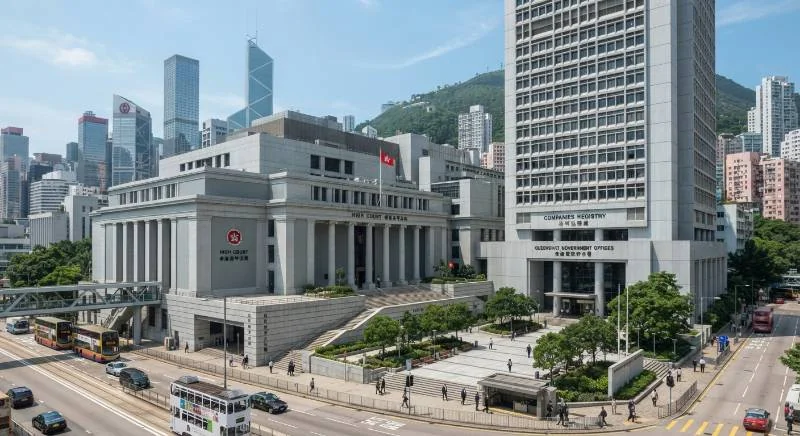
Statutory non-compliance compromises corporate treasury access and institutional longevity. Hong Kong commercial banks are legally compelled under Hong Kong Monetary Authority (HKMA) anti-money laundering regulations to conduct continuous periodic reviews on corporate account holders. Any lapse in corporate good standing, such as a delinquent annual statutory Form NAR1 filing guidelines adherence or an expired Business Registration Certificate, triggers an automated suspension of clearing services, incoming wire blocks, and corporate account terminations. For business owners executing cross-border commerce, retaining first-tier governance through licensed corporate infrastructure is essential to preserve banking continuity and safeguard limited liability status under the Companies Ordinance.
Establishing proper governance begins during baseline legal formation. Founding shareholders must evaluate foundational corporate documentation via Hong Kong Company Incorporation structures that incorporate institutional compliance safeguards from inception, mitigating future governance disruptions.
Dual-Track Statutory Governance: Companies Registry Versus Inland Revenue Department Mandates
The regulatory ecosystem for Hong Kong companies is structured around two distinct government authorities: the Companies Registry (CR), which oversees corporate structure and public transparency under Cap. 622, and the Inland Revenue Department (IRD), which enforces fiscal assessment and tax collection under the Inland Revenue Ordinance (Cap. 112). Maintaining corporate good standing requires parallel execution across both administrative tracks, as satisfaction of one authority’s requirements has zero statutory bearing on the other.
The Companies Registry regulates corporate structure, public disclosures, and corporate transparency. Its primary recurring instrument is the Annual Return (Form NAR1). This document provides an official snapshot of the corporate entity on the exact anniversary of its incorporation, detailing share capital configurations, shareholder register movements, active directorships, charging documentation, and designated corporate secretarial information. Alongside public documentation, companies must maintain physical or electronic internal records at a qualified Hong Kong registered address, notably the Significant Controllers Register (SCR) mandated by the Companies (Amendment) Ordinance 2018.
Enforcement of beneficial ownership rules requires strict alignment with established Significant Controllers Register (SCR) inspection protocols. An entity must designate a qualified Designated Representative (DR) to provide the SCR to authorized law enforcement officers upon statutory demand. Under Cap. 622, the Designated Representative must be an individual resident in Hong Kong or a licensed Trust or Company Service Provider (TCSP) licensee, such as Olesen Global (TCSP License TS010076).
| Regulatory Dimension | Companies Registry (CR) Mandate | Inland Revenue Department (IRD) Mandate |
|---|---|---|
| Governing Ordinance | Companies Ordinance (Cap. 622) | Inland Revenue Ordinance (Cap. 112) |
| Core Annual Instrument | Form NAR1 (Annual Return) | Profits Tax Return (BIR51) & Audited Statements |
| Statutory Filing Deadline | Strictly within 42 days of incorporation anniversary | Within 1 month of issuance (or block extension date) |
| Corporate Record Maintenance | Significant Controllers Register (SCR), Register of Directors, Register of Members | 7-Year Books of Accounts, Invoices, Vouchers, Bank Statements (Section 51C) |
| Public Registry Access | Yes (Public search via Companies Registry e-Services) | No (Strictly confidential between taxpayer and IRD) |
| Statutory Penalties for Default | Escalating late filing fees up to HKD 4,800 + criminal summons | HKD 10,000 fine, triple-tax penalty assessments (Section 82A), court prosecution |
| Qualified Professional Role | Licensed Company Secretary (TCSP Licensee) | Hong Kong Certified Public Accountant (Practicing) |
Concurrently, the Business Registration Office (BRO) of the Inland Revenue Department oversees commercial licensing via the Business Registration Certificate (BRC). Every corporation carrying on business in Hong Kong must renew its BRC either annually or on a three-year triennial cycle, paying the prevailing statutory Business Registration Fee and the Protection of Wages on Insolvency Fund levy. Operating without a valid BRC violates Section 5 of the Business Registration Ordinance (Cap. 310), exposing directors to summary prosecution. Entities must align these dual-track submissions using specialized Statutory Company Secretary Services that continuously audit internal filings against public records.
Operational Entity Classification & Risk Exposure Matrix
Statutory obligations apply universally to all corporate entities incorporated in Hong Kong, but compliance risk and reporting profiles depend on operational classification. Directors often mistakenly assume that non-operational or uncapitalized structures are exempt from statutory governance. In practice, the Companies Registry and Inland Revenue Department enforce distinct reporting standards based on formal statutory status.
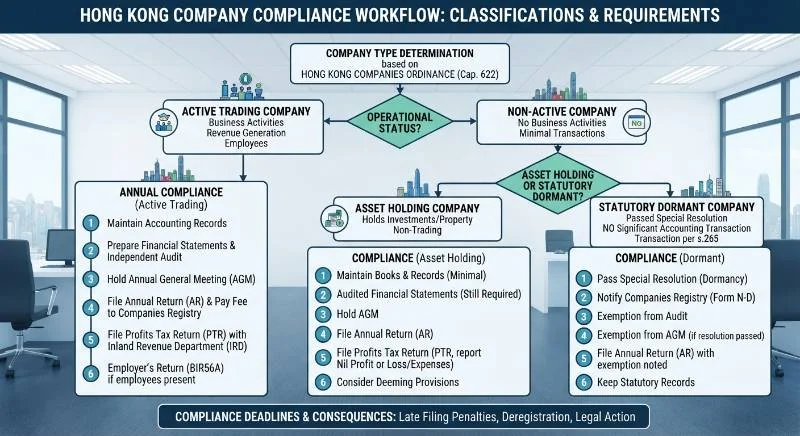
The primary classifications include Active Trading Entities, Passive Asset Holding Companies, Formally Declared Dormant Companies under Section 447 of Cap. 622, and Inactive Shell Entities. The fundamental statutory boundary is the clear legal distinction between an “informally inactive” entity and a company with “statutory dormant status.” A company that executes zero transactions, maintains an idle bank balance, and conducts no commercial trading remains fully active under Hong Kong law until a Special Resolution is passed by members and officially filed with the Registrar of Companies declaring statutory dormancy.
| Entity Operational Status | Form NAR1 Filing Required | CPA Audit Report Mandated | Business Registration (BRC) | Compliance Risk & Legal Exposure |
|---|---|---|---|---|
| Active Trading Entity | Yes (Within 42 days) | Yes (Mandatory under Section 429) | Yes (Annual / Triennial renewal) | High: Exposed to direct audit adjustments, cross-border tax inquiries, and customs verification. |
| Asset / IP Holding Company | Yes (Within 42 days) | Yes (Mandatory balance sheet audit) | Yes (Mandatory local licensing) | Medium-High: Scrutinized under the Foreign Sourced Income Exemption (FSIE) economic substance rules. |
| Statutory Dormant (s.447 Cap. 622) | Exempt (Relieved by statute) | Exempt (Relieved by statute) | Required (Unless formal fee exemption is granted) | Low: Strictly monitored. Entering into a single accounting transaction instantly voids statutory dormancy. |
| Informally Inactive / Zero Revenue | Yes (Within 42 days) | Yes (Audited financial statements required) | Yes (Full fee payment required) | Critical: Common target for default summonses due to false assumptions of automatic statutory exemption. |
Asset and IP holding companies managing foreign trademarks or intellectual assets require comprehensive integration between statutory corporate compliance and corporate governance. Entities licensing intellectual property must substantiate economic reality under the Foreign Sourced Income Exemption (FSIE) regime while defending registered legal title via Global Trademark & Intellectual Property Protection frameworks. In commercial governance, passive entity classification offers no safe harbor from statutory audit and annual return mandates.
End-to-End Annual Statutory Governance Roadmap: Financial Year-End to Tax Defense
Corporate compliance follows a rigid statutory calendar. Managing a Hong Kong entity requires an operational roadmap that aligns internal accounting timelines with government-mandated filing windows. The foundational anchor of this lifecycle is the Financial Year-End (FYE) date chosen by the company’s first board of directors pursuant to Section 369 of the Companies Ordinance.
The corporate lifecycle operates along two parallel operational tracks: Corporate Secretarial Maintenance (determined by the corporate anniversary) and Fiscal Tax Compliance (determined by the Financial Year-End). For tax reporting, adopting a conventional FYE—primarily December 31 or March 31—allows the company to utilize the Inland Revenue Department’s Block Extension Scheme, which provides organized extensions for filing the Profits Tax Return (BIR51).
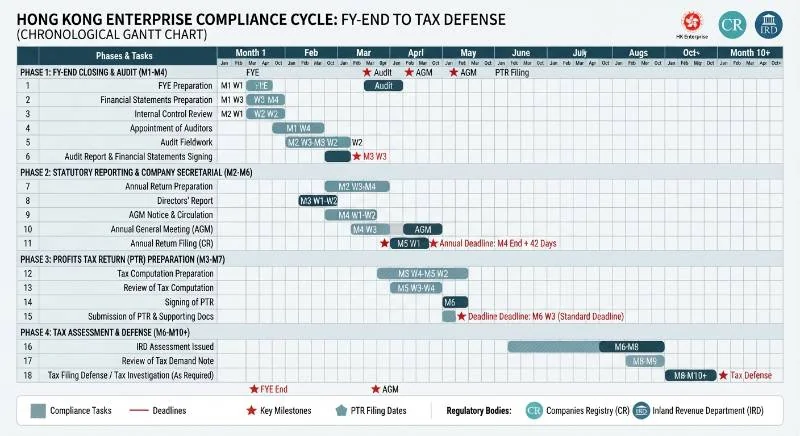
Strategic management of statutory deadlines requires active oversight of four core operational phases across the reporting period:
Phase 1: FYE Close & Preliminary Ledger Settlement (T + 0 to T + 60 Days)
Reconcile bank accounts, match supplier statements, close sub-ledgers, and assemble supporting commercial documentation (sales contracts, shipping bills, commercial invoices). Secure comprehensive bank confirmations directly from institutions to prevent multi-month audit delays.
Phase 2: Incorporation Anniversary Filing & BRC Settlement (Fixed Annual Window)
Execute and file Form NAR1 via the Companies Registry e-Services portal within 42 statutory calendar days. Simultaneously pay the required Business Registration fee upon receiving the Demand Note from the Inland Revenue Department to avoid late payment penalties under Cap. 310.
Phase 3: Certified CPA Statutory Audit Fieldwork (T + 60 to T + 120 Days)
Transmit reconciled accounts, ledger entries, and transactional contracts to an independent Hong Kong Certified Public Accountant (Practicing). The auditor executes testing, verifies revenue realization under HKFRS, validates balance sheet assets, and issues an independent Auditor’s Report.
Phase 4: Board Execution, Tax Return Submission, & Banking Refresh (T + 120 to T + 180 Days)
Convene the board of directors to adopt the audited financial statements. Complete Profits Tax Return (BIR51) alongside statutory tax computations. Deliver the signed audit package to the IRD, then furnish fresh compliance records to treasury institutions for ongoing KYC validation.
Completing this compliance cycle protects corporate operations. Commercial banks in Hong Kong require submission of audited financial statements within six months of financial year-end to maintain credit facilities and transaction limits. Proactive execution of statutory governance is the primary method for preventing corporate bank account freezes during annual compliance reviews. Entities requiring support can secure institutional review directly through Commercial Bank Account Opening protocols designed to meet current HKMA underwriting standards.
Certified CPA Statutory Audit Execution, Profits Tax (BIR51), and FSIE Nexus Defense
Under Section 429 of the Companies Ordinance (Cap. 622), the directors of every private company incorporated in Hong Kong must lay audited financial statements before the company in general meeting annually. An internal compilation, an offshore management report, or an uncertified spreadsheet does not satisfy this mandate. The audit must be conducted by a licensed, practicing Hong Kong Certified Public Accountant (CPA) in accordance with the Hong Kong Standards on Auditing (HKSA) issued by the Hong Kong Institute of Certified Public Accountants (HKICPA).
The Inland Revenue Ordinance operates in direct coordination with this auditing requirement. Under Section 51(1) of Cap. 112, when a company receives a Profits Tax Return (BIR51) from the assessor, it must submit the return accompanied by audited financial statements, tax computations demonstrating assessable profits adjustments, and supplementary reporting forms (such as Form S1 through S18 for specific tax regimes). Meeting this requirement requires adherence to an established certified CPA audit and Profits Tax Return timeline.
Section 51C of the Inland Revenue Ordinance places strict statutory record-keeping duties on company directors. Every corporation carrying on business in Hong Kong must retain sufficient records of its income and expenditure in the English or Chinese language for at least seven years. These records include receipts, invoices, vouchers, detailed asset registers, and original banking documentation. Any director or officer who fails to retain these underlying records without reasonable excuse is guilty of an offense and subject to a statutory penalty of HKD 100,000 under Section 80(1A).
| Compliance Element | Standard Domestic Profits Tax Regime | Offshore Exemption Claim (Historic) | Foreign Sourced Income Exemption (FSIE 2024-2026) |
|---|---|---|---|
| Statutory Corporate Tax Rate | Two-tier: 8.25% (First HKD 2M), 16.5% (Balance) | 0% on qualifying offshore trading profits | 0% on passive dividends, interest, equity disposals, and IP income |
| Substantiation Threshold | Standard accruals and deductions under Cap. 112 | Operations, contract execution, and staff strictly offshore | Economic Substance (ES) or Nexus Approach validation |
| Economic Substance Mandate | Standard physical or agency nexus in Hong Kong | Historically low substance required within Hong Kong | High: Adequate qualified employees and local operational expenditure |
| CPA Audit Scrutiny Level | Standard HKSA verification of transactions | Extensive documentation audit (interviews, travel logs) | Stringent verification of outsourced activities and monitoring logs |
| Direct IRD Defense Process | Standard formal tax assessment validation | Detailed written queries and documentary production | Pre-assessment Commissioner determinations or advance rulings |
Hong Kong’s implementation of the refined Foreign Sourced Income Exemption (FSIE) regime has transformed cross-border tax defense. Multinational enterprise (MNE) groups claiming tax exemptions on foreign-sourced passive income—such as dividends, interest, intellectual property royalties, and asset disposal gains—must satisfy rigorous economic substance or nexus requirements within Hong Kong. Passive holding entities must demonstrate adequate qualified employees and local operational expenditure within Hong Kong to secure exemptions. International groups must structure their accounts with direct technical guidance from Certified CPA Audit & Profits Tax Compliance specialists to protect offshore claims and avoid retroactive tax liabilities under Cap. 112 Section 82A.
Corporate Health Audit Checklist and Fiduciary Risk Mitigation Matrix
Cross-border executives and management boards should conduct regular audits of their Hong Kong corporate operations. Use this diagnostic matrix to assess your company’s corporate standing, identify governance gaps, and execute corrective action before regulatory enforcement begins.
Hong Kong Corporate Statutory Health Checklist
- Annual Return Verification: Form NAR1 submitted to Companies Registry within 42 days of the corporate anniversary date; registry e-filing receipt on file.
- Business Registration Validity: BRC certificate current, statutory levy paid, and original certificate displayed at the registered office address.
- Significant Controllers Register (SCR): Maintained on site at the registered office; Designated Representative formally appointed and certified.
- Independent CPA Audit: Financial accounts audited annually by a licensed Hong Kong CPA (Practicing) under Cap. 622 Section 429.
- Profits Tax Return (BIR51): Submitted within the statutory deadline alongside complete audited accounts and tax computations.
- Statutory Record Custody: Register of Directors, Register of Members, Register of Secretaries, and board minutes maintained for the mandatory 7-year duration.
- TCSP Licensee Verification: Company Secretary holds an active Trust or Company Service Provider License issued by the Companies Registry.
- Commercial Banking Alignment: Company records at financial institutions match official Companies Registry filings.
When an internal review identifies compliance deficiencies, corporate secretarial negligence, or unfiled returns, directors must take immediate remediation steps. Many companies inadvertently work with unlicensed intermediaries who sub-contract secretarial duties to third parties, resulting in delayed filings, lost records, and unresolved court summonses. In these cases, management should follow a structured step-by-step company secretary handover process to restore compliant governance.
Replacing a non-performing Company Secretary requires straightforward legal procedure under the Companies Ordinance:
- Board Resolution Approval: Pass a formal board resolution revoking the appointment of the outgoing corporate secretary and appointing an authorized TCSP licensee, such as Olesen Global, with immediate or specified effective date.
- Execution of Form ND2A: Prepare and execute Form ND2A (Notice of Change of Company Secretary and Director) within 15 days of the transition for filing with the Hong Kong Companies Registry.
- Physical and Digital Custody Transfer: Secure direct transfer of the statutory register binder, common seal, electronic corporate records, and active correspondence files from the predecessor.
- Significant Controllers Register (SCR) Designation: Officially notify the Companies Registry of the change in Designated Representative under Section 653ZC of Cap. 622, updating the statutory records stored at the designated Hong Kong premises.
- Inland Revenue Department Notification: File statutory written notification with the Business Registration Office to reflect the updated corporate correspondence and representative address within one month.
Post-Handover Statutory Remediation Audit
Upon assuming custody, professional corporate service providers execute a comprehensive reconciliation of historical filings. This remedial audit examines past Annual Returns (NAR1), Business Registration renewals, certified financial statement lodgments, and SCR records to uncover latent reporting gaps before regulatory enforcement triggers court summonses or bank account freezing.
Senior Company Secretary & Certified Auditor FAQ Vault
Can a Hong Kong private company opt out of the annual statutory audit if it conducts zero operations?
+
No. Under the Hong Kong Companies Ordinance (Cap. 622), every incorporated private company must prepare audited financial statements certified by an independent Hong Kong Certified Public Accountant (Practicing), regardless of transaction volume or operational activity. The only statutory exception applies to companies that have formally applied for and received official “Dormant” status from the Companies Registry via special resolution under Section 5 of Cap. 622. A company that is merely inactive or running at a financial loss without official dormant registration remains fully liable for annual audits.
What are the severe consequences of late submission of Form NAR1 to the Companies Registry?
+
Under Cap. 622, Form NAR1 must be delivered within 42 days of the company’s incorporation anniversary. Failure to file within this window results in escalating statutory late registration fees ranging from HKD 870 to HKD 4,800. Persistent failure leads to criminal prosecution of the company and its responsible officers under Section 662, carrying potential court fines up to HKD 50,000 alongside daily default fines of HKD 1,000, as well as the eventual striking off of the company by the Registrar.
How does an offshore profit claim affect the complexity of the Hong Kong statutory CPA audit?
+
Claiming an offshore non-taxable status does not waive the statutory audit requirement. In fact, it increases audit scrutiny. The CPA auditor must audit the financial statements under Hong Kong Financial Reporting Standards (HKFRS) while compiling extensive supporting documentation—such as commercial agreements, logistics documentation, board meeting minutes, communication logs, and personnel contracts outside Hong Kong—to substantiate to the Inland Revenue Department that income was wholly derived from activities performed outside the territory under territorial tax rules and the Foreign Sourced Income Exemption (FSIE) regime.
Who qualifies to act as a Designated Representative for the Significant Controllers Register (SCR)?
+
Pursuant to Section 653ZC of Cap. 622, a company must designate at least one natural person or institutional representative residing in or licensed in Hong Kong to provide assistance to law enforcement officers regarding the SCR. Qualified parties include: a director, employee, or member of the company who is a Hong Kong resident; a licensed Trust or Company Service Provider (TCSP); or a practicing accounting or legal professional in Hong Kong. Non-resident individuals or unlicensed corporate entities cannot legally fulfill this statutory duty.
Why does a corporate commercial bank account in Hong Kong get suspended during compliance failures?
+
Hong Kong commercial banks operate under strict anti-money laundering (AML) and counter-terrorist financing (CTF) oversight regulated by the Hong Kong Monetary Authority (HKMA). Banks conduct mandatory annual periodic reviews (Know Your Customer reviews). If a company fails to provide renewed Business Registration Certificates, updated certified audit reports, or current NAR1 returns proving active registration and legal standing, institutional risk divisions will flag the entity as non-compliant, restrict outward wire access, and freeze operational merchant balances until full clearance is proven.
Can a single sole director also serve as the Company Secretary under Hong Kong law?
+
No. Section 474(4) of the Companies Ordinance expressly prohibits a sole director from acting simultaneously as the Company Secretary. Furthermore, a private company having only one director cannot appoint a corporate secretary whose sole director is also the sole director of the company. A distinct qualified party—either an individual permanent resident of Hong Kong or a licensed corporate service provider (TCSP Licensee)—must be formally appointed.
Consult with Olesen Global’s Licensed Corporate Specialists
Backed by Hong Kong TCSP License TS010076, practicing company secretaries, and certified CPA auditors.