Navigating Hong Kong Business Expenses Tax Deductibility: The Executive Framework
Under the territorial tax system of Hong Kong, corporations are taxed solely on net profits arising in or derived from the territory at rates of 8.25% on the first HK$2,000,000 of assessable profits and 16.5% on the remainder. Qualifying corporate expenses must satisfy the strict statutory nexus established under Section 16 of the Inland Revenue Ordinance (IRO Cap. 112), maintaining an empirical documentation clearance rate of over 98% when verified against independent audit standards.
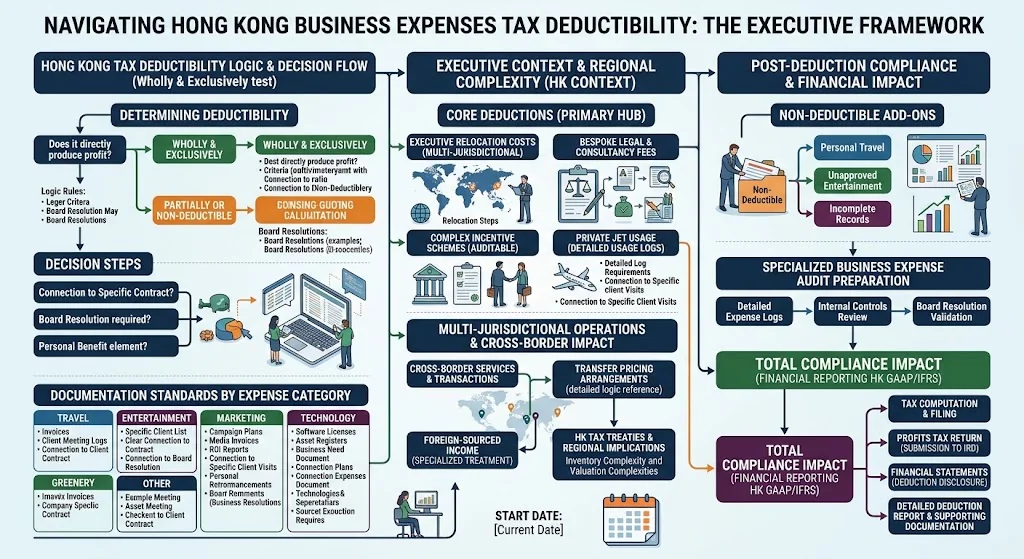
Operating a private limited entity in Hong Kong delivers distinct advantages, spearheaded by a simple territorial corporate tax regime and low headline rates under the two-tiered profits tax rates regime. However, calculating taxable corporate profits is fundamentally distinct from calculating net income under Hong Kong Financial Reporting Standards (HKFRS). Commercial accounting outlays do not automatically constitute statutory deductions when completing the annual Profits Tax Return (BIR51).
Every commercial deduction must align with the Inland Revenue Ordinance (Cap. 112). Discrepancies between recognized operational spending and allowable deductions require systematic statutory add-backs during the annual reconciliation process, coordinated in conjunction with an independent Statutory Audit and Tax Filing.
Statutory Ground Rules: The Section 16 Production of Assessable Profits Test
The operational foundation of corporate tax deductibility in Hong Kong rests upon Section 16(1) of the IRO. To qualify as an allowable outgoing, an expense must be incurred in the production of assessable profits during the relevant basis period. This rule establishes what tax jurisprudence recognizes as the statutory nexus test.
“Section 16(1) operates as an unyielding filter. A commercial disbursement may make perfect business sense to an executive board, but if it bears no direct statutory nexus to income chargeable to Hong Kong profits tax, the deduction will fail as a matter of law.”
— Senior Tax Counsel, Hong Kong Revenue Law Chambers
To establish deductibility, the outgoing must fulfill three central criteria under the Dual-Nexus Statutory Expense Validation Protocol:
- Temporal Incurrence: The liability must be definitively incurred during the basis period. Contingent liabilities or speculative reserves do not satisfy this requirement.
- Direct Income Nexus: A direct causal bridge must connect the expenditure to trading activities that produce revenue subject to Hong Kong profits tax. If revenue is exempt offshore, matching operational expenses are automatically disallowed.
- Revenue Characterization: The outlay must relate to circulating capital (routine operations) rather than fixed capital (enduring assets or corporate infrastructure).
The statutory nexus is scrutinized thoroughly by the Inland Revenue Department (IRD). Expenses connected to tax-exempt income, offshore branch activities, or capital transactions are systematically disallowed during profits tax computations.
Evaluation Framework: Assessing Deductibility Across Operational Categories
Routine commercial expenditures fall into distinct operational brackets with specific deductibility criteria under the IRO. Evaluating outlays according to these benchmarks prevents unexpected disallowances when filing tax returns.
| Expenditure Category | Statutory Treatment | Statutory Basis | Audit & Substantiation Criteria |
|---|---|---|---|
| Commercial Office Lease | Fully Deductible | Section 16(1)(b) | Stamped tenancy agreement, bank settlement records, commercial business justification. |
| SaaS & Cloud Subscriptions | Fully Deductible | Section 16(1) | Enterprise service invoices, recurring transaction logs, direct staff allocation proof. |
| Digital Marketing & Ad Spend | Fully Deductible | Section 16(1) | Platform receipts (Google/Meta), clear link to products yielding assessable revenue. |
| Pre-Commencement Costs | Conditional (Add-Back) | Section 17(1)(c) | Incurred prior to trading commencement; treated as capital unless direct statutory exception applies. |
| Staff Mandatory MPF | Fully Deductible (Capped) | Section 16(1)(q) | Capped at 15% of total employee emoluments for the basis period. |
| Traffic Fines & Penalties | Strictly Non-Deductible | Section 17(1) | Infringements of law cannot be incurred to generate assessable corporate profits. |
Pre-commencement operational expenditures require careful handling. Under Hong Kong tax practice, costs incurred prior to the exact date an enterprise opens its doors or completes its first commercial transaction are deemed preliminary capital expenditures. As detailed in Departmental Interpretation and Practice Notes (Inland Revenue Department DIPN No. 40), these amounts must generally be added back to accounting profits unless they represent immediately deductible statutory items.
Statutory Prohibitions: Disallowed Deductions Under Section 17
While Section 16 outlines allowable deductions, Section 17 of the IRO sets down negative prohibitions that bar specific categories of expense regardless of commercial necessity. Where conflict arises, Section 17 supersedes Section 16.
The four primary statutory prohibitions under Section 17 non-allowable deductions include:
- Domestic or Private Expenditure: Section 17(1)(a) explicitly bars any domestic or private expenses, including non-business travel, personal living expenses, and utility expenses for personal premises.
- Capital Outlays and Improvements: Section 17(1)(c) disallows any expenditure of a capital nature, capital withdrawals, or outlays for structural building improvements, requiring them to be written off or claimed through statutory capital allowances.
- Non-Specific General Provisions: Blanket reserves for doubtful debts or inventory obsolescence are disallowed under Section 17(1). Only specific bad debts proved uncollectible during the basis period qualify under Section 16(1)(d).
- Taxes Paid on Profits: Income taxes paid within Hong Kong or comparable foreign taxes paid on profits are non-deductible under Section 17(1)(g), preserving the statutory integrity of the assessable profit baseline.
During the statutory audit, an independent Certified Public Accountant reviews the general ledger to flag these prohibited categories. The CPA creates formal tax adjustments, increasing assessable income to reflect the mandatory add-backs.
Capital Allowances vs. Revenue Expenditures: Navigating Part VI Rules
Capital assets such as plant, machinery, servers, and corporate commercial real estate cannot be expensed immediately under Section 16(1). Instead, corporate taxpayers recover these outlays via the statutory depreciation regime codified under capital allowances Part VI of the IRO.
Hong Kong tax law offers accelerated relief through several targeted statutory mechanisms:
- Section 16G Immediate 100% Write-Off: Full initial-year tax write-offs apply to qualifying computer hardware, enterprise software, and manufacturing machinery used directly in business operations.
- Commercial Building Allowance (CBA): Under Section 33A, capital expenditure on the construction or purchase of commercial premises receives an annual building allowance of 4% of qualifying capital cost across 25 years.
- Refurbishment Allowances: Under Section 16F, capital expenditures incurred on the renovation or refurbishment of commercial business premises qualify for a direct statutory deduction spread equally across five consecutive years (20% per year).
- Plant and Machinery Depreciation: Assets that do not qualify under Section 16G enter the standard capital allowance pool under Section 37, generating an Initial Allowance of 60% in the year of purchase, followed by Annual Allowances ranging from 10% to 30% on the reducing balance.
| Asset / Expenditure Profile | Statutory Mechanism | First-Year Tax Deduction | Subsequent Annual Deduction |
|---|---|---|---|
| Laptops, Cloud Hardware, Servers | Section 16G Specified Equipment | 100% Direct Write-Off | Nil (Fully Relieved) |
| Commercial Office Renovation | Section 16F Building Refurbishment | 20% of Incurred Capital | 20% per year (Years 2 to 5) |
| Office Furniture and Fixtures | Section 37 Machinery Pool (20%) | 60% Initial + 20% Annual Allowance | 20% on Reducing Balance |
| Company Vehicles (Passenger) | Section 37 Machinery Pool (30%) | 60% Initial + 30% Annual Allowance | 30% on Reducing Balance |
Navigating these depreciation schedules requires continuous ledger maintenance and alignment with professional Hong Kong Accounting and Audit Services to prevent discrepancies between financial statement depreciation and statutory tax allowances.
Complex Corporate Scenarios: Cross-Border Architectures, FSIE, and Web3 Outlays
For multinational groups and cross-border commercial operators, tax deductibility extends beyond basic administrative operating expenses. Recent compliance updates, including the updated Foreign Source Income Exemption (FSIE) regime, mean cross-border recharges face heightened review from Hong Kong tax assessors.
“The IRD evaluates cross-border holding structures with surgical precision. If an entity claims offshore tax exemption while charging executive management fees against Hong Kong operations, the assessor will review transactional substance and invoke transfer pricing rules under DIPN 59.”
— Senior Partner, International Tax Advisory Practice
Three complex corporate structures require specific technical management:
1. Cross-Border Management Service Fees
Intercompany management service agreements frequently trigger IRD audits. To support deductibility, the Hong Kong enterprise must establish that genuine services were rendered, the charges meet arm’s-length transfer pricing standards under Section 50AAF, and the costs correlate directly with assessable income generation.
2. FSIE Nexus and Outgoing Apportionment
Under the FSIE regime, dividend income, equity disposal gains, and foreign intellectual property proceeds received by a covered entity may qualify for tax exemption subject to economic substance requirements. Where a Hong Kong business earns both onshore profits and exempt offshore income, administrative and shared operational overheads must be apportioned using an approved, defensible turnover methodology.
3. Web3 and Decentralized Protocol Outlays
Digital asset enterprises, fintech platforms, and Web3 teams operating out of Hong Kong incur unconventional expenditures. On-chain gas transaction fees, independent smart contract auditing costs, node staking expenses, and payments to foreign remote software engineers are deductible under Section 16(1) provided they link directly to taxable revenue generation. These transactions must be documented with comprehensive cryptographic records, transaction hashes, and fiat-equivalent pricing valuations.
Strict Statutory Hurdles for Intra-Group Financing and Interest Deductions
Interest deductions face specific hurdles in Hong Kong. To deduct borrowing costs, corporations must satisfy both Section 16(1)(a) and at least one statutory condition set out in Section 16(2) of the Inland Revenue Ordinance Cap. 112.
- Lender Taxation Test: If corporate funds are borrowed from an overseas affiliate or non-financial counterparty, the interest paid is deductible only if the counterparty is subject to Hong Kong profits tax on the corresponding interest income.
- Financial Institution Borrowing: Interest paid on funds borrowed from recognized domestic or international licensed banks is fully deductible, provided the underlying facility was secured against genuine business assets rather than tax-free deposits.
- Anti-Avoidance and Sub-Participation: Deductions are disallowed if an intra-group financing structure operates as a back-to-back arrangement designed to transfer funds offshore tax-free.
Common Audit Triggers: Director Remuneration, Travel, and Mixed-Use Expenses
Audit profiling by the IRD focuses on expenses that carry mixed personal and corporate benefit. Where non-commercial outlays are identified, tax assessors may disallow the deduction and review the company’s past returns.
Key audit triggers and their required defensive documentation include:
- Director Remuneration Reasonableness: Director fees and executive salaries paid to shareholders are deductible under Section 16(1). However, amounts that diverge significantly from industry standards or that distribute profits to reduce corporate tax liabilities risk disallowance under Section 61 or 61A general anti-avoidance rules.
- Executive Travel Allocations: Corporate travel claims require itemized flight tickets, formal accommodation vouchers, meeting agendas, and executive briefing records. Trips that combine personal vacations with business activities must be pro-rated, deducting only the commercial portion.
- Corporate Client Entertainment: Entertainment expenses must connect directly to active commercial relationships or pending deals. Detailed entertainment logs tracking attendees, corporate affiliations, and the business purpose of each meal or event are necessary to satisfy audit standards.
- Home-Office Apportionment: Where remote executives conduct business operations from personal residential properties, claims for utilities, broadband, and square-footage rent must use an apportionment based on dedicated square footage and documented hours of operation.
When incorporating an enterprise via Hong Kong Company Registration, maintaining clean segregation between corporate accounts and personal director transactions from day one helps minimize future audit inquiries.
Statutory Recordkeeping and IRD Audit Defense Protocols
Under Section 51C of the IRO, every person carrying on a trade, profession, or business in Hong Kong must keep sufficient records of their income and expenditure in the English or Chinese language for at least seven years following the completion of the relevant basis period. Failure to comply is an offense carrying statutory fines up to HK$100,000.
Essential records that must be retained under Section 51C include:
- General ledgers, day books, cash records, and bank statements showing daily cash movements.
- Supplier invoices, receipt vouchers, debit notes, and executed service agreements.
- Asset registers detailing purchase dates, serial IDs, vendor terms, and proof of payment.
- Independent audit working papers, computation schedules, and annual returns filed with the Hong Kong Companies Registry and IRD.
Tax Deductibility Compliance Checklist
Review every expense category against this statutory verification checklist before submitting financial records to your auditor:
Statutory Lifecycle & Compliance Roadmap
Statutory Roadmap
Inception & Ledger Setup
- Chart of accounts setup under HKFRS
- Document retention protocols initiated
Operational Governance
- Monthly reconciliations & vouchers
- Capital vs. revenue classification
Anniversary Audit
- Independent CPA statutory audit
- Statutory tax add-back adjustments
BIR51 Tax Filing
- Audited accounts and BIR51 delivery
- Proactive IRD audit defense
Anti-Middleman Trap Verification Guide
Corporate managers often delegate financial administration to intermediary service agencies. However, sub-contracting corporate filings to unregulated brokers introduces serious legal and financial risks under the Anti-Money Laundering and Counter-Terrorist Financing Ordinance (Cap. 615).
Three common middleman vulnerabilities expose corporate directors to liability:
- Unlicensed Subcontracting Markups: Unregulated intermediaries routinely re-sell audit and tax services through multiple subcontracting tiers, raising service fees while limiting technical oversight and audit defense capabilities.
- Unregistered Nominee Shell Addresses: Intermediaries often place hundreds of corporate clients at virtual addresses that fail to meet corporate secretarial regulations, drawing heightened IRD scrutiny.
- Unsubstantiated Account Guarantees: Unlicensed agents may promise guaranteed bank account approvals or tax-free status, exposing directors to investigation for non-compliant tax filings.
To confirm compliance, verify that your corporate services provider holds a valid Trust or Company Service Provider (TCSP) license directly via the public Companies Registry TCSP Register. Olesen Global maintains corporate governance standards under TCSP License TC010076, managing company secretarial, accounting, and audit workflows directly with in-house personnel.
Resource: Statutory Expense Deductibility Diagnostic Manual
Avoid regulatory rejections and reduce add-back surprises. This guide covers statutory depreciation schedules, arm’s-length intercompany fee benchmarks, and Section 51C audit defense procedures.
- Complete Section 16/17 statutory expense matrix.
- Depreciation schedule breakdown for hardware and digital infrastructure.
- Standard document templates for cross-border management fee justifications.
Frequently Asked Questions: Hong Kong Corporate Tax Deductions
What is the difference between an accounting expense and a tax-deductible expense in Hong Kong?
An accounting expense reflects any operational cost recognized under Hong Kong Financial Reporting Standards (HKFRS) to show an entity’s commercial performance. For tax purposes under Section 16 of the Inland Revenue Ordinance, however, an expense is tax-deductible only if it is incurred wholly and exclusively to generate assessable Hong Kong profits and is not of a capital nature. Non-deductible accounting items—such as book depreciation, general bad-debt provisions, and domestic outlays—must be added back in the statutory tax computation.
Why must tax computation and filing be coordinated through a licensed corporate and accounting provider?
Hong Kong incorporated entities must submit an audited financial statement prepared by an independent Certified Public Accountant alongside their Profits Tax Return (BIR51). Working with an established corporate service provider like Olesen Global (TCSP License TC010076) ensures that everyday corporate governance, maintained through ongoing Company Secretary Services, connects directly with accounting ledgers and independent statutory audit workflows. This approach maintains full compliance with the Companies Ordinance and the Inland Revenue Ordinance.
What are the regulatory risks of claiming non-compliant business expense deductions in Hong Kong?
Under Section 80 and Section 82 of the Inland Revenue Ordinance, filing incorrect returns without a reasonable excuse or engaging in willful tax evasion exposes directors to significant penalties. These include court-imposed fines up to HK$50,000, punitive treble taxes of up to 300% of the undercharged tax, and potential criminal imprisonment. Because the IRD regularly conducts retrospective field audits covering seven years of company records, unsubstantiated claims can lead to disallowed deductions and accumulated interest charges.
Are foreign currency exchange losses incurred in trading deductible?
Foreign exchange losses are tax-deductible only if they arise from ordinary revenue transactions, such as paying trade suppliers or settling operational bills. Losses from capital movements—such as remitting equity capital or securing long-term foreign currency loans—are treated as capital losses and are non-deductible under Section 17(1)(c).
Initiate Your 3-Step Tax Deductibility and Compliance Review
Managing statutory add-backs, maintaining transfer pricing compliance, and organizing audit schedules requires hands-on technical management. Olesen Global provides direct statutory administration, independent audit support, and direct IRD BIR51 filing management under TCSP License TC010076, eliminating intermediary markups and subcontracting delays.
- Upload Operational Ledgers: Provide preliminary trial balances, expense logs, and operational contracts through our secure advisory portal.
- 1-on-1 Statutory Add-Back Diagnostic: A dedicated corporate compliance advisor will review your expense classifications, identify Section 17 disallowances, and calculate your available capital allowances.
- Direct Audit and IRD Filing: Finalize statutory audit schedules and secure direct submission of your Profits Tax Return (BIR51) to the Inland Revenue Department.
Ensure Tax Compliance and Protect Your Business Margins
Speak directly with a licensed corporate compliance specialist for a detailed review of your company’s deductible expenses and statutory audit preparation.
Direct Execution (No Subcontracting)
Zero Hidden Fees
1-on-1 Dedicated Compliance Advisor