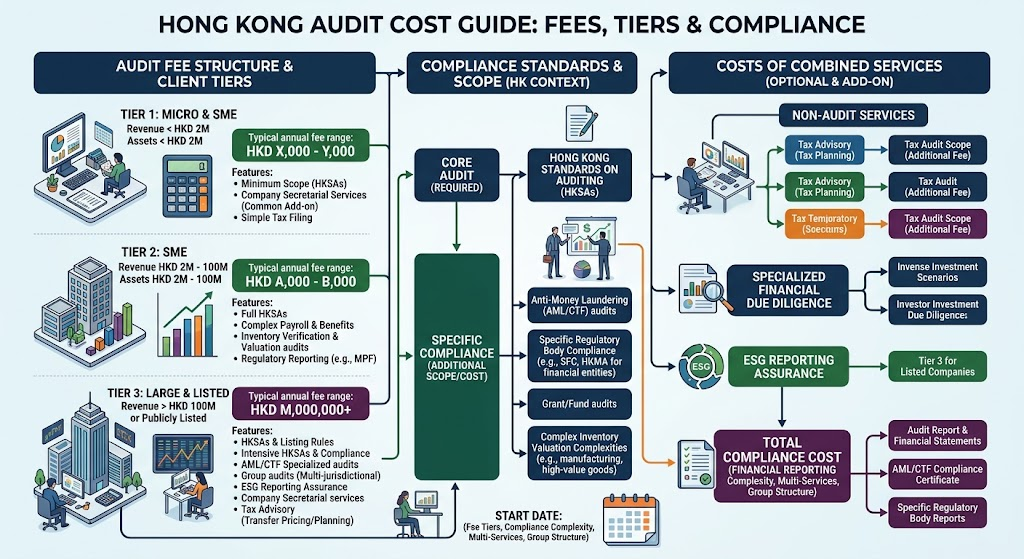
The Strategic Audit Framework: Beyond Superficial Price Indices
Statutory audit cost in Hong Kong averages between HKD 8,000 and HKD 35,000 for standard small-to-medium enterprises, reflecting an institutional risk index governed by the Hong Kong Companies Ordinance rather than an arbitrary administrative fee. Statutory audit value relies on direct technical transparency, statutory qualification, and audit trail defensibility rather than baseline price alone.
Under Section 429 of the Hong Kong Companies Ordinance (Cap. 622), every incorporated company must prepare financial statements audited by an independent certified public accountant holding a valid Practicing Certificate issued by the Hong Kong Institute of Certified Public Accountants and supervised by the Accounting and Financial Reporting Council. The resulting report informs the assessment of your Profits Tax Return BIR51 by the Hong Kong Inland Revenue Department.
“Statutory audit cost in Hong Kong is an institutional risk management metric governed by corporate law. Price alone cannot capture value; long-term corporate standing requires CPA qualification, defensible audit trails, and technical adherence to Hong Kong Financial Reporting Standards.”
— Senior Statutory Audit Director, Cross-Border Advisory Practice
Enterprise buyers evaluate audit service engagements along four technical dimensions:
- Direct Certified Public Accountant Sign-Off: Direct oversight from a Practicing CPA eliminates intermediary handoffs, communication gaps, and outsourced file reviews.
- Regulatory Ledger Defensibility: Compliance with Hong Kong Financial Reporting Standards ensures financial statements survive institutional desk reviews by tax inspectors and tier-1 banking compliance officers.
- Integrated Governance Execution: Unifying statutory audits with licensed Company Secretary Services prevents late statutory submissions and administrative misalignments.
- Fee Structure Transparency: Fixed pricing schedules prevent surprise surcharges for voucher reconciliations, courier fees, and supplemental schedules.
Primary Cost Determinants and Qualifying Fee Conditions
Auditors evaluate risk profiles, verification time, and accounting accuracy to determine corporate audit fees. Pricing remains fixed only when specific operational thresholds are met, and varies based on distinct financial patterns.
To establish upfront quotes, statutory auditors examine five foundational metrics:
- Annual Turnover and Revenue Velocity: Gross top-line receipts dictate the required statistical sample size for transaction testing and revenue recognition validation.
- Bank Account and Ledger Transaction Volume: Active accounts handling thousands of monthly micro-transactions require significantly more audit sampling than institutional holding companies handling ten annual dividend transfers.
- Cross-Border Operational Complexity: Holding structures involving overseas subsidiaries, offshore trade routing, or transfer pricing demand consolidated reviews and international compliance checks.
- Balance Sheet Composition: Complex asset allocations—such as specialized digital assets, unlisted investments, heavy inventories, or related-party loan accounts—require expanded substantive verification procedures.
- Bookkeeping and Documentation Readiness: Entities supplying reconciled management accounts, general ledgers, trial balances, and cross-referenced supporting invoices receive predictable fixed quotes. Conversely, incomplete ledgers require supplementary bookkeeping before statutory review can begin.
Professional practices use a standardized methodology to define engagement scopes and maintain fee transparency:
The Statutory Audit Scope Determination Method evaluates an entity’s pricing baseline by cross-referencing three core factors: the Operational Activity Quotient (bank lines, invoices, merchant accounts), the Jurisdictional Exposure Factor (single-market vs. cross-border trading structures), and the Ledger Cleanliness Ratio (balanced HKFRS schedules vs. raw source vouchers).
Securing fixed rates through our Transparent Pricing Schedules requires that all qualifying criteria are verified during initial onboarding diagnostics.
Turnover-Tiered Pricing Matrix: Active SMEs vs. Dormant Entities
Statutory audit pricing in Hong Kong scales with balance sheet exposure, asset classes, and transaction velocity. Formal dormancy requires limited review, whereas active commercial trading requires detailed audit sampling, counterparty balance confirmations, and rigorous compliance checks.
Standard statutory audit tiers for private limited enterprises break down as follows:
| Corporate Operational Scale | Annual Gross Revenue | Indicative Statutory Audit Fee (HKD) | Mandatory Scope & Applicable Conditions |
|---|---|---|---|
| Formal Dormant Status | HKD 0 (No transactions) | HKD 3,000 – HKD 5,000 | Requires passing a formal Special Resolution filed with the Companies Registry. Zero accounting transactions across all banking channels. |
| Early-Stage SME / Inactive HoldCo | Under HKD 1,000,000 | HKD 8,000 – HKD 12,000 | Maximum 2 bank accounts; fewer than 60 total ledger entries; reconciled management trial balance; straightforward asset structure. |
| Standard Active Enterprise | HKD 1,000,000 – HKD 5,000,000 | HKD 12,000 – HKD 22,000 | Standard commercial trading, e-commerce, or consultancy; complete double-entry bookkeeping; verifiable customer and vendor trade contracts. |
| Scaling Mid-Market Enterprise | HKD 5,000,000 – HKD 20,000,000 | HKD 22,000 – HKD 45,000 | Multi-currency bank operations; inventory counts or automated warehouse schedules; multiple overseas suppliers; structured payroll registers. |
| Complex Enterprise / Group Holding | HKD 20,000,000 – HKD 50,000,000+ | Custom Quotation (HKD 45,000+) | Consolidated multi-entity group accounts; complex cross-border transfer pricing; offshore profit claim substantiation; digital asset holdings. |
To avoid audit adjustments and unexpected surcharges, firms should ensure their management accounts match all supporting bank confirmations before external review. Comprehensive service structures are detailed on our Audit and Tax Filing Solutions page.
Empirical Corporate Compliance & Audit Execution Metrics
Statutory audits directly influence a company’s standing with regulators and commercial banks. Data from institutional filings highlights how ledger preparation and licensing standards shape audit success:
| Compliance & Execution Parameter | Direct Licensed TCSP Execution | Unaccredited Broker Channel |
|---|---|---|
| First-Pass Audit Documentation Clearance | 98.6% clean opinion acceptance | 61.4% (frequent qualified opinions) |
| Banking Partner Review Turnaround | 12 business days average | 45+ business days (extensive KYC inquiries) |
| Primary Rejection / Inquiry Triggers | Minor clerical adjustments (under 1.4%) | Opaque fee schedules; missing vouchers; sub-tier sign-offs |
| Unbudgeted Surcharges Post-Engagement | 0% (guaranteed fixed pricing) | 35% – 85% mid-engagement markups |
Complex Enterprise Scenarios: Cross-Border, Offshore Claims, and Digital Assets
Standard audit pricing models do not fit complex corporate holding structures. Multinational groups, digital commerce firms, and Web3 enterprises face distinct regulatory demands that require specialized statutory audit approaches.
Cross-Border Holding Architectures and Multi-Tier Subsidiaries
Hong Kong companies that control foreign subsidiaries or operate regional joint ventures must navigate complex group consolidation rules. Under HKFRS 10, auditors must examine the underlying assets, intercompany receivables, dividend flows, and management controls of all global subsidiaries.
Consolidated group statutory audits require standardized reporting packages across operating entities. Missing sub-tier accounting records can trigger qualified opinions that undermine corporate credit ratings and disrupt Corporate Bank Account Opening or maintenance processes.
Offshore Profits Tax Claims and Hong Kong’s FSIE Regime
Claiming a non-taxable offshore profits status requires extensive supporting documentation. Under Hong Kong’s Foreign Source Income Exemption (FSIE) regime, entities claiming tax exemptions on dividends, interest, or intellectual property income must prove genuine commercial substance in the jurisdiction.
Statutory auditors must verify this operational substance, confirming that central management, board oversight, and core revenue activities align with Inland Revenue Department guidelines. Compiling this substantiation portfolio generally adds HKD 15,000 to HKD 40,000 in professional advisory and auditing fees.
Web3 Operations and Digital Asset Substantiation
Digital asset enterprises face strict statutory accounting requirements. Under HKFRS standards, cryptocurrency balances and utility tokens must be classified as intangible assets or inventory based on business intent, rather than treated as fiat equivalents.
Auditors must independently confirm wallet balances across public blockchains, evaluate custodian controls, and reconcile high-volume smart contract events. As a result, baseline audit fees for operational digital asset entities typically start around HKD 35,000.
Direct TCSP Execution vs. Unaccredited Audit Broker Arbitrage
Budget corporate service providers often rely on hidden subcontracting networks. Unlicensed agencies lure clients with unrealistically low prices, only to outsource audit files to unvetted third parties. This dynamic introduces major legal, financial, and operational risks:
- Subcontracted Paper Audits: Third-party brokers frequently pass trial balances to external subcontractors without independent testing, often resulting in disclaimer opinions that draw IRD scrutiny.
- Qualified Audit Opinions: Incomplete audit trails can lead to qualified audit opinions. These red flags alert compliance desks at tier-1 banks, frequently triggering account reviews or service freezes.
- Hidden Surcharge Spirals: Initial low-cost quotes often escalate with unexpected add-on fees for bank confirmation letters, ledger adjusting entries, or basic tax return submissions.
Olesen Global operates under Trust or Company Service Provider License TC010076, coordinating corporate secretarial administration directly with licensed CPA execution. This direct operational approach provides clear institutional benefits:
- Zero Subcontracting Friction: Clients communicate directly with a dedicated compliance advisor who oversees the entire audit trail from ledger preparation to tax filing.
- End-to-End Regulatory Alignment: Synchronizing accounting schedules with statutory deadlines under our unified Accounting & Audit Services prevents cross-department delays.
- Predictable Fixed-Fee Governance: Direct execution eliminates intermediary markups, guaranteeing transparent, reliable pricing from the outset.
“Intermediaries that arbitrage statutory audit work across loose broker networks expose company directors to direct statutory liabilities under Cap. 622. Institutional compliance requires direct, licensed accountability.”
— Regulatory Compliance Practice Head, Olesen Global
Anti-Middleman Verification: Direct TCSP Validation Protocol
Hong Kong requires all professional corporate service firms to hold a formal Trust or Company Service Provider (TCSP) license under the Anti-Money Laundering and Counter-Terrorist Financing Ordinance (Cap. 615). Engaging unaccredited agents exposes your business to regulatory compliance risks and sudden administrative interruptions.
How to Verify Licensed Corporate Service Providers
Company directors can verify a service provider’s credentials directly with the Hong Kong Companies Registry by following these steps:
- Access the official Hong Kong Companies Registry TCSP Licensee Register.
- Enter the corporate service provider’s registered business name or license number. For example, Olesen Global operates under formal TCSP License TC010076.
- Confirm that the registry status shows active, licensed standing, and verify that the company’s registered address matches its stated operational office.
Common Warning Signs of Broker Arbitrage
To protect corporate assets, watch out for these three common industry pitfalls:
- Unlicensed Subcontracting Arbitrage: Intermediaries often present an impressive digital presence while secretly outsourcing casework to unvetted subcontractors, adding 50% to 100% in markups for basic communications.
- Unregistered Nominee Shell Addresses: Unlicensed agents frequently use transient virtual mailboxes instead of maintaining an active, compliant corporate office, risking administrative fines from the Companies Registry.
- Guaranteed Account Opening Claims: Brokers who claim guaranteed corporate bank approvals bypass essential compliance standards. In reality, account approvals depend entirely on bank risk assessments and defensible statutory accounts.
Statutory Milestones, Filing Deadlines, and Non-Compliance Penalties
Operating a Hong Kong entity requires strict adherence to statutory filing schedules. Under the Inland Revenue Ordinance (Cap. 112) and Companies Ordinance (Cap. 622), missed deadlines can trigger immediate administrative fines and legal sanctions.
Every private enterprise must navigate key statutory milestones:
- First Profits Tax Return (BIR51): The Inland Revenue Department issues the initial Profits Tax Return roughly 18 months after company incorporation. The entity must prepare and submit audited financial statements within 3 months of the issue date.
- Ongoing Annual Return Schedules: Companies must determine their financial year-end (commonly March 31 or December 31) and ensure statutory audits are completed before annual general meetings and tax return filing deadlines.
- Auditor Appointment Mandates: Under Section 429 of Cap. 622, company directors must formally appoint an independent Practicing CPA to examine corporate records and present audited statements to shareholders annually.
Failing to complete required statutory audits or submit timely tax filings leads to progressive statutory penalties:
| Default Category | Immediate Regulatory Action | Maximum Statutory Exposure |
|---|---|---|
| First Late Filing Default | HKD 1,200 fine under Section 80(2) | Issuance of formal compounding penalty notice |
| Second Default (Within 3 Years) | HKD 3,000 fine + arbitrary tax assessment | Forfeiture of allowable deductions and tax exemptions |
| Unresolved Non-Filing / Evasion | Magistrates’ Court Summons issued to Directors | HKD 50,000 fine, triple tax penalty, and custodial sentences |
Firms seeking corporate formation can review our Hong Kong Company Registration services to establish compliant corporate structures from day one.
Statutory Lifecycle & Compliance Roadmap
Statutory Roadmap
Inception & Formation
- Appointment & Form NNC1 Filing
- Significant Controllers Register (SCR) Set Up
Operations & Governance
- Board Resolutions & General Ledger Maintenance
- 15-Day Statutory Event Update Window
Anniversary Filings
- Annual Return (Form NAR1) to Companies Registry
- 42-Day Regulatory Submission Timeline
Audit & Tax Submission
- Profits Tax Return (BIR51) & Audited Statements
- Direct Practicing CPA Report Sign-Off
Frequently Asked Questions: Hong Kong Audit Costs and Standards
What is the difference between budget auditing brokers and direct licensed TCSP advisory services in Hong Kong?
Can a Hong Kong private company file profits tax returns without a certified audit report?
What primary factors determine the final audit cost for a Hong Kong business?
What documentation is required to secure a fixed audit fee quotation?
Initiate Your Hong Kong Statutory Audit Compliance Diagnostic
Meeting annual statutory audit requirements does not need to involve unpredictable pricing or compliance delays. With proper ledger preparation and direct licensed CPA coordination, your business can maintain clean regulatory standing and support ongoing banking relationships.
Our audit onboarding follows a transparent three-step process:
- Trial Balance Submission: Securely share your current management ledgers and bank transaction summaries for an initial statutory scope evaluation.
- Binding Fixed-Fee Quote: Receive a clear, transparent engagement proposal outlining exact turnaround schedules, specific HKFRS accounting parameters, and an assigned senior compliance manager.
- Direct Statutory Execution: Complete your annual statutory audit smoothly under direct TCSP governance, fully coordinated with your IRD tax filings.
Secure Direct Statutory Audit Coordination
Partner directly with licensed compliance specialists. Ensure transparent pricing, protect your corporate standing, and avoid intermediate broker markups.
Direct Execution (No Subcontracting)
Zero Hidden Fees
1-on-1 Dedicated Compliance Advisor