Table of Contents
Incorporating a company under the Hong Kong Companies Ordinance (Cap. 622) confers legal personality but zero proprietary commercial rights over the corporate name. Exclusive commercial monopolies over brand names, logos, and product identifiers require statutory registration under the Trade Marks Ordinance (Cap. 559) administered by the Intellectual Property Department (IPD). Conducting commercial transactions under an approved corporate name without trademark clearance exposes directors to statutory trademark infringement, High Court commercial injunctions, and common law passing off liabilities across Hong Kong, Mainland China, and international markets.
Definitive Statutory Scope: The Corporate Name Fallacy Versus Trademark Monopolies
One of the most catastrophic legal misapprehensions harbored by corporate founders and multinational executives is the assumption that official incorporation by the Hong Kong Companies Registry grants unchallengeable authority to use that corporate name in commercial trade. Under the laws of Hong Kong and comparative common law jurisdictions, the administrative grant of a Certificate of Incorporation merely establishes a legal person. It certifies that the company exists as a body corporate capable of entering into contracts, suing, and being sued under the Companies Ordinance (Cap. 622). It functions as an administrative identification tag, entirely divorced from proprietary intellectual property ownership.
In contrast, statutory trademark rights derive exclusively from the Trade Marks Ordinance (Cap. 559) and are adjudicated by the Intellectual Property Department (IPD). A registered trademark grants its proprietor an exclusive commercial monopoly over specified classes of goods and services within the territorial boundaries of Hong Kong. When an enterprise incorporates an entity via professional Hong Kong company registration and entity formation services, the Companies Registry only vets the proposed name against existing names currently appearing on the index of company names. The Registrar does not search the Trade Marks Register, nor does the Registrar assess whether the corporate title infringes upon pre-existing registered trademarks or common law brand goodwill.
Consequently, operating a commercial enterprise where your trading label matches your corporate title without obtaining independent trademark protection exposes the entity and its directors to immediate legal liabilities. Senior executives routinely find their enterprises served with cease-and-desist notifications, emergency High Court injunction applications, and claims for account of profits. Understanding the fundamental mechanics of a registered company name versus statutory trademark protection in Hong Kong represents the baseline governance duty for every company director seeking to commercialize goods, deliver cross-border services, or execute capital raises.
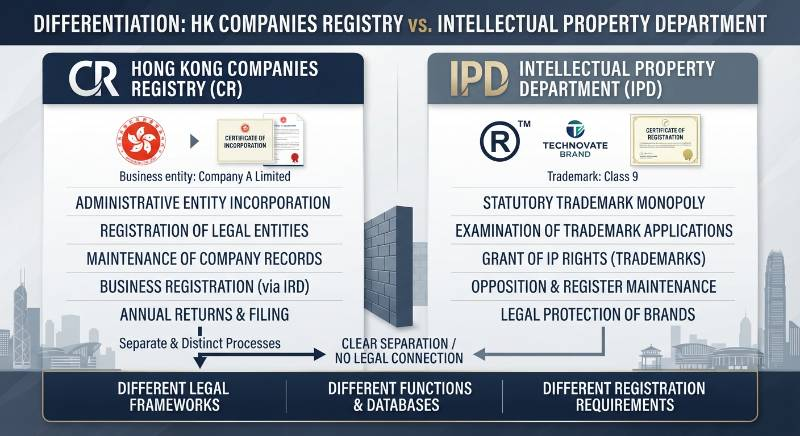
Statutory Registry Dichotomy: Companies Ordinance (Cap. 622) Versus Trade Marks Ordinance (Cap. 559)
The operational chasm between corporate entity registration and intellectual property prosecution stems from the divergent legislative mandates of the respective regulatory bodies. The Companies Registry operates under the Companies Ordinance (Cap. 622) with the primary mission of maintaining a transparent public registry of legal entities, securing corporate disclosure, facilitating commercial transactions, and enforcing statutory filings such as Annual Returns (NAR1) and Significant Controllers Registers (SCR). The Registrar evaluates name availability under Section 100 on narrow grounds: whether the name is identical to an existing company name, whether it constitutes a criminal offense to use it, or whether it contains restricted statutory terms such as “Trust”, “Chamber of Commerce”, or “Bank” without ministerial consent.
Conversely, the Trade Marks Registry operates within the Intellectual Property Department under the Trade Marks Ordinance (Cap. 559). The IPD evaluates applications through an adversarial examination framework based on absolute grounds for refusal (Section 11, focusing on distinctiveness, descriptiveness, and generic terms) and relative grounds for refusal (Section 12, focusing on identical or confusingly similar marks registered for identical or similar goods and services). Securing clearance in the Companies Registry provides no defense whatsoever against statutory infringement claims under Section 18 of Cap. 559. If an enterprise uses its corporate name as a trade mark or business sign on packaging, websites, digital advertising, or invoices, and that name conflicts with an existing registered trademark, the entity is prima facie liable for infringement.
| Legal Parameter | Companies Registry (Cap. 622) | Trade Marks Registry (Cap. 559) |
|---|---|---|
| Governing Entity | Registrar of Companies | Registrar of Trade Marks (IPD) |
| Statutory Objective | Establish legal personality & corporate capacity | Grant commercial exclusive monopoly rights |
| Examination Scope | Literal identity against current CR index | Distinctiveness, confusing similarity, class overlap |
| Infringement Defense | Incorporation certificate is NOT a legal defense | Full statutory monopoly & direct cause of action |
| Statutory Sanction | Name change direction (Section 108) | Injunctions, damages, delivery up, account of profits |
Furthermore, under Section 108 of the Companies Ordinance, if a company is registered with a name that is “too like” a name that should have appeared in the index, or if the name gives so misleading an indication of the nature of its activities as to be likely to cause harm to the public, the Registrar possesses the statutory power to direct the company to change its name within a specified period. When trademark owners uncover an entity incorporating their protected mark into its corporate title, they can initiate an administrative complaint to the Registrar under Section 108 or file an action in the High Court of Hong Kong seeking an interlocutory injunction under the common law tort of passing off. Maintaining proper corporate governance overseen by licensed statutory company secretary services ensures that corporate names are vetted against statutory conflict parameters before public filings occur.
Cross-Border Prosecution Architectures: Direct Regional Filings Versus the Madrid System
Intellectual property rights are strictly territorial. A trademark registered in Hong Kong under Cap. 559 provides zero statutory protection in Mainland China, Macau, the United States, or the European Union. Enterprising corporate groups expanding across the Greater Bay Area and Western markets must engineer cross-border brand prosecution architectures that balance operational velocity, cost structures, and legal vulnerability. The choice centers on direct national filings versus international extensions via the World Intellectual Property Organization (WIPO) Madrid System.
For cross-border commerce bridging Hong Kong and the mainland, businesses face two distinct legal systems within one sovereign state. The China National Intellectual Property Administration (CNIPA) operates under a rigid civil law “first-to-file” system governed by the PRC Trademark Law. Unlike Hong Kong, which recognizes common law rights through prior commercial use and passing off actions, Mainland China grants ownership almost exclusively to the entity that first secures filing receipt from CNIPA. Hong Kong entities operating production lines or supply chain fulfillment hubs across Guangdong must execute dedicated PRC trademark registration strategies for Hong Kong enterprises well before initiating commercial manufacturing or marketing campaigns.
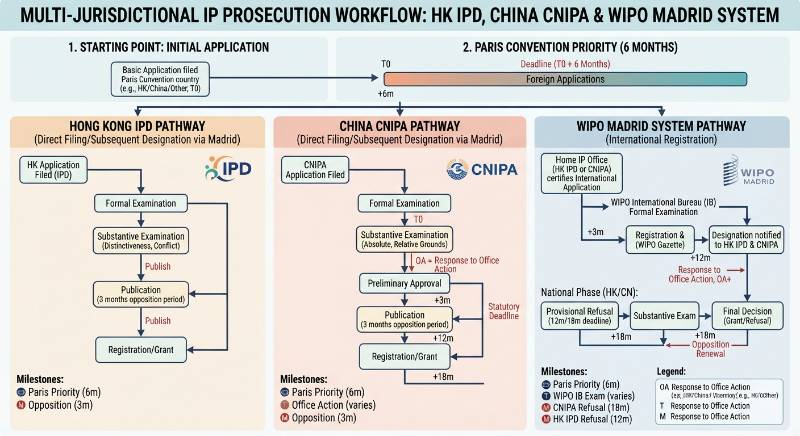
When expanding globally, corporate legal teams must navigate the critical tradeoffs between Madrid System versus direct national trademark prosecution. The Madrid Protocol allows an applicant with an existing basic application or registration in a contracting state to file a single international application through WIPO, designating over 130 member countries. While the Madrid Protocol offers administrative convenience and centralized renewal governance, it contains structural legal vulnerabilities that sophisticated corporate directors must weigh carefully:
- The Five-Year Dependency Rule (“Central Attack”): An international registration remains completely dependent on the basic home application or registration for five years from its registration date. If the home country application is rejected, withdrawn, or cancelled during this five-year window, all international designations collapse simultaneously. Transforming these into direct national filings involves crushing local legal fees and stringent statutory deadlines.
- Sub-Class Rigidity in China: CNIPA classifies goods and services into highly granular sub-classes based on its domestic Classification of Similar Goods and Services. Madrid applications designating China often suffer standard office actions or unresolvable refusals because broad Nice Classification descriptions fail to conform to CNIPA’s strict sub-class requirements. Direct national filing enables tailored specification drafting that maximizes protection across all critical sub-classes.
- Paris Convention Priority Deployment: Enterprises executing phased rollouts should leverage Article 4 of the Paris Convention. By filing a first application in Hong Kong, the applicant secures a 6-month international priority window to file corresponding applications across Mainland China, the US, or the EU, with the subsequent filings backdated to the initial Hong Kong filing date. This mechanism insulates the brand against predatory squatters while the corporate team finalizes foreign distributor and financing agreements.
Strategic Comparison: Trademark Protection Routes and Jurisdictional Protocols
Selecting the optimal trademark filing pathway requires analyzing legal risk tolerance, target commercial markets, budget allocations, and immediate enforcement needs. Direct prosecution through certified local agents provides structural resilience against centralized invalidation, while the Madrid System provides scalable administrative consolidation for mature brand portfolios managed by specialized IP counsel.
| Strategic Criterion | Hong Kong IPD (Direct) | China CNIPA (Direct) | Madrid Protocol (WIPO) |
|---|---|---|---|
| Governing Statute / Treaty | Trade Marks Ordinance (Cap. 559) | PRC Trademark Law | Madrid Protocol / WIPO Regulations |
| Filing Velocity & Issuance | 6 to 9 Months (Standard) | 9 to 12 Months (Examination fast-track) | 12 to 18 Months (Per territory) |
| First-to-Use vs. First-to-File | First-to-Use recognized (Common Law) | Strict First-to-File (Civil Law) | Governed by designated member laws |
| Vulnerability to Central Attack | Zero (Completely independent) | Zero (Completely independent) | Severe (5-year absolute dependency) |
| Sub-Class Precision | Broad class heading acceptance | Highly specialized CNIPA sub-classes | Frequently rejected by local examiners |
| Customs Border Recordation | Available via HK Customs (Cap. 559) | Full General Administration of Customs | Requires separate domestic conversion |
Engaging professional counsel through integrated global trademark registration and brand portfolio prosecution guarantees that multi-jurisdictional filings are audited against conflicting prior registrations, correct sub-class itemizations, and international treaty timelines before capital is committed.
Mitigating Bad-Faith Squatting, Shadow Companies, and Cross-Border Supply Chain Hijacking
Hong Kong’s reputation as a world-class financial center has historically led bad-faith actors to establish what regulatory authorities term “shadow companies.” These are entities incorporated in Hong Kong with names intentionally mimicking prominent international or domestic brand names. Unscrupulous operators use these corporate identities to issue fraudulent manufacturing authorizations, print deceptive packaging, and market counterfeit goods across Southeast Asia and Mainland China, claiming they are authorized by a “Hong Kong corporate headquarters.”
To dismantle shadow companies and rectify bad-faith squatting, intellectual property proprietors must execute coordinated legal measures spanning corporate registry rectification and intellectual property litigation. Where a shadow company incorporates your registered mark into its corporate title, the trademark holder can file a formal complaint with the Companies
Registry under Section 108 of the Companies Ordinance (Cap. 622) petitioning the Registrar of Companies to issue an administrative direction requiring the offending entity to change its name. The Registrar maintains statutory authority to direct a corporate name change if the registered name is “too like” a name appearing in the index of company names or if the name gives an impression that the company is connected with an established brand when no such relationship exists.
Administrative Rectification vs. Judicial Passing-Off Injunctions
Corporate legal counsel must evaluate whether to pursue an administrative remedy via the Companies Registry or immediate civil litigation in the High Court of the Hong Kong Special Administrative Region. While the administrative route under Section 108 of Cap. 622 presents a cost-effective procedural mechanism, strict statutory deadlines apply:
| Legal Vector | Statutory Basis | Statutory Limitation Window | Available Remedies |
|---|---|---|---|
| Companies Registry Administrative Objection | Companies Ordinance (Cap. 622) Section 108 | Within 12 months from the date of the offending company’s registration. | Registrar’s Direction to change name; replacement of name with corporate registration number if non-compliant. |
| High Court Intellectual Property Litigation | Trade Marks Ordinance (Cap. 559) & Common Law Tort of Passing Off | 6-year statutory limitation period under Limitation Ordinance (Cap. 347). | Interlocutory and permanent injunctions, mandatory company name change orders, delivery up/destruction of materials, damages, or account of profits. |
| Cross-Border Supply Chain Enforcement | Trade Descriptions Ordinance (Cap. 362) | 3 years from commission or 1 year from discovery by customs authorities. | Seizure of counterfeit goods at port of entry/exit, criminal prosecution of corporate officers, asset freezing. |
If the 12-month administrative limitation under Section 108 has lapsed, brand owners must commence High Court proceedings asserting common law passing off and, where applicable, statutory infringement under the Trade Marks Ordinance (Cap. 559). In Target Petroleum Inc. v. Target Petrochemical Co., Limited, the High Court confirmed that registering a corporate name confers no defense against an action for passing off. Upon securing a judicial declaration, the High Court issues an injunction directing the directors to convene a board meeting, execute a special resolution, and lodge Form NNC2 with the Companies Registry to effect an immediate name change.
Should the shadow company’s directors ignore the High Court order, the court can appoint a judicial master or registrar to sign the statutory corporate name change documents on behalf of the recalcitrant entity, while initiating civil contempt proceedings against the offending directors. This legal mechanism neutralizes bad-faith operators who attempt to evade service by relying on nominee corporate structures.
Cross-Border Border Enforcement: Intercepting Infringements via Hong Kong Customs and Excise
Hong Kong serves as one of the world’s premier logistics transshipment hubs. Consequently, cross-border intellectual property protection requires dynamic deployment of customs enforcement regimes. Corporate registry rectification addresses entity identity theft, but physical supply chain interdiction stops infringing goods from entering global transit channels.
Under the Trade Descriptions Ordinance (Cap. 362), the Hong Kong Customs and Excise Department (C&ED) possesses wide statutory powers to inspect, seize, and forfeit commercial goods bearing forged trademarks, false trade descriptions, or unauthorized corporate identifiers. To leverage C&ED’s interdiction capabilities, intellectual property proprietors must file an official Notice of Detention backed by certified copies of Hong Kong Trademark Registration Certificates issued by the Intellectual Property Department (IPD).
Strategic Synergy: Hong Kong C&ED and Mainland China Customs (GACC)
Multi-jurisdictional brand protection demands simultaneous customs recordal with General Administration of Customs of the People’s Republic of China (GACC) and the Hong Kong C&ED. Because shadow companies frequently commission manufacture in Guangdong Province before funneling goods through Hong Kong air and ocean ports for international distribution, dual-customs filing enables real-time interdiction on both sides of the border. When GACC intercepts outbound freight, cross-notified Hong Kong customs officers can execute asset freezes and statutory inspections on the consignee’s Hong Kong corporate registration address.
Senior Company Secretary & Auditor FAQ Vault
Does incorporating a Hong Kong limited company grant proprietary trademark rights?
No. Incorporating a limited company with the Companies Registry under the Companies Ordinance (Cap. 622) and obtaining a Business Registration Certificate from the Inland Revenue Department does not confer proprietary rights over that name as an intellectual property asset. Trademark protection is exclusively governed by the Trade Marks Registry under the Trade Marks Ordinance (Cap. 559). A registered company name provides no legal defense against a civil action for trademark infringement or common law passing off initiated by the owner of an earlier registered mark.
How can a trademark owner challenge a shadow company if the 12-month limit under Section 108 of Cap. 622 has passed?
Once the 12-month administrative objection window under Section 108 expires, the Registrar of Companies cannot issue an administrative name change direction on the grounds of “too like.” The trademark proprietor must initiate proceedings in the High Court of Hong Kong, claiming common law passing off and infringement under Section 18 of the Trade Marks Ordinance (Cap. 559). Upon prevailing, the court will issue an injunction requiring the entity to change its name. If the shadow company defaults on the order, the trademark owner may petition the Registrar to enforce Section 110 of Cap. 622, which substitutes the offending company name with its corporate registration number.
Can an overseas brand owner without a Hong Kong trademark registration successfully enjoin a local infringer?
Yes, through the common law tort of passing off, provided the foreign entity can establish the three essential limbs established in Reckitt & Colman Products Ltd v Borden Inc: (1) existing goodwill or reputation in Hong Kong, (2) a misrepresentation by the defendant leading or likely to lead the public to believe the goods or business are connected, and (3) actual or prospective damage. However, proving unregistered goodwill requires extensive evidentiary documentation of local business transactions, cross-border sales, or international advertising reaching Hong Kong consumers. Registering a Hong Kong trademark beforehand eliminates the burden of proving local goodwill and provides statutory exclusivity.
What corporate accounting and profits tax implications apply when holding global trademarks in a Hong Kong entity?
Where intellectual property assets are consolidated into a Hong Kong holding company to facilitate international licensing, corporate groups must comply with Hong Kong’s Foreign Sourced Income Exemption (FSIE) regime under the Inland Revenue Ordinance (Cap. 112). Intellectual property income (e.g., cross-border royalties) is subject to the modified nexus approach: tax exemption on foreign IP income is tied to qualifying research and development (R&D) expenditures incurred in Hong Kong. All licensing agreements, arm’s-length royalty fee structures, and related-party transfers must satisfy Section 50AAF transfer pricing documentation mandates and pass annual Certified Public Accountant (CPA) statutory audits.
How does the Significant Controllers Register (SCR) assist in exposing bad-faith trademark squatters?
Under Part 12, Division 2A of the Companies Ordinance (Cap. 622), every Hong Kong company must maintain a Significant Controllers Register (SCR) identifying individuals who ultimately hold more than 25% ownership or voting rights, or exercise significant influence over the company. Although the SCR is not publicly searchable, designated law enforcement and regulatory authorities—including the Companies Registry, Police, and Customs & Excise—can inspect it upon demand. In trademark litigation involving bad-faith squatters utilizing corporate nominee directors, High Court discovery applications (such as Norwich Pharmacal orders) can compel TCSP license holders and company secretaries to reveal the true ultimate beneficial controllers, piercing the nominee shield.
What happens to a corporate bank account when an entity is subjected to a statutory company name rectification order?
Authorized institutions (banks) governed by the Hong Kong Monetary Authority (HKMA) conduct continuous Know-Your-Customer (KYC) monitoring. When the Registrar of Companies strikes an infringing corporate name and replaces it with a registration number under Section 110, or when the High Court issues an injunction against the company’s trading identity, commercial banks typically freeze incoming and outgoing transactions on risk-management grounds. To normalize commercial banking operations, the entity must present a certified amended Certificate of Incorporation, revised Business Registration Certificate, and formal corporate resolutions demonstrating compliance with statutory directives.
Consult with Olesen Global’s Licensed Corporate Specialists
Backed by Hong Kong TCSP License TS010076, practicing company secretaries, and certified CPA auditors.