Statutory Framework & Core Directives
Cross-border corporate structuring across Hong Kong, the British Virgin Islands (BVI), and the Cayman Islands is governed by the Hong Kong Companies Ordinance (Cap. 622), Inland Revenue Ordinance (Cap. 112), and international Economic Substance standards. Structuring an intermediary holding layer requires verifiable commercial substance under the Hong Kong Foreign-Sourced Income Exemption (FSIE) regime and State Taxation Administration (STA) Public Notice [2018] No. 9 to secure treaty dividend withholding concessions at 5%. Operating through a Hong Kong licensed Trust or Company Service Provider (TCSP License TS010076) guarantees direct compliance with Significant Controllers Register mandates and mandatory certified CPA statutory annual audits.
Architectural Nexus: Statutory Scope and Multi-Jurisdictional Alignment
Modern cross-border enterprise architecture relies on multi-tiered corporate configurations that segment risk, streamline capital injections, and enable global expansion. The benchmark blueprint for enterprises expanding out of or into the Asia-Pacific region integrates an ultimate parent company in the Cayman Islands, an intermediate special purpose vehicle (SPV) incorporated in the British Virgin Islands, an operational holding hub organized in Hong Kong, and direct operating subsidiaries such as Wholly Foreign-Owned Enterprises (WFOEs) in Mainland China. Executing this blueprint requires a granular comparative structural analysis of Hong Kong vs BVI holding vehicles to ensure each corporate tier withstands rigorous statutory review.
Every tier within this corporate chain fulfills an explicit statutory and economic function. The Cayman Islands exempted company provides the institutional governance architecture favored by Tier-1 venture capital funds and public stock exchanges, including HKEX, NASDAQ, and the NYSE. Directly beneath this, the BVI business company serves as an asset-containment and transactional vehicle, isolating operational liabilities, facilitating flexible joint venture equity splits, and enabling rapid corporate reorganizations under the BVI Business Companies Act without public disclosure of ownership records. However, deploying an offshore island entity directly above a Mainland Chinese operating company triggers severe regulatory and fiscal penalties under current anti-avoidance statutes.

The Hong Kong private limited company acts as the essential common-law bridge. Functioning under the Companies Ordinance (Cap. 622), a Hong Kong entity possesses recognized civil legal personality, transparent public registry documentation, and direct access to comprehensive bilateral tax agreements. When structured through licensed Hong Kong Company Incorporation protocols, the Hong Kong holding vehicle ceases to be a passive conduit and transforms into an operational command center. This structural legitimacy is indispensable for clearing commercial bank compliance screening and securing preferential cross-border withholding tax treatments.
Macro Regulatory Frameworks: Cap. 622, BVI BOSS Act, and Cayman DITC Governance
Cross-border corporate groups must satisfy three distinct corporate and anti-money laundering (AML) regulatory regimes simultaneously. In Hong Kong, corporate administration is anchored by the Companies Ordinance (Cap. 622) and the Anti-Money Laundering and Counter-Terrorist Financing Ordinance (Cap. 615). Cap. 615 mandates that trust or company service providers must operate under formal licenses issued by the Companies Registry. Under Olesen Global’s licensed direct administration (TCSP License TS010076), Hong Kong companies must maintain an accurate Significant Controllers Register (SCR) at their registered office or designated location, accessible to law enforcement officers upon statutory demand. The SCR requires continuous identification, verification, and recording of individuals or legal entities exerting more than 25% ownership or significant ultimate control.
Simultaneously, intermediate offshore tiers are governed by evolving automatic tax information exchange and beneficial ownership statutes. BVI business companies operate under the Beneficial Ownership Secure Search System Act (BOSS Act), requiring registered agents to enter beneficial ownership intelligence into a confidential government search system. Concurrently, the BVI Economic Substance (Companies and Limited Partnerships) Act mandates that entities conducting relevant activities—including pure equity holding, fund management, and IP holding—must file annual economic substance declarations. Failing to satisfy substance rules or report via the registered agent triggers punitive progressive fines, involuntary striking-off, and cross-border regulatory reporting to foreign competent authorities.
In the Cayman Islands, governance falls under the International Tax Cooperation (Economic Substance) Act and oversight by the Department of International Tax Cooperation (DITC). Every Cayman entity must complete an annual Economic Substance Notification (ESN) as a statutory prerequisite to filing its Annual Return. Furthermore, relevant entities engaging in non-exempt activities must complete comprehensive economic substance reporting via the Cayman DITC Portal, documenting the presence of qualified personnel, expenditure within the islands, and local direction. Aligning multi-jurisdictional reporting necessitates professional corporate oversight through verified Statutory Company Secretary Services to eliminate reporting contradictions between the Hong Kong Companies Registry, the BVI Registry of Corporate Affairs, and the Cayman General Registry.
Structural Selection Matrix: Hong Kong HoldCo, BVI SPV, and Cayman TopCo
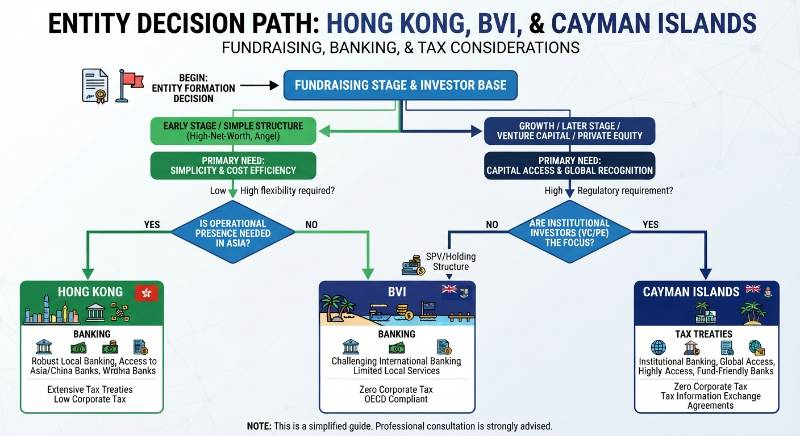
Selecting the appropriate entity archetype requires cross-referencing institutional investor preferences, tax treaties, regulatory compliance burdens, and capital costs. Structuring a venture-backed enterprise requires precision, as demonstrated in specialized models for venture capital offshore structuring via Cayman SPV and Hong Kong entities. The matrix below defines the legal, regulatory, and operational characteristics of the primary cross-border entities.
| Comparative Dimension | Hong Kong Private Limited Company (Cap. 622) | British Virgin Islands Business Company (BCA) | Cayman Islands Exempted Company (Companies Act) |
|---|---|---|---|
| Statutory Access & Legal Capacity | Onshore common-law entity with comprehensive commercial capacity. Governed strictly by Companies Ordinance (Cap. 622). Requires at least 1 natural person director. Corporate directors permitted only under limited non-group structures. | Offshore corporate body governed by BVI Business Companies Act (as amended). Corporate directors permitted. Extreme constitutional flexibility regarding memorandum and articles of association. | Offshore exempted body corporate under Cayman Companies Act. Highly adaptable share capital structures, multiple share classes, preferred voting, and institutional governance mechanisms. |
| Incorporation Timeline & Capital Rules | 1 to 2 business days via Companies Registry e-Registry. No mandatory minimum paid-up capital (standard: HKD 10,000 divided into 10,000 ordinary shares). Capital can be denominated in any major currency. | 1 to 3 business days through registered agent. Standard authorized capital is 50,000 shares of no par value or USD 1.00 par value. No capital duty on incorporation up to 50,000 shares. | 3 to 5 business days (expedited 24-hour service available). Standard registered capital is USD 50,000 divided into 50,000 shares of USD 1.00. Government incorporation fee tiers correlate with authorized capital. |
| Corporate Secretarial & Physical Nexus | Mandatory licensed Company Secretary residing in HK or holding a TCSP License (Cap. 615, e.g., Olesen Global TS010076). Must maintain a physical Hong Kong registered office address; post office boxes are strictly invalid. | Mandatory licensed Class I–IV Registered Agent located within the BVI territory. Must maintain a physical registered office address supplied by the licensed resident agent. | Mandatory licensed Registered Office Provider established in the Cayman Islands. Corporate secretarial administration handled through the resident licensed agent. |
| Annual Accounting & Audit Mandates | Mandatory annual statutory audit performed by independent Hong Kong Certified Public Accountants (practicing CPAs). Must submit audited financial statements and Profits Tax Return (BIR51) to the Inland Revenue Department. | Mandatory filing of the BVI Annual Financial Return (AFR) with the Registered Agent within 9 months of financial year-end. No public filing, and statutory independent audit is not required unless regulated. | No statutory annual audit requirement for non-regulated holding entities. Must maintain books of account confirming transactions for a minimum rolling period of 5 years. Regulated funds subject to CIMA audit. |
| Commercial Bank Onboarding Feasibility | Highest institutional viability across Tier-1 global institutions (HSBC, Standard Chartered, Bank of China). Full bilateral transparency and robust regulatory recognition ease compliance clearance. | Challenging standalone viability. Most global commercial banks decline standalone BVI operating accounts without a substantive operating parent or substantial local trading infrastructure. | Moderate to low for daily commercial transaction banking. Ideal for institutional custody, venture capital capital-call facilities, and private bank escrow structures. |
| Double Tax Agreements & Withholding Access | Direct access to 45+ bilateral Double Taxation Agreements (DTAs), notably the Mainland-HK Comprehensive Avoidance of Double Taxation Arrangement (CDTA). Direct access to 5% dividend withholding tax rate. | Zero double taxation treaties with commercial trading powers. Standard non-treaty withholding tax applies on remittances from source countries (e.g., standard 10% PRC dividend withholding tax). | Zero commercial DTAs providing preferential dividend or royalty withholding reductions. Subject to full statutory non-treaty foreign withholding tax rates. |
| Economic Substance Burden & Enforcement | Governed by the FSIE regime. Pure Equity Holding Entities (PEHE) enjoy reduced substance requirements (monitoring shareholdings, statutory filing compliance, adequate local HK secretarial administration). | Governed by the Economic Substance Act. Pure equity holding entities face reduced compliance, but mandatory reporting via the BOSS system is strictly enforced with financial penalties. | Governed by the International Tax Cooperation Act. Pure equity holding companies face modified reporting via the DITC portal. Strict penalties for non-filing, including entity dissolution. |
Corporate planners and executive boards must identify the structural intersection between investor equity requirements and bottom-line operational cash flow. While the Cayman-BVI chain provides capital formation mechanics for initial public offerings, the Hong Kong intermediate company provides the commercial interface required to interact with sovereign tax authorities, secure debt financing, and open bank accounts.
Capital Mobilization and Commercial Banking Underwriting Protocols
The operational success of a multi-tiered corporate structure depends on clearing compliance screening at tier-1 commercial banking institutions. Over the past decade, financial institutions operating under Hong Kong Monetary Authority (HKMA) oversight have instituted stringent Customer Due Diligence (CDD) and Know Your Customer (KYC) requirements. Opening corporate bank accounts for offshore holding vehicles requires proving the legitimacy of funds, ultimate beneficial ownership, and commercial rationale. Navigating these requirements demands a deliberate roadmap for commercial bank account opening for Hong Kong holding structures.
When underwriting multi-jurisdictional corporate groups, compliance officers evaluate the source of wealth (SoW) and source of funds (SoF) across the entire group. In cross-border investments involving Mainland Chinese assets, commercial banks require confirmation of cross-border regulatory compliance. This includes State Administration of Foreign Exchange (SAFE) Circular 37 registration for individual domestic founders, or Circular 592/Circular 3 registration (ODI protocols) for corporate outbound investors. Lacking these regulatory approvals signals capital flight risk to compliance teams, triggering immediate rejection of the bank account application.
To secure account approvals across institutional lenders like HSBC, Standard Chartered, Bank of East Asia, or OCBC, groups must present a documented commercial nexus through professional Commercial Bank Account Opening services. Financial institutions will not onboard paper entities with vague business models. Underwriting teams demand:
- Fully executed cross-border contracts, intra-group service agreements, or formal equity purchase agreements.
- Documented identity verification for all ultimate beneficial owners (UBOs) holding 10% or more, certified in compliance with TCSP statutory standards.
- Bank reference letters and six months of historical corporate account statements from affiliated operating companies.
- A board-approved summary detailing anticipated cross-border transaction volumes, counterparty profiles, and initial deposit proofs.
Tax Optimization, FSIE Regimes, and CDTA Withholding Tax Mechanics
Cross-border corporate groups must actively manage tax optimization and treaty compliance. Hong Kong enforces a territorial system of taxation alongside the Foreign-Sourced Income Exemption (FSIE) regime under the Inland Revenue (Amendment) (Taxation on Specified Foreign-sourced Income) Ordinance. The FSIE regime scrutinizes four types of foreign-sourced income received in Hong Kong: dividends, interest, disposal gains on equity interests, and intellectual property income. Meeting these compliance requirements requires adherence to the Hong Kong Foreign Source Income Exemption economic substance rules.
Under the FSIE architecture, an entity classified as a Pure Equity Holding Entity (PEHE)—whose primary function is acquiring and holding equity stakes in other entities—is subject to a reduced economic substance requirement. A PEHE does not need to maintain extensive technical operations in Hong Kong. It satisfies statutory substance thresholds if it complies with all statutory registration and filing requirements under Cap. 622, ensures board resolutions are documented locally, and maintains adequate human resources and premises in Hong Kong. Working with a licensed corporate secretary fulfills these economic substance criteria. However, if the entity engages in intra-group financing, trading, or intellectual property licensing, it is classified as a Non-PEHE, triggering higher local operational spending and staff thresholds.
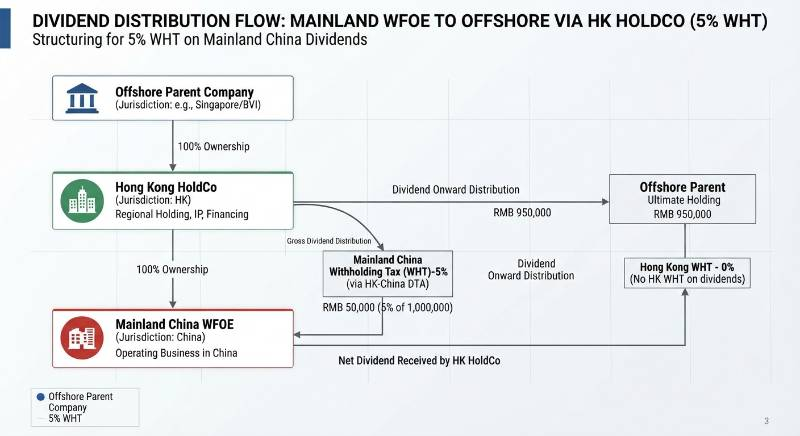
The primary advantage of routing cross-border holding structures through Hong Kong is access to the Comprehensive Double Taxation Arrangement (CDTA) between the Mainland and Hong Kong. Remitting dividends from a Mainland Chinese subsidiary directly to a BVI or Cayman entity triggers a standard 10% non-treaty withholding tax under Mainland Enterprise Income Tax (EIT) law. Distributing profits through a verified Hong Kong holding company slashes this withholding liability to 5%. Securing this benefit requires active governance to satisfy requirements for securing 5 percent dividend withholding tax under the Mainland-Hong Kong CDTA.
To qualify for the 5% preferential dividend withholding tax rate, the Hong Kong holding vehicle must satisfy two administrative and legal tests:
- Certificate of Resident Status (CoR): The Hong Kong entity must obtain an official CoR issued by the Inland Revenue Department (IRD). The IRD will only issue this certificate if the company proves management and commercial substance within Hong Kong, rather than functioning as a paper intermediary.
- Beneficial Ownership Doctrine under STA Bulletin [2018] No. 9: The Mainland State Taxation Administration enforces strict anti-treaty shopping rules. Under Bulletin 9, the Hong Kong holding vehicle must qualify as the Beneficial Owner of the underlying dividend distributions. The entity cannot serve as a conduit company that funnels 60% or more of received profits to third-country residents within 12 months. It must maintain dedicated senior management, directorship oversight, authentic operational accounts, and verifiable commercial risk absorption.
Corporate groups managing intellectual property should also protect their corporate identities across border checkpoints through direct Global Trademark & Intellectual Property filings, safeguarding their brand equity across major Asian jurisdictions.
Enterprise Multi-Tier Compliance Checklist and Governance Pitfalls
Operating a multi-jurisdictional corporate architecture demands consistent compliance across all entity tiers. Neglecting statutory deadlines exposes officers to director disqualification, civil financial penalties, and involuntary administrative strike-offs. In Hong Kong, private limited companies must meet annual compliance obligations, including mandatory Certified CPA Audit & Tax Compliance reviews. These annual audits are statutory prerequisites for submitting the Profits Tax Return (BIR51) and obtaining a Certificate of Resident Status from the IRD.
Corporate leadership must integrate regular governance reviews into their operating calendars to ensure each corporate entity remains fully compliant with statutory mandates:
- Hong Kong Annual Return (Form NAR1): Executed and delivered to the Companies Registry within 42 days of the anniversary of incorporation under Cap. 622.
- Business Registration Certificate (BRC) Renewal: Validated annually or triennially with the Inland Revenue Department Business Registration Office.
- CPA Statutory Financial Audit: Completed annually by an independent Hong Kong Certified Public Accountant to support the BIR51 tax return.
- Significant Controllers Register (SCR) Real-Time Maintenance: Monitored continuously by the licensed TCSP Company Secretary, noting any change in ownership within 7 business days.
- BVI Annual Financial Return (AFR): Lodged with the local BVI registered agent within 9 months following the fiscal year close.
- BVI & Cayman Economic Substance Returns: Documented and filed annually through registered agents to verify relevant activities and substance classifications.
- Mainland China Annual AIC/SAMR Reporting: Completed by June 30 for operating WFOEs, reconciling outbound dividends and cross-border currency files.
- Permanent Establishment (PE) Risk Elimination: Ensuring offshore holding directors do not enter contracts or conduct operations within jurisdictions that trigger unintended corporate tax liabilities.
For an exhaustive breakdown of statutory secretarial duties, review our compliance blueprint on statutory company secretary and certified CPA audit compliance.
Senior Corporate Secretary and Statutory Auditor Practical FAQ Vault
Why insert a Hong Kong holding company between a BVI/Cayman SPV and a Mainland China operating WFOE?
Interposing a Hong Kong private limited company between an offshore top-tier entity (BVI or Cayman Islands) and an onshore operating subsidiary (such as a Mainland China Wholly Foreign-Owned Enterprise, or WFOE) delivers decisive tax, legal, and operational advantages:
- Withholding Tax Mitigation under the Double Tax Arrangement (DTA): Under the Mainland China-Hong Kong Comprehensive Double Taxation Arrangement, qualified Hong Kong tax residents holding at least 25% equity in a Mainland subsidiary can reduce dividend withholding tax from the standard statutory rate of 10% down to 5%, subject to obtaining a Hong Kong Resident Certificate (CoR) and fulfilling the State Taxation Administration’s “Beneficial Owner” (Circular 9) substance tests. Pure offshore entities in the BVI or Cayman Islands do not enjoy bilateral tax treaty benefits with Mainland China.
- Document Legalization and Regulatory Expediency: China’s State Administration for Market Regulation (SAMR) requires legal certification of foreign investor identity documents. Hong Kong legalizations are executed swiftly and cost-effectively through a China Appointed Attesting Officer (CAAO), whereas offshore documents from the Cayman Islands or BVI require multi-tier legalizations, consular certifications, or apostille protocols that take significantly longer and cost considerably more.
- Commercial Banking Interface: Tier-one commercial and private banks consistently scrutinize direct BVI-to-China investment flows due to heightened anti-money laundering (AML) and anti-tax avoidance protocols. An intermediate Hong Kong operating or holding vehicle functions as an onshore financial bridge with audited financial transparency, vastly streamlining corporate banking operations and capital account repatriation.
How do offshore Economic Substance Regulations (ESR) interact with Hong Kong’s Foreign Sourced Income Exemption (FSIE) regime?
Both jurisdictions have instituted rigorous substance compliance mandates driven by the OECD Forum on Harmful Tax Practices (FHTP) and EU Code of Conduct Group, but they apply at different operational stages of the structure:
- BVI and Cayman ESR (Entity Level Substance): If an offshore SPV engages in “holding company business” (pure equity holding entity) or “financing and leasing business,” it must comply with statutory substance tests. Pure equity holding entities (PEHEs) face reduced substance requirements (e.g., maintaining registered agents, paying annual fees, and ensuring all statutory board minutes and filings are retained). Operating entities, however, must demonstrate adequate local physical presence, qualified personnel, and operational expenditure within the jurisdiction.
- Hong Kong FSIE Regime (Income Exemption Substance): Under Hong Kong’s modernized FSIE regime (Inland Revenue Ordinance Cap. 112), offshore dividends, equity disposal gains, interest, and intellectual property proceeds received in Hong Kong by a multinational enterprise (MNE) entity are deemed taxable unless specific economic substance requirements are satisfied. Pure equity holding companies in Hong Kong satisfy substance requirements by meeting statutory human resource and operational spending thresholds in Hong Kong, managed under board oversight.
Structures must be modeled collaboratively across both levels to prevent triggering dual non-compliance liabilities or unintended corporate income tax exposure.
Can an offshore BVI or Cayman entity open a corporate bank account directly in Hong Kong without a Hong Kong intermediary company?
While legally permissible under the Hong Kong Banking Ordinance, commercial bank account opening for standalone BVI or Cayman standalone entities without local operational nexus has become exceptionally restrictive across licensed Hong Kong financial institutions. Tier-one corporate banks routinely reject pure offshore vehicle account applications unless:
- The offshore vehicle forms part of an institutional private equity, venture capital, or publicly listed conglomerate with substantial assets under management; or
- The offshore company registers in Hong Kong as a registered non-Hong Kong company under Part 16 of the Companies Ordinance (Cap. 622), obtains an Inland Revenue Department Business Registration Certificate, and demonstrates verifiable administrative presence in the territory.
Establishing a Hong Kong private limited company directly beneath the offshore vehicle resolves this operational bottleneck, allowing groups to access local multicurrency clearing accounts and corporate treasury services smoothly.
What recurring statutory filings are required annually across both Hong Kong and Cayman/BVI entities to preserve Good Standing?
Cross-border architectures require strict adherence to multi-jurisdictional annual statutory compliance calendars:
- Hong Kong Tier:
- Annual Return (Form NAR1) lodged with the Companies Registry within 42 days of the company’s incorporation anniversary.
- Renewal of the Business Registration Certificate (BRC) with the Business Registration Office.
- Preparation and filing of statutory audited financial statements signed by a Hong Kong Certified Public Accountant (Practicing) together with the Profits Tax Return (BIR51) to the Inland Revenue Department.
- Maintenance and continuous updating of the statutory Significant Controllers Register (SCR) and designated representative mandate under Cap. 622.
- BVI and Cayman Tier:
- Annual government fee payments to preserve the Certificate of Good Standing.
- Filing of annual economic substance notifications and economic substance returns via the registered agent.
- For BVI companies: Annual Financial Return (AFR) balance sheet and income statement submission to the registered agent within 9 months of the fiscal year-end, along with continuous maintenance of the private Register of Directors and Beneficial Ownership register.
- For Cayman companies: Annual Return and statutory declaration filed with the Cayman Registrar of Companies every January.
Failure to satisfy statutory deadlines risks administrative strike-off, asset freezing, and statutory fines across all active jurisdictions.
How do transparency mandates like Hong Kong’s SCR align with the BVI BOSS system and Cayman Beneficial Ownership registers?
All three jurisdictions enforce strict transparency frameworks tracking ultimate beneficial ownership (UBO) controlling over 25% of voting rights, share capital, or board appointment authority:
- Hong Kong SCR: Under Part 12 of Cap. 622, every private company must maintain a Significant Controllers Register at its registered office or a designated place, identifying registrable persons and legal entities. The register is non-public but must be open to inspection by authorized law enforcement officers (e.g., Companies Registry, Inland Revenue Department, Hong Kong Police).
- BVI BOSS Act: The Beneficial Ownership Secure Search System mandates that registered agents record ultimate UBO information on an encrypted government search platform accessible solely by competent regulatory authorities, maintaining confidentiality from public registries.
- Cayman Islands Beneficial Ownership Regime: In-scope companies must establish and maintain a beneficial ownership register at their registered office, submitted periodically to the competent authority’s search engine platform. Under updated legislative frameworks, access remains regulated while balancing global anti-money laundering exchange conventions.
Corporate secretarial teams must ensure ultimate holding disclosures are verified across all tiers to prevent statutory discrepancies during routine compliance inspections.
What stamp duty obligations arise when transferring Hong Kong company shares into an offshore holding structure?
Transferring shares of a Hong Kong private company to a newly established BVI or Cayman vehicle triggers Hong Kong ad valorem stamp duty under the Stamp Duty Ordinance (Cap. 117):
- Statutory Rate: The current ad valorem stamp duty rate is 0.1% on each of the bought and sold notes (totaling 0.2% aggregated) applied to the higher of the transaction consideration or the net asset value (NAV) of the underlying Hong Kong company.
- Valuation Evidence: The Stamp Office requires submission of the latest audited financial statements, recent management accounts, and property valuation certificates (if the company holds real estate) to substantiate fair market value.
- Section 45 Relief for Associated Bodies Corporate: If the transfer occurs between associated companies where one entity owns at least 90% of the issued share capital of the other, or a common third parent owns at least 90% of both, the restructuring group may apply for formal stamp duty relief under Section 45 of Cap. 117. Crucially, strict anti-avoidance clawback conditions apply if the structural association ceases within two years from the transfer date.
Consult with Olesen Global’s Licensed Corporate Specialists
Backed by Hong Kong TCSP License TS010076, practicing company secretaries, and certified CPA auditors.