Hong Kong Salaries Tax vs Profits Tax: The Ultimate 2026 Optimization Guide
For international founders, remote business owners, and foreign directors, navigating the tax framework of Hong Kong can yield significant financial advantages. The region’s low-tax environment is highly attractive, but maximizing your net returns requires a clear understanding of how personal and corporate incomes interact. This guide breaks down the structural differences between these two tax pillars to help you structure your earnings efficiently.
The Core Comparison: Rates, Forms, and Deadlines
Hong Kong taxes income based on its source and nature rather than global residency. This approach is governed by the Inland Revenue Department (Hong Kong), which administers separate taxes for employment and business operations.
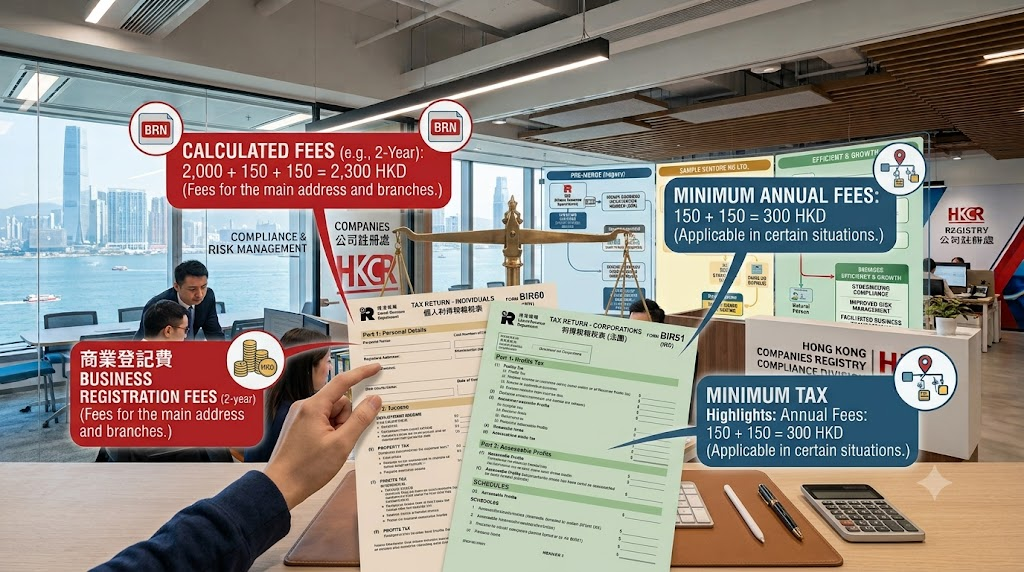
Salaries Tax is levied on income arising in or derived from Hong Kong from any office, employment, or pension. Conversely, Profits Tax is charged on every person (including corporations, partnerships, and sole proprietorships) carrying on a trade, profession, or business in Hong Kong on their assessable profits.
Understanding how these systems differ in rates, forms, and filing timelines is essential for maintaining compliance while managing your tax liabilities effectively.
Primary Tax Return Form
Standard Filing Deadline
Primary Allowable Deductions
Dividends Tax Treatment
| Feature | Salaries Tax | Profits Tax (Corporations) |
|---|---|---|
| Progressive (2% to 17%) or a standard flat rate of 15%. | Two-tiered: 8.25% on the first HKD 2M; 16.5% on the remainder. | |
| BIR60 individual tax return | BIR51 profits tax return | |
| Within 1 month from the date of issue (typically issued in May). | Within 1 month from the date of issue (typically issued in April). Extensions are available based on accounting year-ends. | |
| Outgoings and expenses wholly, exclusively, and necessarily incurred in producing income; personal allowances. | All outgoings and expenses incurred in the production of assessable profits; capital allowances. | |
| Not applicable (exempt from tax). | Exempt from tax when distributed to shareholders. |
The two-tiered profits tax rates system designed by the government significantly lowers the tax burden for small and medium-sized enterprises (SMEs). By taxing the first HKD 2,000,000 of corporate profits at just 8.25%, Hong Kong remains one of the most competitive business hubs globally.
For individuals, the Inland Revenue Department IRD calculates liabilities using both progressive rates and a standard flat rate, automatically applying the lower option to ensure taxpayers benefit from the most favorable calculation.
Solving the ‘Director’s Dilemma’: Salary vs. Dividend Distributions
For corporate founders and foreign directors, determining how to extract profits from a Hong Kong entity is a key decision. This challenge, known as the “Director’s Dilemma,” involves balancing salaries against dividend distributions to optimize tax efficiency.
To analyze this, we utilize The HK Corporate-Individual Tax Velocity Framework. This methodology assesses the combined tax impact of corporate profits tax and personal salaries tax to maximize your overall net returns.
“Many international founders mistakenly believe that paying themselves a high salary is always the most tax-efficient route because it reduces corporate taxable income. However, once your personal income crosses key progressive tax brackets, it is often more advantageous to utilize Hong Kong’s tax-free dividend policy.”
— Alan Wong, Senior Tax Strategist at Olesen Global
Let’s examine the mechanics of both approaches:
- The Salary Route: Salary paid to a director is a fully deductible business expense for the company under Inland Revenue Department guidelines. This reduces the company’s assessable profits. However, the recipient must pay personal salaries tax on this income.
- The Dividend Route: Dividends are paid out of post-tax corporate profits. While the company cannot deduct dividend payments, Hong Kong does not levy any withholding tax on dividends, nor are they taxable in the hands of the recipient.
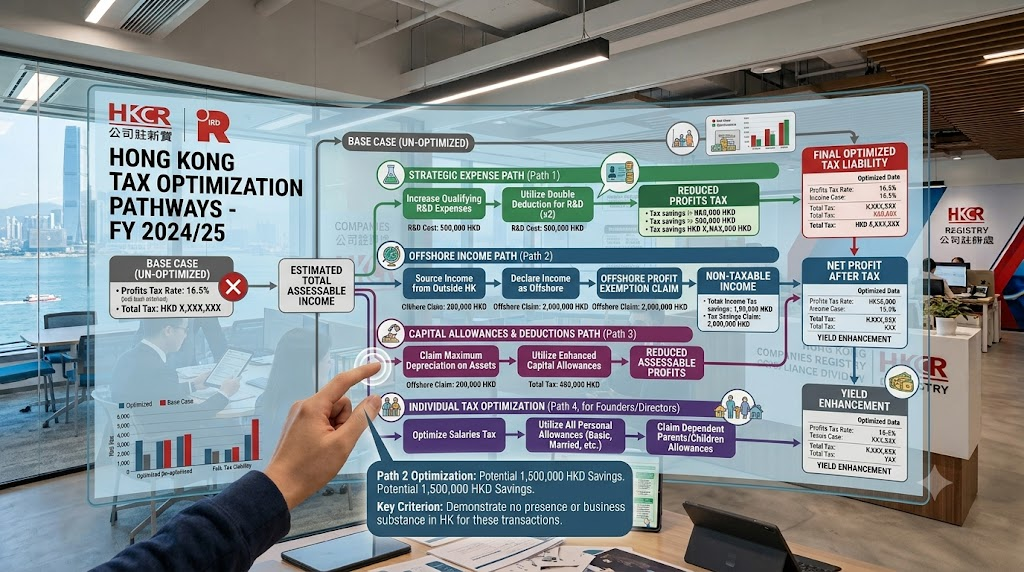
Tax Optimization Calculation
Consider a Hong Kong company with HKD 1,500,000 in net income before director compensation. Let’s compare two different distribution strategies:
Scenario A: Full Salary Distribution
- The company pays the director a salary of HKD 1,500,000.
- Corporate taxable profits: HKD 0 (Corporate tax paid: HKD 0).
- Director’s personal salaries tax liability (after basic allowance of HKD 132,000): Progressive rates apply, resulting in approximately HKD 129,000 in personal tax.
- Total combined tax paid: HKD 129,000.
Scenario B: Combined Salary and Dividend Distribution
- The company pays the director a modest salary of HKD 300,000 and distributes the remaining HKD 1,200,000 as dividends.
- Corporate taxable profits: HKD 1,200,000. Under the two-tiered profits tax rates (8.25%), corporate tax is HKD 99,000.
- Director’s personal salaries tax on the HKD 300,000 salary (after basic allowance): Approximately HKD 3,360.
- Dividends received: HKD 1,101,000 (Tax-free).
- Total combined tax paid: HKD 102,360.
- Net tax savings: HKD 26,640.
Additionally, salary payments generally require MPF contributions for Hong Kong residents. Mandatory Provident Fund contributions are capped at HKD 1,500 per month for both employers and employees, which should be factored into your overall calculations.
Structuring your business efficiently from the start can simplify these decisions. Our team at Hong Kong Company Registration can help set up your entity with the appropriate corporate structure.
Advanced Strategy: Personal Assessment to Offset Business Losses
For entrepreneurs operating sole proprietorships, partnerships, or closely-held corporations, Hong Kong offers a tax relief option known as Personal Assessment.
Personal Assessment is not a separate tax. Instead, it is a voluntary election that allows individual taxpayers to aggregate their income from various sources, including:
- Employment income (subject to Salaries Tax)
- Business profits (subject to Profits Tax)
- Rental income (subject to Property Tax)
By electing for Personal Assessment, you can offset business losses incurred in your corporate or sole proprietorship operations directly against your personal employment income. This can lead to a significant reduction in your overall tax liability.
For example, if you earned HKD 600,000 in salary from a separate employment but incurred a loss of HKD 400,000 in your startup business, Personal Assessment allows you to aggregate these figures, reducing your net taxable income to HKD 200,000. This strategy is particularly valuable for founders in their early years of operation when initial losses are common.
Niche Scenarios: Web3, E-Commerce, and the FSIE Regime
Hong Kong’s Territorial Taxation System is a major draw for modern, digital businesses. Under this system, profits derived from outside Hong Kong are generally exempt from local corporate tax.
However, the rise of digital business models has led to updated compliance requirements, particularly under the Foreign Sourced Income Exemption (FSIE) regime.
Let’s look at how these rules apply to specific business models:
- Web3 and Crypto Startups: The tax treatment of Web3 projects in Hong Kong depends on where key decisions are made. If your development team is based globally and your servers are hosted outside Hong Kong, you may be eligible to claim an offshore tax exemption HK. However, active trading of digital assets within Hong Kong is typically classified as local business activity and subject to Profits Tax.
- Cross-Border E-Commerce: For e-commerce businesses, the IRD reviews several factors to determine the source of profits, including where contracts with suppliers are signed, where inventory is stored, and where marketing operations are managed. If your logistics and customer base are entirely outside Hong Kong, your e-commerce profits may qualify for offshore status.
- Consulting and Professional Services: If you run a consulting firm from Hong Kong but perform your services physically at client locations overseas, those service fees are generally considered offshore and may be exempt from Hong Kong tax.
Under the FSIE regime, multinational entities must meet economic substance requirements in Hong Kong to claim tax exemptions on certain offshore-sourced incomes, such as interest, dividends, and intellectual property revenue. Working with an experienced Company Secretary Services provider can help ensure your corporate records align with these requirements.
Compliance and Audit Requirements for HK Companies
While Hong Kong offers a highly competitive tax environment, it maintains strict compliance standards. Unlike some offshore jurisdictions, every incorporated Hong Kong company must prepare audited financial statements annually.
Before filing your BIR51 profits tax return, your company’s accounts must undergo certified audits conducted by a licensed Hong Kong Certified Public Accountant (CPA). This requirement ensures that all deductions and offshore claims are verified and compliant with local tax laws.
Failing to meet these obligations can lead to serious consequences:
- Late Filing Penalties: Submitting your BIR51 or BIR60 tax returns after the deadline can result in immediate fines and court summonses.
- Estimated Assessments: If you do not file your tax return, the IRD may issue an estimated tax assessment, which is often significantly higher than your actual liability.
- Audit Scrutiny: Inaccurate tax classifications or unsubstantiated offshore claims can trigger detailed audits by the IRD, potentially leading to back taxes and penalties.
To avoid these risks, businesses often outsource their compliance. Utilizing comprehensive Accounting & Audit Services ensures your financial records are maintained accurately and submitted on time.
As a first-hand TCSP Licensed provider (license number TC010076), Olesen Global provides expert corporate services directly, helping you stay compliant with the IRD without any intermediary fees.
Frequently Asked Questions on HK Tax Optimization
Can a foreign director avoid HK Salaries Tax entirely?
Yes, under certain conditions. If a foreign director does not visit Hong Kong for more than 60 days in a tax year and has no local employment duties performed within the territory, they may not be subject to Salaries Tax. However, any director’s fees paid by a company registered in Hong Kong are generally taxable, as the office of director is legally located in Hong Kong.
How does the IRD verify offshore status under the FSIE?
The IRD reviews several factors to verify offshore claims, including where business decisions are made, where contracts are negotiated and signed, and where operations are physically carried out. To support an offshore claim, companies must maintain clear documentation, such as emails, travel records, shipping documents, and meeting minutes.
How do Hong Kong double taxation treaties affect foreign owners?
Hong Kong has established comprehensive double taxation agreements with over 40 jurisdictions. These treaties help prevent the same income from being taxed twice, allowing foreign business owners to claim tax credits in their home countries for taxes paid in Hong Kong.
Is an annual HK company audit and tax filing mandatory even for inactive businesses?
Yes. Even if a company is inactive or has not yet commenced business, it is still required to file an annual profits tax return. You can file a “nil” tax return, but you must still meet the filing deadlines to avoid penalties.
Optimize Your Hong Kong Tax Strategy with Olesen Global
Don’t let tax complexities slow your business down. Partner with Olesen Global, a licensed TCSP License TC010076 provider, to streamline your corporate filings and optimize your tax position.
Our team of local experts provides direct, reliable support from our physical office in Hong Kong, helping you manage everything from company registration to CPA audits with full transparency.